


A depletable pool of adenosine in area CA1 of the rat hippocampus
- PMID: 11264305
- PMCID: PMC6762415
- DOI: 10.1523/JNEUROSCI.21-07-02298.2001
A depletable pool of adenosine in area CA1 of the rat hippocampus
Abstract
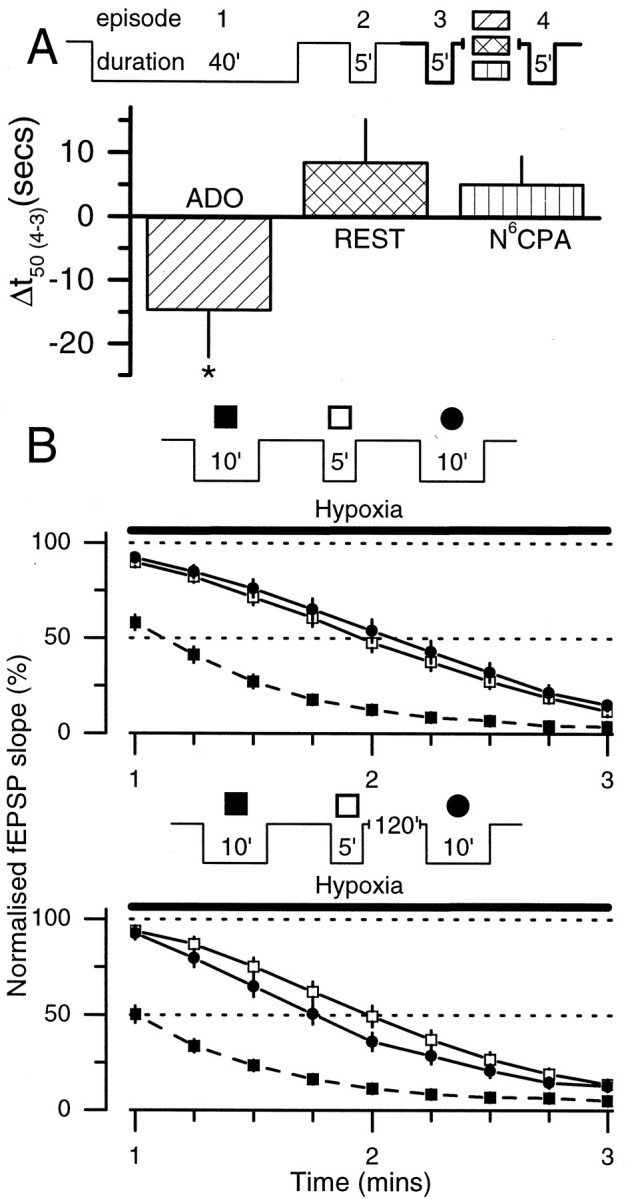
Adenosine plays a major modulatory and neuroprotective role in the mammalian CNS. During cerebral metabolic stress, such as hypoxia or ischemia, the increase in extracellular adenosine inhibits excitatory synaptic transmission onto vulnerable neurons via presynaptic adenosine A(1) receptors, thereby reducing the activation of postsynaptic glutamate receptors. Using a combination of extracellular and whole-cell recordings in the CA1 region of hippocampal slices from 12- to 24-d-old rats, we have found that this protective depression of synaptic transmission weakens with repeated exposure to hypoxia, thereby allowing potentially damaging excitation to both persist for longer during oxygen deprivation and recover more rapidly on reoxygenation. This phenomenon is unlikely to involve A(1) receptor desensitization or impaired nucleoside transport. Instead, by using the selective A(1) antagonist 8-cyclopentyl-1,3-dipropylxanthine and a novel adenosine sensor, we demonstrate that adenosine production is reduced with repeated episodes of hypoxia. Furthermore, this adenosine depletion can be reversed at least partially either by the application of exogenous adenosine, but not by a stable A(1) agonist, N(6)-cyclopentyladenosine, or by endogenous means by prolonged (2 hr) recovery between hypoxic episodes. Given the vital neuroprotective role of adenosine, these findings suggest that depletion of adenosine may underlie the increased neuronal vulnerability to repetitive or secondary hypoxia/ischemia in cerebrovascular disease and head injury.
Figures


References
-
- Arlinghaus L, Lee KS. Endogenous adenosine mediates the sustained inhibition of excitatory synaptic transmission during moderate hypoxia. Brain Res. 1996;724:265–268. - PubMed
-
- Berne RM, Rubio R, Curran GH. Release of adenosine from ischemic brain. Circ Res. 1974;35:262–271.
-
- Blumbergs PC. Pathology. In: Reilly P, Bullock R, editors. Head injury: pathophysiology and management of severe closed injury. Chapman & Hall; London: 1997. pp. 40–70.
-
- Chen J, Simon R. Ischemic tolerance in the brain. Neurology. 1997;48:306–311. - PubMed
-
- Cherubini E, Ben-Ari Y, Krnjevic K. Anoxia produces smaller changes in synaptic transmission, membrane potential, and input resistance in immature rat hippocampus. J Neurophysiol. 1989;62:882–895. - PubMed
Publication types
MeSH terms
Substances
Grants and funding
LinkOut - more resources
Full Text Sources
Miscellaneous
