. 2001 Apr;75(8):3731-9.
doi: 10.1128/JVI.75.8.3731-3739.2001.

Palindromic sequence plays a critical role in human foamy virus dimerization

Affiliations

Palindromic sequence plays a critical role in human foamy virus dimerization

D Cain et al. J Virol. 2001 Apr.

Abstract

The retroviral RNA genome is dimeric, consisting of two identical strands of RNA linked near their 5' ends by a dimer linkage structure. Previously it was shown that human foamy virus (HFV) RNA transcribed in vitro contained three sites, designated SI, SII, and SIII, which contributed to the dimerization process (O. Erlwein, D. Cain, N. Fischer, A. Rethwilm, and M. O. McClure, Virology 229:251-258, 1997). To characterize these sites further, a series of mutants were designed and tested for their ability to dimerize in vitro. The primer binding site and a G tetrad in SI were dispensable for dimerization. However, a mutant that changed the 3' end of SI migrated slower on nondenaturing gels than wild-type RNA dimers. The sequence composition of the SII palindrome, consisting of 10 nucleotides, proved to be critical for in vitro dimerization, since mutations within this sequence or replacement of the sequence with a different palindrome of equal length impaired in vitro dimerization. The length of the palindrome also seems to play an important role. A moderate extension to 12 nucleotides was tolerated, whereas an extension to 16 nucleotides or more impaired dimerization. When nucleotides flanking the palindrome were mutated in a random fashion, dimerization was unaffected. Changing the SIII sequence also led to decreased dimer formation, confirming its contribution to the dimerization process. Interesting mutants were cloned into the infectious molecular clone of HFV, HSRV-2, and were transfected into BHK-21 cells. Mutations in SII that reduced dimerization in vitro also abolished virus replication. In contrast, constructs containing mutations in SI and SIII replicated to some extent in cell culture after an initial drop in viral replication. Analysis of the SIM1 mutant revealed reversion to the wild type but with the insertion of an additional two nucleotides. Analysis of cell-free virions demonstrated that both replication-competent and replication-defective mutants packaged nucleic acid. Thus, efficient dimerization is a critical step for HFV to generate infectious virus, but HFV RNA dimerization is not a prerequisite for packaging.


Figures
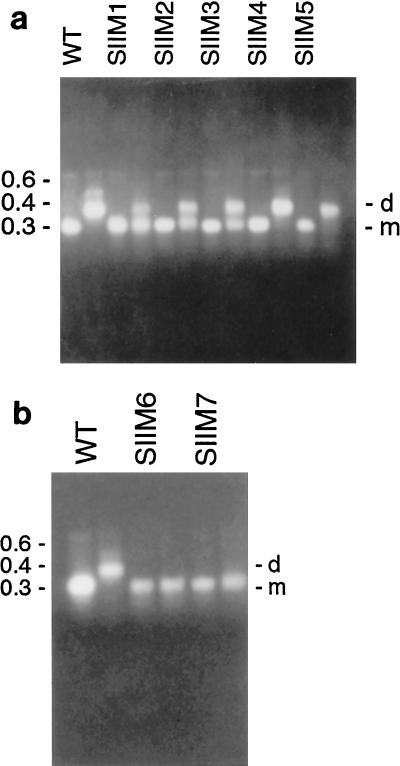
FIG. 1
FIG. 1
Mutations to sequences in and surrounding the palindrome in SII, as shown by agarose gel electrophoresis. (a) First two lanes, wild-type (WT) RNA, nucleotides 322 to 480; next two lanes, SIIM1; next two lanes, SIIM2; next two lanes, SIIM3; next two lanes, SIIM4; next two lanes, SIIM5. (b) First two lanes, wild-type RNA, nucleotides 322 to 480; next two lanes, SIIM6; next two lanes, SIIM7. The first lane of each pair contains denatured RNA, the second lane contains native RNA. The numbers to the left of the gels indicate nucleic acid sizes (in kilobases). d, dimer; m, monomer.
FIG. 2
FIG. 2
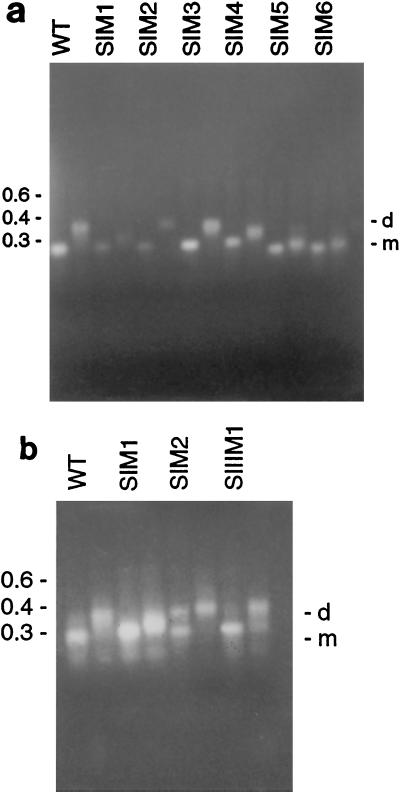
Mutations in SI and SIII, as shown by agarose gel electrophoresis. (a) First two lanes, wild-type (WT) RNA, nucleotides 322 to 480; next two lanes, SIM1; next two lanes, SIM2; next two lanes, SIM3; next two lanes, SIM4; next two lanes, SIM5; next two lanes, SIM6. (b) First two lanes, wild-type RNA, nucleotides 322 to 480; next two lanes, SIM1; next two lanes, SIM2; next two lanes, SIIIM1. The first lane of each pair contains denatured RNA, the second lane contains native RNA. The numbers to the left of the gels indicate nucleic acid sizes (in kilobases). d, dimer; m, monomer.
FIG. 3
FIG. 3
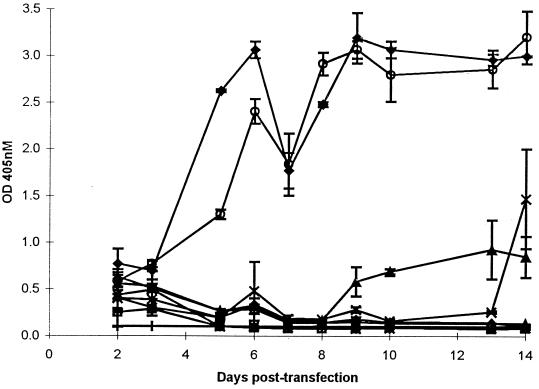
Comparison of RT levels produced by wild-type (HSRV-2) and dimer mutants in BHK-21 cells. BHK-21 cells seeded at 2 × 10⁵ on the previous day were transfected with 10 μg of wild-type HSRV-2 (⧫), SIM1 (▴), SIIM2 (▵), SIIM4 (○), SIIM7 (∗), SIIM8 (◊), M32 (□), or SIIIM2 (x) DNA, and supernatant fluid was assayed for RT activity up to day 14 p.t. Supernatant from uninfected cells was also assayed (|). The means ± standard deviations of quadruplicate determinations for each construct are shown. OD 405 nM, optical density at 405 nM.
FIG. 4
FIG. 4
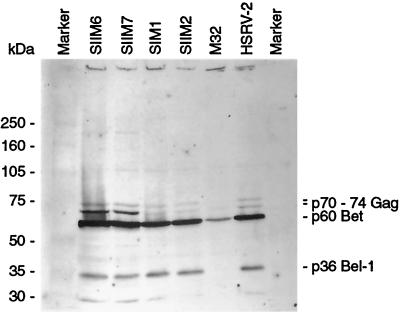
Comparison of viral protein expression levels between wild-type (HSRV-2) and mutants. BHK-21 cells (2 × 10⁵) were transfected with 10 μg of wild-type (HSRV-2) or mutant DNA. The levels of viral protein expression were assessed on day 2 p.t. by Western blotting using HFV antibody-positive human serum. The first and last lanes are full-range molecular mass protein markers.
FIG. 5
FIG. 5
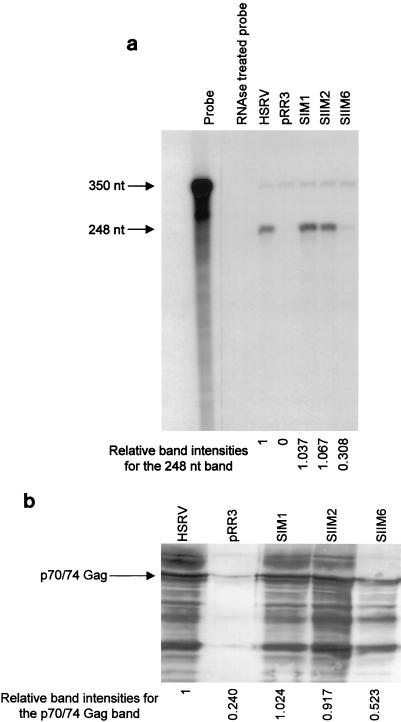
Analysis of virions released from wild-type virus (HSRV-2) and dimerization mutants. BHK/Bel-1 cells were transfected with 10 μg of the respective DNA, and the virus was pelleted 48 h later as described in Materials and Methods. (a) RPA of nucleic acid isolated from virions. The full-length probe and the protected fragment of 350 and 248 nucleotides (nt), respectively, are shown. The relative band intensities of each band compared with that of the positive control HSRV-2, determined using LabImage version 2.51, are shown at the bottom of the gel. (b) Western blot with foamy virus-infected antiserum. The 70- and 74-kDa doublet of the Gag protein is indicated. The relative band intensities of the 70- and 74-kDa Gag doublet compared with that of the positive control HSRV-2, determined using LabImage version 2.51, are shown at the bottom of the gel.

References

    1. Awang G, Sen D. Mode of dimerization of HIV-1 genomic RNA. Biochemistry. 1993;32:11453–11457. - PubMed
    1. Baldwin D N, Linial M I. The roles of Pol and Env in the assembly pathway of human foamy virus. J Virol. 1998;72:3658–3665. - PMC - PubMed
    1. Bender W, Chien Y H, Chattopadhyay S, Vogt P K, Gardner M B, Davidson N. High-molecular-weight RNAs of AKR, NZB, and wild mouse viruses and avian reticuloendotheliosis virus all have similar dimer structures. J Virol. 1978;25:888–896. - PMC - PubMed
    1. Berkhout B, Essink B B, Schoneveld I. In vitro dimerization of HIV-2 leader RNA in the absence of PuGGAPuA motifs. FASEB J. 1993;7:181–187. - PubMed
    1. Berkhout B, van Wamel J L. Role of the DIS hairpin in replication of human immunodeficiency virus type 1. J Virol. 1996;70:6723–6732. - PMC - PubMed

Publication types

MeSH terms

LinkOut - more resources