. 2001 Feb 19;152(4):825-34.
doi: 10.1083/jcb.152.4.825.

Rab27a is required for regulated secretion in cytotoxic T lymphocytes

Affiliations

Rab27a is required for regulated secretion in cytotoxic T lymphocytes

J C Stinchcombe et al. J Cell Biol. .

Abstract

Rab27a activity is affected in several mouse models of human disease including Griscelli (ashen mice) and Hermansky-Pudlak (gunmetal mice) syndromes. A loss of function mutation occurs in the Rab27a gene in ashen (ash), whereas in gunmetal (gm) Rab27a dysfunction is secondary to a mutation in the alpha subunit of Rab geranylgeranyl transferase, an enzyme required for prenylation and activation of Rabs. We show here that Rab27a is normally expressed in cytotoxic T lymphocytes (CTLs), but absent in ashen homozygotes (ash/ash). Cytotoxicity and secretion assays show that ash/ash CTLs are unable to kill target cells or to secrete granzyme A and hexosaminidase. By immunofluorescence and electron microscopy, we show polarization but no membrane docking of ash/ash lytic granules at the immunological synapse. In gunmetal CTLs, we show underprenylation and redistribution of Rab27a to the cytosol, implying reduced activity. Gunmetal CTLs show a reduced ability to kill target cells but retain the ability to secrete hexosaminidase and granzyme A. However, only some of the granules polarize to the immunological synapse, and many remain dispersed around the periphery of the CTLs. These results demonstrate that Rab27a is required in a final secretory step and that other Rab proteins also affected in gunmetal are likely to be involved in polarization of the granules to the immunological synapse.


Figures
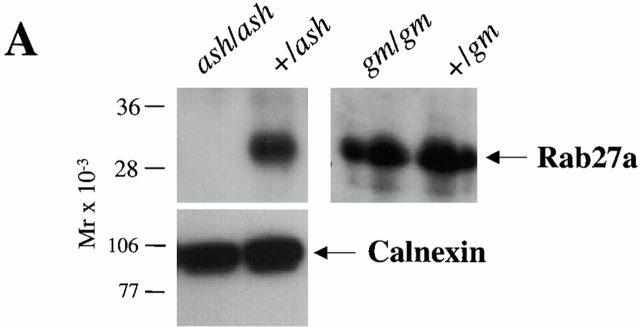
Figure 1
Figure 1
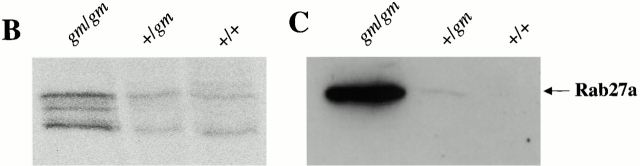
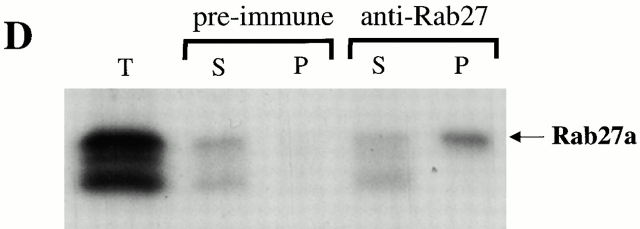
Rab27a is not expressed in ashen and at least partially inactivated in gunmetal CTLs. (A) Immunoblot of cell lysates from ashen and gunmetal CTLs using Rab27a-specific antibody (4B12). CTLs from ash/ash, +/ash, gm/gm, and +/gm were subjected to immunoblot analysis as described in Materials and Methods (top). A loading control using antibody anticalnexin (ER membrane–associated protein) shows that equal amounts of protein were loaded in each lane (bottom). (B) In vitro prenylation of gm/gm, +/gm, and +/+ (wild-type) CTL cytosolic Rabs. Recombinant RGGT was used to transfer [3H]GGPP to cytosolic Rabs as described in Materials and Methods. After the prenylation reaction, Rabs were separated by SDS-PAGE, transferred to a PVDF membrane, and visualized by PhophorImager. (C) The same membrane was then immunoblotted using 4B12, a Rab27a-specific antibody. (D) Immunoprecipitation of Rab27 from the in vitro prenylation reaction. gm/gm CTL cytosolic Rabs were prenylated in vitro (total reaction, T) and precipitated with either preimmune serum (negative control) or an anti-Rab27 antibody (N688) bound to protein A–Sepharose beads. Proteins unbound (supernatant, S) and bound (pellet, P) to the beads were separated by SDS-PAGE and visualized by autoradiography.
Figure 1
Figure 1
Rab27a is not expressed in ashen and at least partially inactivated in gunmetal CTLs. (A) Immunoblot of cell lysates from ashen and gunmetal CTLs using Rab27a-specific antibody (4B12). CTLs from ash/ash, +/ash, gm/gm, and +/gm were subjected to immunoblot analysis as described in Materials and Methods (top). A loading control using antibody anticalnexin (ER membrane–associated protein) shows that equal amounts of protein were loaded in each lane (bottom). (B) In vitro prenylation of gm/gm, +/gm, and +/+ (wild-type) CTL cytosolic Rabs. Recombinant RGGT was used to transfer [3H]GGPP to cytosolic Rabs as described in Materials and Methods. After the prenylation reaction, Rabs were separated by SDS-PAGE, transferred to a PVDF membrane, and visualized by PhophorImager. (C) The same membrane was then immunoblotted using 4B12, a Rab27a-specific antibody. (D) Immunoprecipitation of Rab27 from the in vitro prenylation reaction. gm/gm CTL cytosolic Rabs were prenylated in vitro (total reaction, T) and precipitated with either preimmune serum (negative control) or an anti-Rab27 antibody (N688) bound to protein A–Sepharose beads. Proteins unbound (supernatant, S) and bound (pellet, P) to the beads were separated by SDS-PAGE and visualized by autoradiography.
Figure 1
Figure 1
Rab27a is not expressed in ashen and at least partially inactivated in gunmetal CTLs. (A) Immunoblot of cell lysates from ashen and gunmetal CTLs using Rab27a-specific antibody (4B12). CTLs from ash/ash, +/ash, gm/gm, and +/gm were subjected to immunoblot analysis as described in Materials and Methods (top). A loading control using antibody anticalnexin (ER membrane–associated protein) shows that equal amounts of protein were loaded in each lane (bottom). (B) In vitro prenylation of gm/gm, +/gm, and +/+ (wild-type) CTL cytosolic Rabs. Recombinant RGGT was used to transfer [3H]GGPP to cytosolic Rabs as described in Materials and Methods. After the prenylation reaction, Rabs were separated by SDS-PAGE, transferred to a PVDF membrane, and visualized by PhophorImager. (C) The same membrane was then immunoblotted using 4B12, a Rab27a-specific antibody. (D) Immunoprecipitation of Rab27 from the in vitro prenylation reaction. gm/gm CTL cytosolic Rabs were prenylated in vitro (total reaction, T) and precipitated with either preimmune serum (negative control) or an anti-Rab27 antibody (N688) bound to protein A–Sepharose beads. Proteins unbound (supernatant, S) and bound (pellet, P) to the beads were separated by SDS-PAGE and visualized by autoradiography.
Figure 3
Figure 3
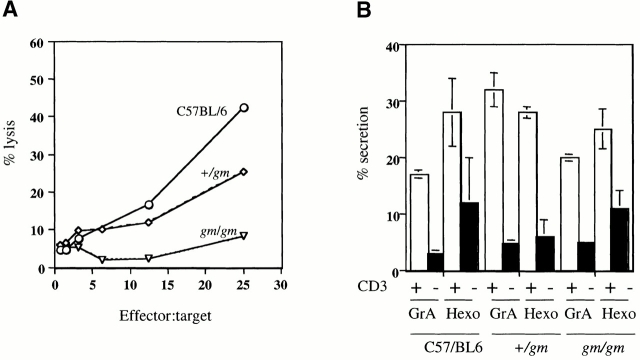
Gunmetal CTLs show reduced target cell lysis but normal secretion. (A) Graph of percent lysis (y-axis) at various ratios of effector cells to a fixed number of target cells (x-axis) for wild-type C57BL/6 (+/+, open circles), heterozygous (+/gm, open squares), and homozygous (gm/gm, open triangles) gunmetal mice. (B) Graph of percent of total secretion from CTLs derived from +/+, +/gm, and gm/gm mice in response to cross-linking with an antibody to the CD3 subunit of the TCR (white bars) or no stimulation (black bars). Secretion of both granzyme A (GrA) and hexosaminidase (Hexo) is shown.
Figure 2
Figure 2
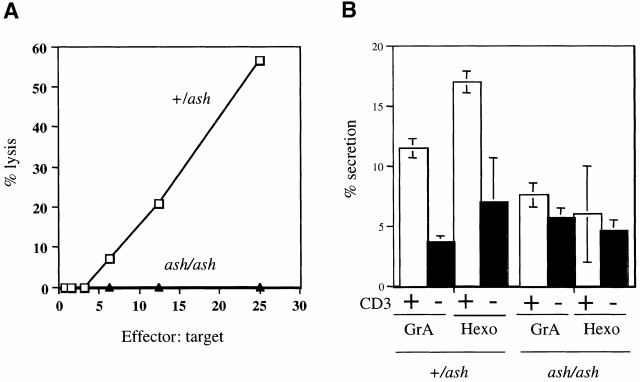
Ashen CTLs cannot lyse targets or secrete their granule contents. (A) Graph of percent lysis (y-axis) at various ratios of effector cells to a fixed number of target cells (x-axis) for heterozygous (+/ash, open squares) and homozygous (ash/ash, filled triangles) ashen mice. (B) Graph of percentage of total secretion from CTLs derived from +/ash and ash/ash mice in response to cross-linking with an antibody to the CD3 subunit of the TCR (white bars) or no stimulation (black bars). Secretion of both granzyme A (GrA) and hexosaminidase (Hexo) is shown.
Figure 6
Figure 6
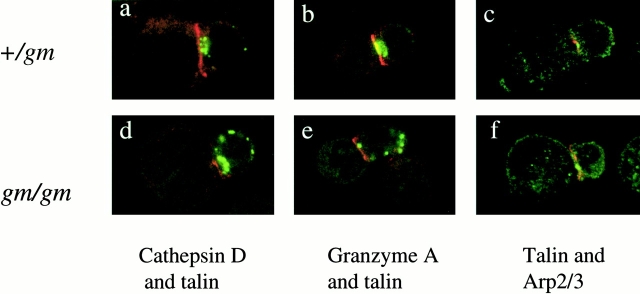
Lytic granule polarization is impaired in gunmetal mice. Allogeneic CTLs conjugated with P815 target cells from +/gm (a–c) and gm/gm (d–f) stained with antibodies against cathepsin D (green, a and d), granzyme A (green, b and e), Arp2/3 (green, c and f), and talin (red). Bar, 10 μm.
Figure 4
Figure 4
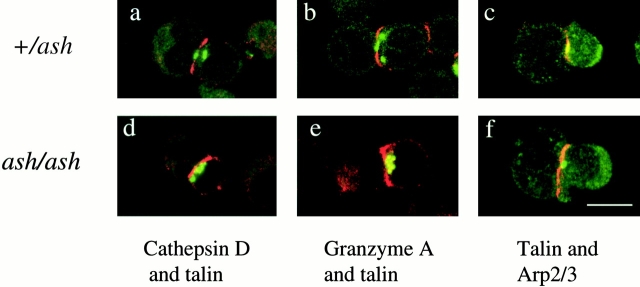
The lytic granules of ashen CTLs polarize at the immunological synapse. Allogeneic CTLs conjugated with P815 target cells, from +/ash (a–c) and ash/ash (d–f) stained with antibodies against cathepsin D (green, a and d), granzyme A (green, b and e), Arp2/3 (green, c and f), and talin (red). Bar, 10 μm.
Figure 5
Figure 5
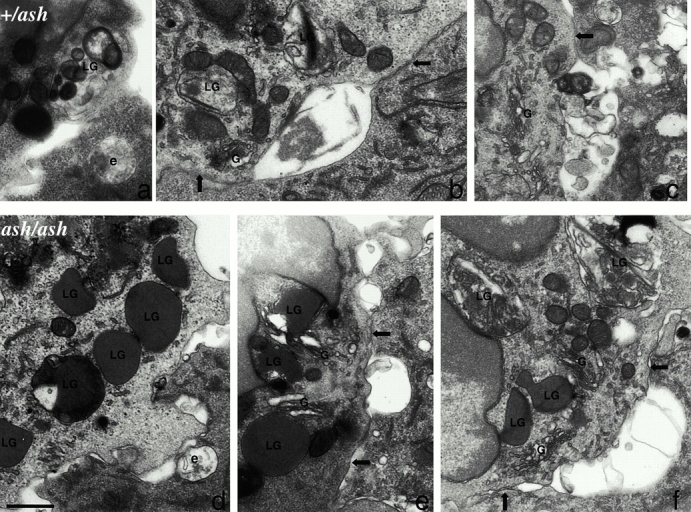
Lytic granules polarize with the Golgi complex but do not dock with the plasma membrane in ash/ash CTLs. Semithick (150–200 nm; a and e) and thin (50–60 nm; b–d and f) stained sections of +/ash (a–c) and ash/ash (d–e) CTLs (left) conjugated to P815 target cells (right). In both cells the Golgi complex (G) polarizes to the CTL plasma membrane at the immunological synapse. In both cell types the lytic granules (LG) have a heterologous appearance. In +/ash CTLs the lytic granules are either closely associated with the plasma membrane (e.g., a) or are absent (e.g., c) because the cells have already exocytosed, whereas in ash/ash CTLs (d–f) they accumulate behind the Golgi complex but fail to dock with the membrane. Note in b–c and e–f that in both cell types the CTLs and P815 cell plasma membranes are tightly aligned in some regions of the contact membrane (arrows) but that there is a gap between the two membranes directly opposite the polarized Golgi complex, probably corresponding to the talin hole. This gap contains crystalline and membranous material similar to that stored in lytic granules in +/ash cells but lacks it in ash/ash cells. Note in the sections shown in a and d in the target cells, endocytic structures (e) also appear to polarize to the contact sites. Bar, 500 nm.

References

    1. Baetz K., Isaaz S., Griffiths G.M. Loss of cytotoxic T lymphocyte function in Chediak-Higashi syndrome arises from a secretory defect that prevents lytic granule exocytosis. J. Immunol. 1995;154:6122–6131. - PubMed
    1. Boissy R.E., Nordlund J.J. Molecular basis of congenital hypopigmentary disorders in humansa review. Pigment Cell Res. 1997;10:12–24. - PubMed
    1. Chen D., Guo J., Miki T., Tachibana M., Gahl W.A. Molecular cloning and characterization of rab27a and rab27b, novel human rab proteins shared by melanocytes and platelets. Biochem. Mol. Med. 1997;60:27–37. - PubMed
    1. Detter J.C., Zhang Q., Mules E.H., Novak E.K., Mishra V.S., Li W., McMurtrie E.B., Tchernev V.T., Wallace M.R., Seabra M.C., Swank R.T., Kingsmore S.F. Rab geranylgeranyl transferase alpha mutation in the gunmetal mouse reduces Rab prenylation and platelet synthesis. Proc. Natl. Acad. Sci. USA. 2000;97:4144–4149. - PMC - PubMed
    1. Fruth U., Prester M., Golecki J.R., Hengartner H., Simon H.G., Kramer M.D., Simon M.M. The T cell-specific serine proteinase TSP-1 is associated with cytoplasmic granules of cytolytic T lymphocytes. Eur. J. Immunol. 1987;17:613–621. - PubMed

Publication types

MeSH terms