


Enhancement of translation by the epsilon element is independent of the sequence of the 460 region of 16S rRNA
- PMID: 11266541
- PMCID: PMC31293
- DOI: 10.1093/nar/29.7.1420
Enhancement of translation by the epsilon element is independent of the sequence of the 460 region of 16S rRNA
Abstract
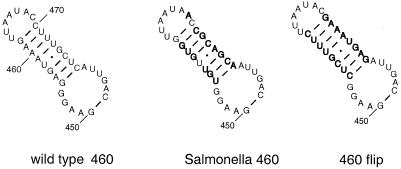
The epsilon enhancer element is a pyrimidine-rich sequence that increases expression of T7 gene 10 and a number of Escherichia coli mRNAs during initiation of translation and inhibits expression of the recF mRNA during elongation. Based on its complementarity to the 460 region of 16S rRNA, it has been proposed that epsilon exerts its enhancer activity by base pairing to this complementary rRNA sequence. We have tested this model of enhancer action by constructing mutations in the 460 region of 16S rRNA and examining expression of epsilon-containing CAT reporter genes and recF-lacZ fusions in strains expressing the mutant rRNAs. Replacement of the 460 E.coli stem-loop with that of Salmonella enterica serovar Typhimurium or a stem-loop containing a reversal of all 8 bp in the helical region produced fully functional rRNAs with no apparent effect on cell growth or expression of any epsilon-containing mRNA. Our experiments confirm the reported effects of the epsilon elements on gene expression but show that these effects are independent of the sequence of the 460 region of 16S rRNA, indicating that epsilon-rRNA base pairing does not occur.
Figures
References
-
- Gualerzi C.O. and Pon,C.L. (1990) Initiation of mRNA translation in prokaryotes. Biochemistry, 29, 5881–5889. - PubMed
-
- O’ Connor M., Bayfield,M.A., Gregory,S.T., Lee,W.-C.M., Lodmell,J.S., Mankad,A., Thompson,J.R., Vila-Sanjurgo,A., Squires,C.L. and Dahlberg,A.E. (2000) Probing ribosome structure and function: analyses with RNA and protein mutants. In Garrett,R.A., Douthwaite,S.R., Liljas,A., Matheson,A.T., Moore,P.B. and Noller,H.F. (eds), The Ribosome: Structure, Function, Antibiotics, and Cellular Interactions. American Society for Microbiology, Washington, DC, pp. 217–228.
-
- Olins P.O. and Rangwala,S.H. (1989) A novel sequence element derived from bacteriophage T7 mRNA acts as an enhancer of translation of the lacZ gene in Escherichia coli. J. Biol. Chem., 264, 16973–16976. - PubMed
-
- Golshani A., Golomehova,V., Mironova,R., Ivanov,I.G. and Abou-Haidar,M.G. (1997) Does the epsilon sequence of phage T7 function as an initiator for the translation of CAT mRNA in Escherichia coli? Biochem. Biophys. Res. Commun., 236, 253–256. - PubMed
Publication types
MeSH terms
Substances
Grants and funding
LinkOut - more resources
Full Text Sources
Other Literature Sources
Molecular Biology Databases
Miscellaneous
