. 2001 Apr;183(8):2497-504.
doi: 10.1128/JB.183.8.2497-2504.2001.

Regulation of the acetoin catabolic pathway is controlled by sigma L in Bacillus subtilis

Affiliations

Regulation of the acetoin catabolic pathway is controlled by sigma L in Bacillus subtilis

N O Ali et al. J Bacteriol. 2001 Apr.

Abstract

Bacillus subtilis grown in media containing amino acids or glucose secretes acetate, pyruvate, and large quantities of acetoin into the growth medium. Acetoin can be reused by the bacteria during stationary phase when other carbon sources have been depleted. The acoABCL operon encodes the E1alpha, E1beta, E2, and E3 subunits of the acetoin dehydrogenase complex in B. subtilis. Expression of this operon is induced by acetoin and repressed by glucose in the growth medium. The acoR gene is located downstream from the acoABCL operon and encodes a positive regulator which stimulates the transcription of the operon. The product of acoR has similarities to transcriptional activators of sigma 54-dependent promoters. The four genes of the operon are transcribed from a -12, -24 promoter, and transcription is abolished in acoR and sigL mutants. Deletion analysis showed that DNA sequences more than 85 bp upstream from the transcriptional start site are necessary for full induction of the operon. These upstream activating sequences are probably the targets of AcoR. Analysis of an acoR'-'lacZ strain of B. subtilis showed that the expression of acoR is not induced by acetoin and is repressed by the presence of glucose in the growth medium. Transcription of acoR is also negatively controlled by CcpA, a global regulator of carbon catabolite repression. A specific interaction of CcpA in the upstream region of acoR was demonstrated by DNase I footprinting experiments, suggesting that repression of transcription of acoR is mediated by the binding of CcpA to the promoter region of acoR.


Figures
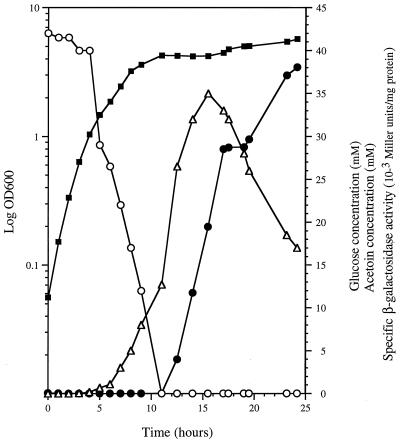
FIG. 1
FIG. 1
Induction of the acoA′-′lacZ fusion after growth in glucose medium. B. subtilis strain QB7700 was cultured in CSK medium containing 42 mM glucose at 37°C. The optical density of the culture, at 600 nm (OD 600) was followed for 24 h, and the glucose and acetoin concentrations and LacZ activity were assayed. ■, optical density at 600 nm; ○, glucose concentration; Δ, acetoin concentration; ●, β-galactosidase specific activity.
FIG. 2
FIG. 2
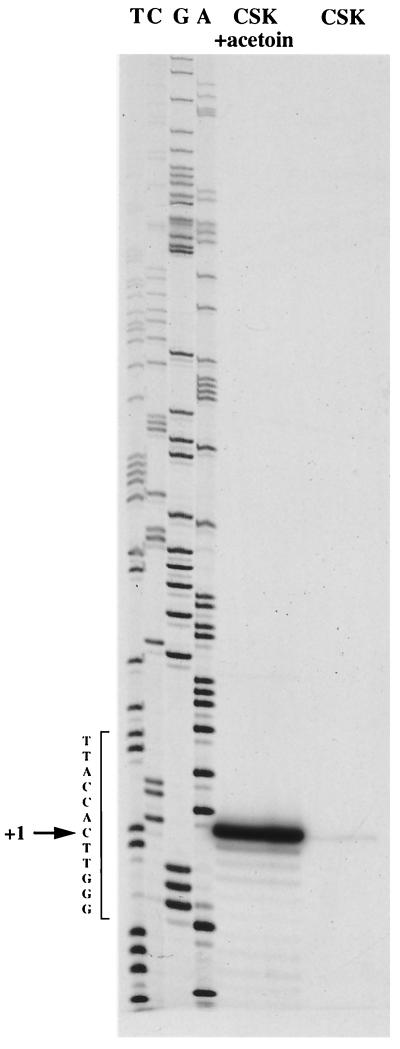
Reverse transcriptase mapping of the transcriptional start site of the acoA gene. RNA was extracted from B. subtilis 168 grown in the presence (+ acetoin) or absence of 10 mM acetoin. The position of the cDNA-extended fragment was compared to that of fragments obtained by sequencing an M13 recombinant phage containing the promoter region, with the same oligonucleotide used as a primer. The transcriptional start site is indicated by an arrow.
FIG. 3
FIG. 3
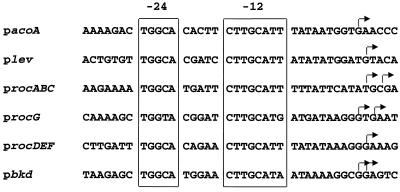
Nucleotide sequences of promoter regions of the acoABCL operon (pacoA), the levanase operon (plev) (6), the rocABC operon (procABC) (4), the rocG gene (procG) (3), the rocDEF operon (procDEF) (14), and the bkd operon (pbkd) (8). The transcriptional start sites are indicated by arrows. The boxes indicate conserved DNA sequences around positions −12 and −24 with respect to the transcriptional start sites.
FIG. 4
FIG. 4
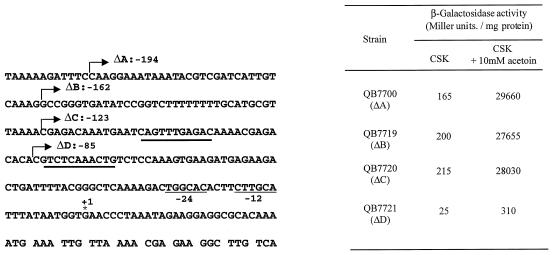
Nucleotide sequence of the acoA upstream region. The deletion end points are indicated by bent arrows and numbered with respect to the transcriptional start site, labeled with an asterisk. −12, −24 sequences are indicated. The boldly underlined regions indicate putative palindromic UAS. The effects of upstream deletions on expression of the acoA′-′lacZ translational fusion are indicated on the right. β-Galactosidase specific activity was determined in extracts prepared from exponentially growing cells in CSK medium containing 10 mM acetoin as the inducer.
FIG. 5
FIG. 5
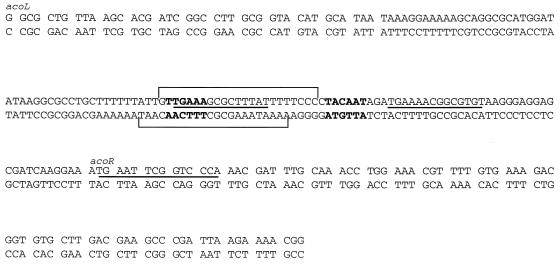
Organization of the acoR promoter region. The DNA sequence located between the end of acoL and the beginning of acoR is shown. DNA regions with similarities to the CRE consensus sequence are underlined. Putative −10 and −35 regions of the acoR promoter are indicated in boldface letters. Regions protected by CcpA are marked by brackets.
FIG. 6
FIG. 6
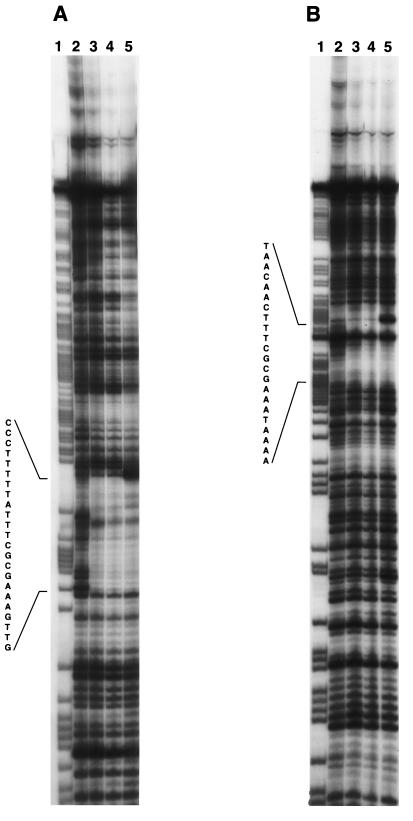
DNase I footprinting analysis of CcpA binding to the acoR promoter region. Lanes containing 2 × 10⁵ cpm of the labeled nontemplate strand (A) and template strand (B) of acoR are shown. Fragments were incubated in the presence of 2 μM purified CcpA. A + G Maxam and Gilbert reaction products of the appropriate DNA fragments were loaded in lanes 1. Lanes 2 through 5 were as follows: lanes 2, no protein; lanes 3, 2 μM CcpA; lanes 4, 2 μM CcpA and 10 μM HPr; and lanes 5, 2 μM CcpA and 10 μM HPr-Ser-P. Regions protected by CcpA are indicated by DNA sequences.

References

    1. Anagnostopoulos C, Spizizen J. Requirements for transformation in Bacillus subtilis. J Bacteriol. 1961;81:741–746. - PMC - PubMed
    1. Barrios H, Valderrama B, Morett E. Compilation and analysis of ς54-dependent promoter sequences. Nucleic Acids Res. 1999;27:4305–4313. - PMC - PubMed
    1. Belitsky B R, Sonenshein A L. An enhancer element located downstream of the major glutamate dehydrogenase gene of Bacillus subtilis. Proc Natl Acad Sci USA. 1999;96:10290–10295. - PMC - PubMed
    1. Calogero S, Gardan R, Glaser P, Schweizer J, Rapoport G, Débarbouillé M. RocR, a novel regulatory protein controlling arginine utilization in Bacillus subtilis, belongs to the NtrC/NifA family of transcriptional activators. J Bacteriol. 1994;176:1234–1241. - PMC - PubMed
    1. Cruz-Ramos H, Hoffmann T, Marino M, Nedjari H, Presecan-Siedel E, Dressen O, Glaser P, Jahn D. Fermentative metabolism of Bacillus subtilis: physiology and regulation of gene expression. J Bacteriol. 2000;182:3072–3080. - PMC - PubMed

Publication types

MeSH terms

LinkOut - more resources