


Configural olfactory learning in honeybees: negative and positive patterning discrimination
- PMID: 11274252
- PMCID: PMC311365
- DOI: 10.1101/lm.8.2.70
Configural olfactory learning in honeybees: negative and positive patterning discrimination
Abstract
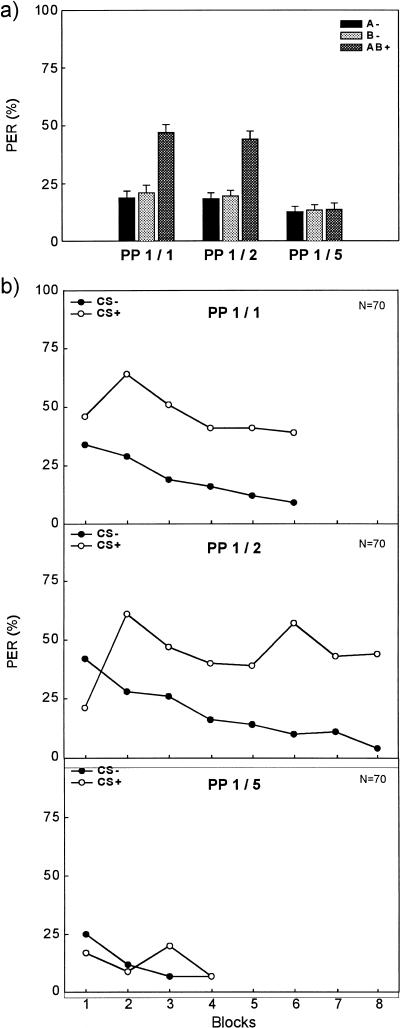
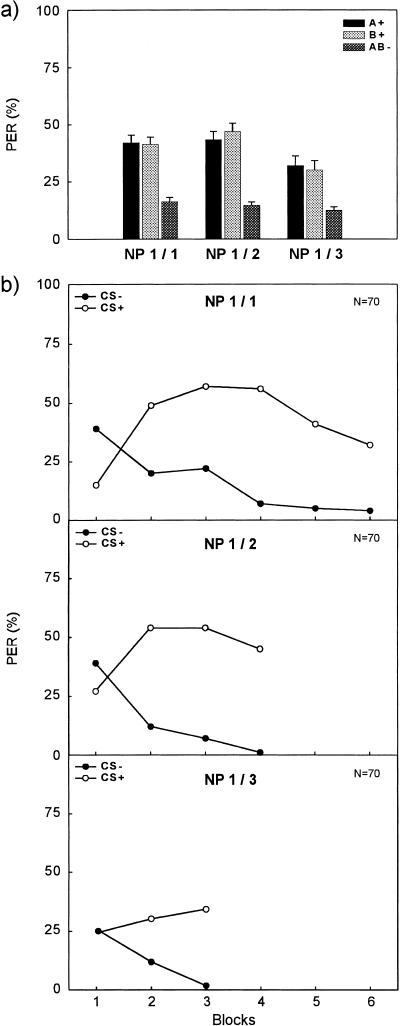
In an appetitive context, honeybees (Apis mellifera) learn to associate odors with a reward of sucrose solution. If an odor is presented immediately before the sucrose, an elemental association is formed that enables the odor to release the proboscis extension response (PER). Olfactory conditioning of PER was used to study whether, beyond elemental associations, honeybees are able to process configural associations. Bees were trained in a positive and anegative patterning discrimination problem. In the first problem, single odorants were nonreinforced whereas the compound was reinforced. In the second problem, single odorants were reinforced whereas the compound was nonreinforced. We studied whether bees can solve these problems and whether the ratio between the number of presentations of the reinforced stimuli and the number of presentations of the nonreinforced stimuli affects discrimination. Honeybees differentiated reinforced and nonreinforced stimuli in positive and negative patterning discriminations. They thus can process configural associations. The variation of the ratio of reinforced to nonreinforced stimuli modulated the amount of differentiation. The assignment of singular codes to complex odor blends could be implemented at the neural level: When bees are stimulated with odor mixtures, the activation patterns evoked at the primary olfactory neuropile, the antennal lobe, may be combinations of the single odorant responses that are not necessarily fully additive.
Figures
References
-
- Bellingham WP, Gillette-Bellingham K, Kehoe EJ. Summation and configuration in patterning schedules with the rat and rabbit. Anim Learn Behav. 1985;13:152–164.
-
- Bitterman ME, Menzel R, Fietz A, Schäfer S. Classical conditioning of proboscis extension in honeybees (Apis mellifera) J Comp Psychol. 1983;97:107–119. - PubMed
-
- Brandon SE, Vogel EH, Wagner AR. A componential view of configural cues in generalization and discrimination in Pavlovian conditioning. Behav Brain Res. 2000;110:67–72. - PubMed
-
- Chandra S, Smith BH. An analysis of synthetic processing of odor mixtures in the honeybee (Apis mellifera) J Exp Biol. 1998;201:3113–3121. - PubMed
-
- Couvillon PA, Bitterman ME. Compound-component and conditional discrimination of colors and odors by honeybees: Further tests of a continuity model. Anim Learn Behav. 1988;16:67–74.
Publication types
MeSH terms
Substances
LinkOut - more resources
Full Text Sources