


Futile transmembrane NH4(+) cycling: a cellular hypothesis to explain ammonium toxicity in plants
- PMID: 11274450
- PMCID: PMC31212
- DOI: 10.1073/pnas.061034698
Futile transmembrane NH4(+) cycling: a cellular hypothesis to explain ammonium toxicity in plants
Abstract
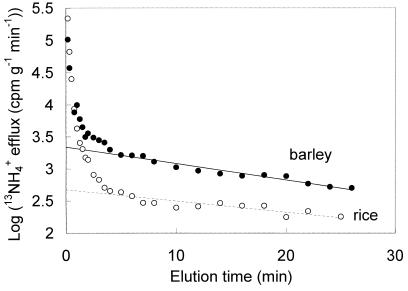
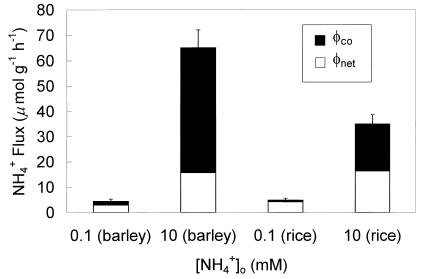
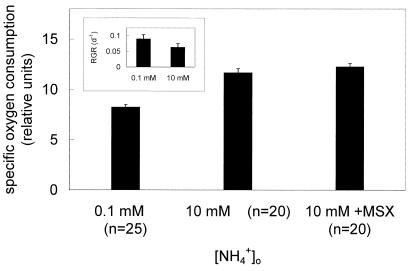
Most higher plants develop severe toxicity symptoms when grown on ammonium (NH(4)(+)) as the sole nitrogen source. Recently, NH(4)(+) toxicity has been implicated as a cause of forest decline and even species extinction. Although mechanisms underlying NH(4)(+) toxicity have been extensively sought, the primary events conferring it at the cellular level are not understood. Using a high-precision positron tracing technique, we here present a cell-physiological characterization of NH(4)(+) acquisition in two major cereals, barley (Hordeum vulgare), known to be susceptible to toxicity, and rice (Oryza sativa), known for its exceptional tolerance to even high levels of NH(4)(+). We show that, at high external NH(4)(+) concentration ([NH(4)(+)](o)), barley root cells experience a breakdown in the regulation of NH(4)(+) influx, leading to the accumulation of excessive amounts of NH(4)(+) in the cytosol. Measurements of NH(4)(+) efflux, combined with a thermodynamic analysis of the transmembrane electrochemical potential for NH(4)(+), reveal that, at elevated [NH(4)(+)](o), barley cells engage a high-capacity NH(4)(+)-efflux system that supports outward NH(4)(+) fluxes against a sizable gradient. Ammonium efflux is shown to constitute as much as 80% of primary influx, resulting in a never-before-documented futile cycling of nitrogen across the plasma membrane of root cells. This futile cycling carries a high energetic cost (we record a 40% increase in root respiration) that is independent of N metabolism and is accompanied by a decline in growth. In rice, by contrast, a cellular defense strategy has evolved that is characterized by an energetically neutral, near-Nernstian, equilibration of NH(4)(+) at high [NH(4)(+)](o). Thus our study has characterized the primary events in NH(4)(+) nutrition at the cellular level that may constitute the fundamental cause of NH(4)(+) toxicity in plants.
Figures
References
-
- Reisenauer H M. In: Nitrogen in the Environment. Nielsen D R, Macdonald J G, editors. New York: Academic; 1978. pp. 157–189.
-
- Kronzucker H J, Siddiqi M Y, Glass A D M. Nature (London) 1997;385:59–61.
-
- Gerendas J, Zhu Z, Bendixen R, Ratcliffe R G, Sattelmacher B. Z Pflanzenernähr Bodenkd. 1997;160:239–251.
-
- Magalhaes J R, Huber D M, Tsai C Y. Plant Sci. 1992;85:135–141.
-
- De Graaf M C C, Bobbink R, Roelofs J G M, Verbeek P J M. Plant Ecol. 1998;135:185–196.
Publication types
MeSH terms
Substances
LinkOut - more resources
Full Text Sources
