. 2001 Apr;67(4):1587-93.
doi: 10.1128/AEM.67.4.1587-1593.2001.

Physiological properties of Saccharomyces cerevisiae from which hexokinase II has been deleted

Affiliations

Physiological properties of Saccharomyces cerevisiae from which hexokinase II has been deleted

J A Diderich et al. Appl Environ Microbiol. 2001 Apr.

Abstract

Hexokinase II is an enzyme central to glucose metabolism and glucose repression in the yeast Saccharomyces cerevisiae. Deletion of HXK2, the gene which encodes hexokinase II, dramatically changed the physiology of S. cerevisiae. The hxk2-null mutant strain displayed fully oxidative growth at high glucose concentrations in early exponential batch cultures, resulting in an initial absence of fermentative products such as ethanol, a postponed and shortened diauxic shift, and higher biomass yields. Several intracellular changes were associated with the deletion of hexokinase II. The hxk2 mutant had a higher mitochondrial H(+)-ATPase activity and a lower pyruvate decarboxylase activity, which coincided with an intracellular accumulation of pyruvate in the hxk2 mutant. The concentrations of adenine nucleotides, glucose-6-phosphate, and fructose-6-phosphate are comparable in the wild type and the hxk2 mutant. In contrast, the concentration of fructose-1,6-bisphosphate, an allosteric activator of pyruvate kinase, is clearly lower in the hxk2 mutant than in the wild type. The results suggest a redirection of carbon flux in the hxk2 mutant to the production of biomass as a consequence of reduced glucose repression.


Figures
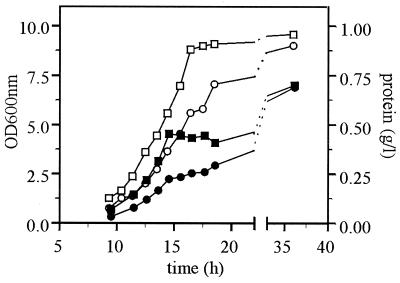
FIG. 1
FIG. 1
Influence on growth characteristics of the HXK2 deletion. The wild-type strain (solid symbols) and the hxk2 mutant strain (open symbols) were grown on YNB–1% glucose. Growth was monitored by measuring the optical density at 600 nm (circles) and the total protein concentration (boxes) of the culture. Errors are <5%. Data are shown from a representative experiment.
FIG. 2
FIG. 2
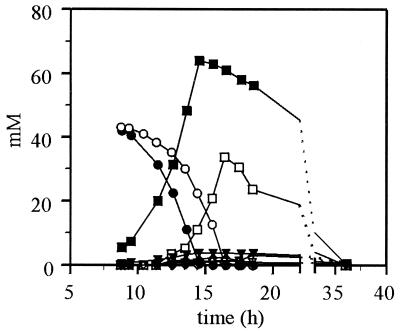
Changes in the external metabolite pattern as a consequence of a HXK2 deletion. The wild-type strain (solid symbols) and the hxk2 mutant strain (open symbols) were grown on YNB–1% glucose. Glucose (circles), ethanol (boxes), glycerol (triangles down), acetate (triangles up), and pyruvate (diamonds) were determined in the supernatant of the culture. Errors are <5%. Data are shown from a representative experiment.
FIG. 3
FIG. 3
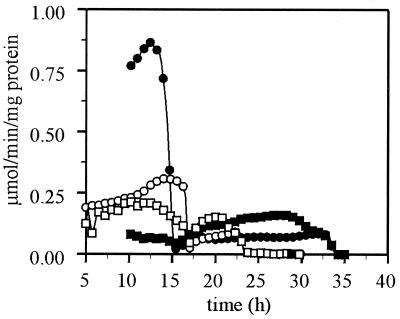
Specific CO2 production, O2 consumption, and RQ during growth. The wild-type strain (solid symbols) and the hxk2 mutant strain (open symbols) were grown on YNB–1% glucose. CO2 production (circles) and O2 consumption (boxes) were measured continuously from the off-gas and are expressed in micromoles per minute per milligram of total cell protein. Errors are <5%. Data are shown from a representative experiment.
FIG. 4
FIG. 4
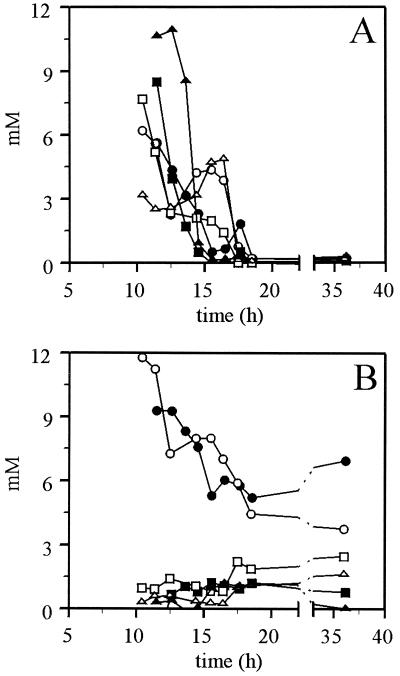
Internal metabolites during growth on glucose. The wild-type strain (solid symbols) and the hxk2 mutant strain (open symbols) were grown on YNB–1% glucose. The intracellular concentrations of glucose-6-phosphate (circles), fructose-6-phosphate (boxes), and fructose-1,6-bisphosphate (triangles) in panel A, and the adenine nucleotides ATP (circles), ADP (boxes), and AMP (triangles) in panel B are expressed in millimolar concentrations in the cytosol. Errors are <5%. Data are shown from a representative experiment.
FIG. 5
FIG. 5
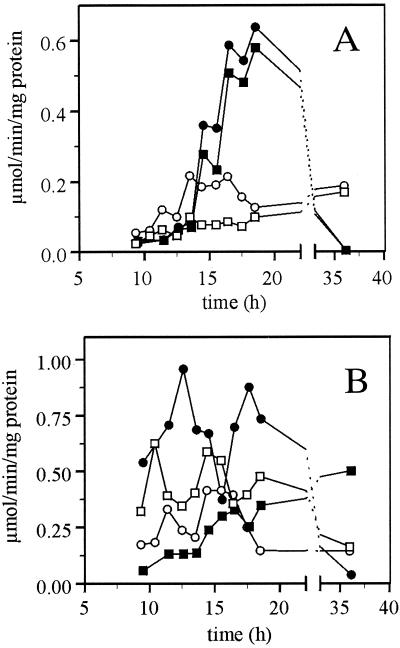
Specific enzyme activities during growth on glucose. The wild-type strain (solid symbols) and the hxk2 mutant strain (open symbols) were grown on YNB–1% glucose. In panel A, the fructose-phosphorylating activity (circles) and the glucose-phosphorylating activity (boxes) (in micromoles of substrate converted per minute per milligram of total cell protein) are depicted. In panel B, the pyruvate decarboxylase activity (circles) and mitochondrial H+-ATPase (boxes) activity are depicted. Errors are <10%. Data are shown from a representative experiment.

References

    1. Behlke J, Heidrich K, Naumann M, Muller E C, Otto A, Reuter R, Kriegel T. Hexokinase 2 from Saccharomyces cerevisiae: regulation of oligomeric structure by in vivo phosphorylation at serine-14. Biochemistry. 1998;37:11989–11995. - PubMed
    1. Bergmeyer H U. Methods of enzymatic analysis. Weinheim, Germany: Verlag Chemie GmbH; 1974.
    1. Bisson L F. High-affinity glucose transport in Saccharomyces cerevisiae is under general glucose repression control. J Bacteriol. 1988;170:4838–4845. - PMC - PubMed
    1. Bisson L F, Fraenkel D G. Expression of kinase-dependent glucose uptake in Saccharomyces cerevisiae. J Bacteriol. 1984;159:1013–1017. - PMC - PubMed
    1. Blázquez M A, Lagunas R, Gancedo C, Gancedo J M. Trehalose-6-phosphate, a new regulator of yeast glycolysis that inhibits hexokinases. FEBS Lett. 1993;329:51–54. - PubMed

Publication types

LinkOut - more resources