


Does the high nucleic acid content of individual bacterial cells allow us to discriminate between active cells and inactive cells in aquatic systems?
- PMID: 11282632
- PMCID: PMC92796
- DOI: 10.1128/AEM.67.4.1775-1782.2001
Does the high nucleic acid content of individual bacterial cells allow us to discriminate between active cells and inactive cells in aquatic systems?
Abstract
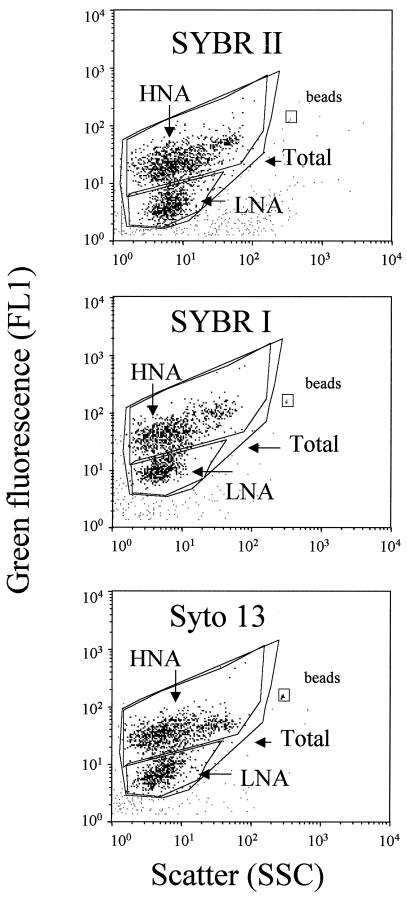
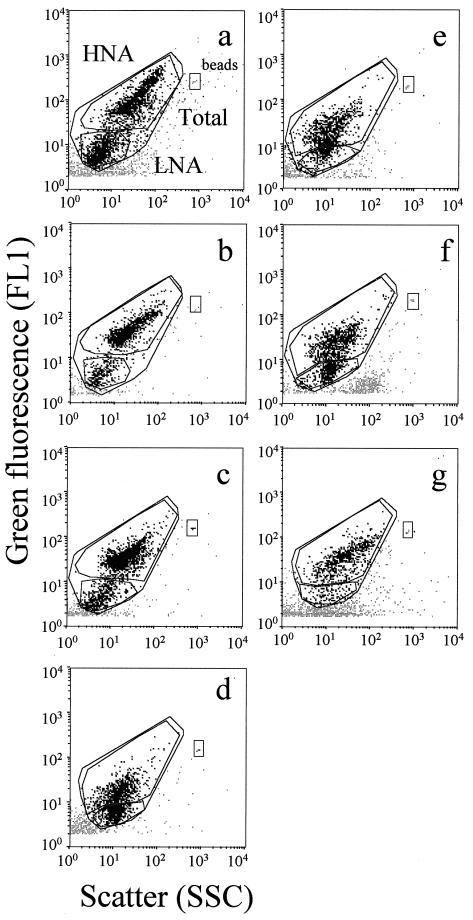
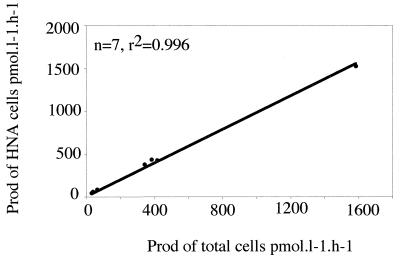
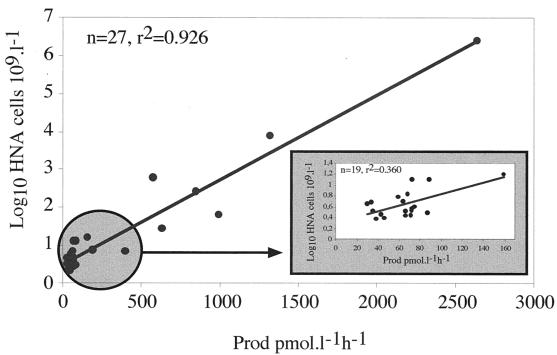
The nucleic acid contents of individual bacterial cells as determined with three different nucleic acid-specific fluorescent dyes (SYBR I, SYBR II, and SYTO 13) and flow cytometry were compared for different seawater samples. Similar fluorescence patterns were observed, and bacteria with high apparent nucleic acid contents (HNA) could be discriminated from bacteria with low nucleic acid contents (LNA). The best discrimination between HNA and LNA cells was found when cells were stained with SYBR II. Bacteria in different water samples collected from seven freshwater, brackish water, and seawater ecosystems were prelabeled with tritiated leucine and then stained with SYBR II. After labeling and staining, HNA, LNA, and total cells were sorted by flow cytometry, and the specific activity of each cellular category was determined from leucine incorporation rates. The HNA cells were responsible for most of the total bacterial production, and the specific activities of cells in the HNA population varied between samples by a factor of seven. We suggest that nucleic acid content alone can be a better indicator of the fraction of growing cells than total counts and that this approach should be combined with other fluorescent physiological probes to improve detection of the most active cells in aquatic systems.
Figures
References
-
- Azam F. Microbial control of oceanic carbon flux: the plot thickens. Science. 1998;280:694–696.
-
- Bernard L, Courties C, Servais P, Troussellier M, Petit M, Lebaron P. Relationships between bacterial cell-size, productivity and genetic diversity in aquatic environments using cell sorting and flow cytometry. Microb Ecol. 2000;40:148–158. - PubMed
-
- Choi J W, Sherr E B, Sherr B F. Dead or alive? A large fraction of ET-inactive marine bacterioplankton cells, as assessed by reduction of CTC, can become ETS-active cells with incubation and substrate addition. Aquat Microb Ecol. 1999;16:27–35.
-
- del Giorgio P A, Scarborough G. Increase in the proportion of metabolically active bacteria along gradients of enrichment in freshwater and marine plankton: implication for estimates of bacterial growth and production rates. J Plankton Res. 1995;17:1905–1924.
-
- del Giorgio P A, Prairie Y T, Bird D F. Coupling between rates of bacterial production and the abundance of metabolically active bacteria in lakes, enumerated using CTC reduction and flow cytometry. Microb Ecol. 1997;34:144–154. - PubMed
Publication types
MeSH terms
Substances
LinkOut - more resources
Full Text Sources
Other Literature Sources
