


Serological, epidemiological, and molecular differences between human T-cell lymphotropic virus Type 1 (HTLV-1)-seropositive healthy carriers and persons with HTLV-I Gag indeterminate Western blot patterns from the Caribbean
- PMID: 11283036
- PMCID: PMC87919
- DOI: 10.1128/JCM.39.4.1247-1253.2001
Serological, epidemiological, and molecular differences between human T-cell lymphotropic virus Type 1 (HTLV-1)-seropositive healthy carriers and persons with HTLV-I Gag indeterminate Western blot patterns from the Caribbean
Abstract
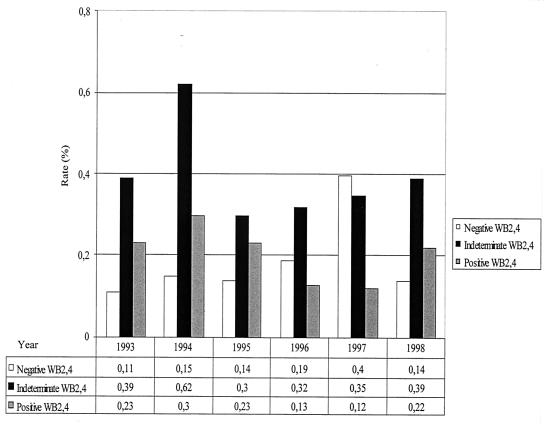
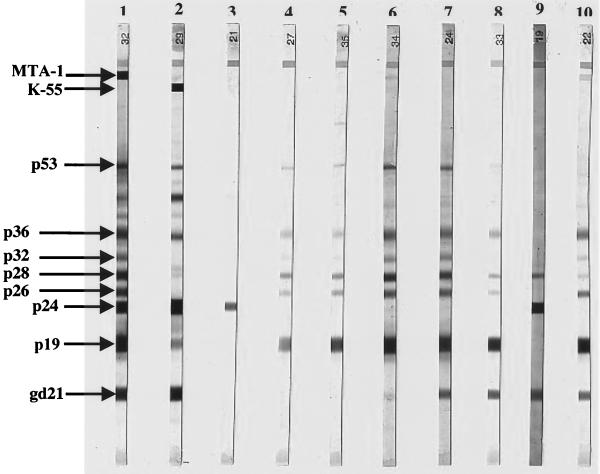
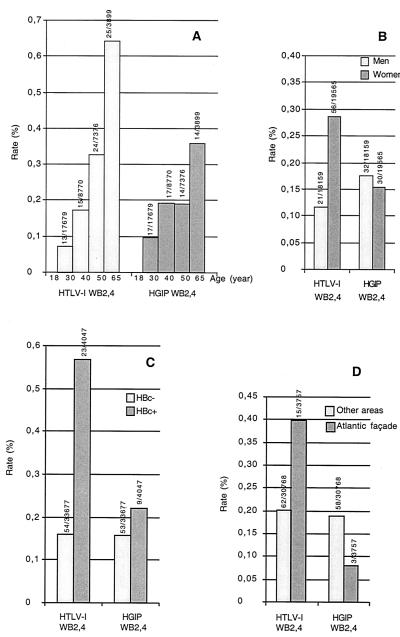
To investigate the significance of serological human T-cell lymphotropic virus type 1 (HLTV-1) Gag indeterminate Western blot (WB) patterns in the Caribbean, a 6-year (1993 to 1998) cross-sectional study was conducted with 37,724 blood donors from Guadeloupe (French West Indies), whose sera were routinely screened by enzyme immunoassay (EIA) for the presence of HTLV-1 and -2 antibodies. By using stringent WB criteria, 77 donors (0.20%) were confirmed HTLV-1 seropositive, whereas 150 (0.40%; P < 0.001) were considered HTLV seroindeterminate. Among them, 41.3% (62) exhibited a typical HTLV-1 Gag indeterminate profile (HGIP). Furthermore 76 (50.7%) out of the 150 HTLV-seroindeterminate subjects were sequentially retested, with a mean duration of follow-up of 18.3 months (range, 1 to 70 months). Of these, 55 (72.4%) were still EIA positive and maintained the same WB profile whereas the others became EIA negative. This follow-up survey included 33 persons with an HGIP. Twenty-three of them (69.7%) had profiles that did not evolve over time. Moreover, no case of HTLV-1 seroconversion could be documented over time by studying such sequential samples. HTLV-1 seroprevalence was characterized by an age-dependent curve, a uniform excess in females, a significant relation with hepatitis B core (HBc) antibodies, and a microcluster distribution along the Atlantic coast of Guadeloupe. In contrast, the persons with an HGIP were significantly younger, had a 1:1 sex ratio, did not present any association with HBc antibodies, and were not clustered along the Atlantic façade. These divergent epidemiological features, together with discordant serological screening test results for subjects with HGIP and with the lack of HTLV-1 proviral sequences detected by PCR in their peripheral blood mononuclear cell DNA, strongly suggest that an HGIP does not reflect true HTLV-1 infection. In regard to these data, healthy blood donors with HGIP should be reassured that they are unlikely to be infected with HTLV-1 or HTLV-2.
Figures
References
-
- Banki K, Maceda J, Hurley E, Ablonczy E, Mattson D H, Szegedy L, Hung C, Perl A. Human T-cell lymphotropic virus (HTLV)-related endogenous sequence, HRES-1, encodes a 28-kDa protein: a possible autoantigen for HTLV-I gag-reactive autoantibodies. Proc Natl Acad Sci USA. 1992;89:1939–1943. - PMC - PubMed
-
- Bonis J, Preux P M, Nzisabira L, Letenneur L, Muhirwa G, Buzingo T, Kamuragiye A, Preux C, Ngoga E, Dumas M, Denis F. HTLV-I in Burundi (East Africa): lack of reactivity to the HTLV-I immunodominant envelope epitope. J Acquir Immune Defic Syndr. 1994;7:1099–1100. - PubMed
-
- Brodine S K, Kaime E M, Roberts C, Turnicky R P, Lal R B. Simultaneous confirmation and differentiation of human T-lymphotropic virus types I and II infection by modified Western blot containing recombinant envelope glycoproteins. Transfusion. 1993;33:925–929. - PubMed
-
- Busch M P, Laycock M, Kleinman S H, Wages J W, Jr, Calabro M, Kaplan J E, Khabbaz R F, Hollingsworth C G. Accuracy of supplementary serologic testing for human T-lymphotropic virus types I and II in US blood donors. Retrovirus Epidemiology Donor Study. Blood. 1994;83:1143–1148. - PubMed
-
- Busch M P, Switzer W M, Murphy E L, Thomson R, Heneine W. Absence of evidence of infection with divergent primate T-lymphotropic viruses in United States blood donors who have seroindeterminate HTLV test results. Transfusion. 2000;40:443–449. - PubMed
Publication types
MeSH terms
Substances
LinkOut - more resources
Full Text Sources
