


A major locus for fasting insulin concentrations and insulin resistance on chromosome 6q with strong pleiotropic effects on obesity-related phenotypes in nondiabetic Mexican Americans
- PMID: 11283790
- PMCID: PMC1226096
- DOI: 10.1086/320100
A major locus for fasting insulin concentrations and insulin resistance on chromosome 6q with strong pleiotropic effects on obesity-related phenotypes in nondiabetic Mexican Americans
Abstract
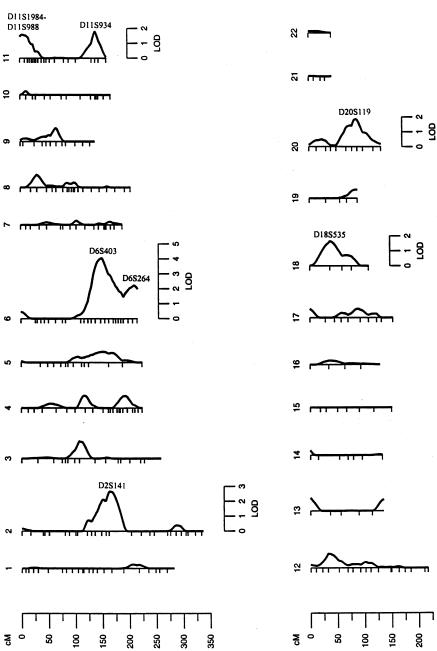
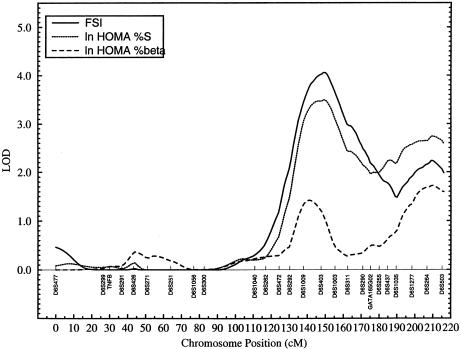
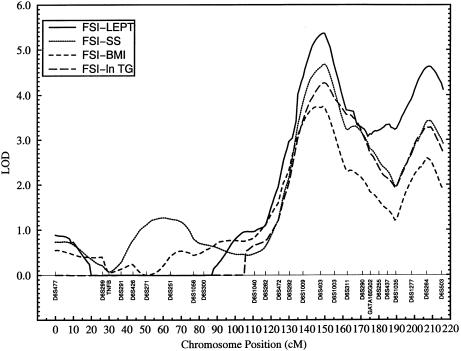
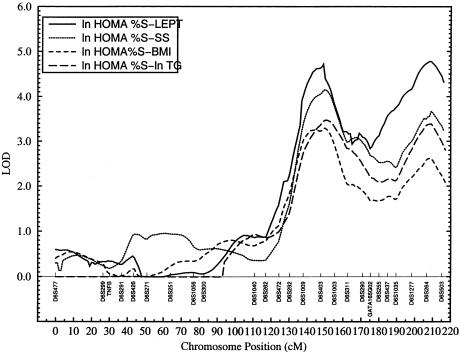
Insulin resistance and hyperinsulinemia are strong correlates of obesity and type 2 diabetes, but little is known about their genetic determinants. Using data on nondiabetics from Mexican American families and a multipoint linkage approach, we scanned the genome and identified a major locus near marker D6S403 for fasting "true" insulin levels (LOD score 4.1, empirical P<.0001), which do not crossreact with insulin precursors. Insulin resistance, as assessed by the homeostasis model using fasting glucose and specific insulin (FSI) values, was also strongly linked (LOD score 3.5, empirical P<.0001) with this region. Two other regions across the genome were found to be suggestively linked to FSI: a location on chromosome 2q, near marker D2S141, and another location on chromosome 6q, near marker D6S264. Since several insulin-resistance syndrome (IRS)-related phenotypes were mapped independently to the regions on chromosome 6q, we conducted bivariate multipoint linkage analyses to map the correlated IRS phenotypes. These analyses implicated the same chromosomal region near marker D6S403 (6q22-q23) as harboring a major gene with strong pleiotropic effects on obesity and on lipid measures, including leptin concentrations (e.g., LOD(eq) for traits-specific insulin and leptin was 4.7). A positional candidate gene for insulin resistance in this chromosomal region is the plasma cell-membrane glycoprotein PC-1 (6q22-q23). The genetic location on chromosome 6q, near marker D6S264 (6q25.2-q26), was also identified by the bivariate analysis as exerting significant pleiotropic influences on IRS-related phenotypes (e.g., LOD(eq) for traits-specific insulin and leptin was 4.1). This chromosomal region harbors positional candidate genes, such as the insulin-like growth factor 2 receptor (IGF2R, 6q26) and acetyl-CoA acetyltransferase 2 (ACAT2, 6q25.3-q26). In sum, we found substantial evidence for susceptibility loci on chromosome 6q that influence insulin concentrations and other IRS-related phenotypes in Mexican Americans.
Figures
References
Electronic-Database Information
-
- Online Mendelian Inheritance in Man (OMIM), http://www.ncbi.nlm.nih.gov/Omim/ (for IGF2R [MIM 147280], ACAT2 [MIM 100678], and OPRM1 [MIM 600018])
References
-
- Almasy L, Dyer TD, Blangero J (1997) Bivariate quantitative trait linkage analysis: pleiotropy versus co-incident linkages. Genet Epidemiol 14:953–958 - PubMed
Publication types
MeSH terms
Substances
Grants and funding
LinkOut - more resources
Full Text Sources
Other Literature Sources
Medical
Molecular Biology Databases
Research Materials
Miscellaneous
