. 2001 Apr 2;20(7):1508-18.
doi: 10.1093/emboj/20.7.1508.

Cpx signaling pathway monitors biogenesis and affects assembly and expression of P pili

Affiliations

Cpx signaling pathway monitors biogenesis and affects assembly and expression of P pili

D L Hung et al. EMBO J. .

Abstract

P pili are important virulence factors in uropathogenic Escherichia coli. The Cpx two-component signal transduction system controls a stress response and is activated by misfolded proteins in the periplasm. We have discovered new functions for the Cpx pathway, indicating that it may play a critical role in pathogenesis. P pili are assembled via the chaperone/usher pathway. Subunits that go 'OFF-pathway' during pilus biogenesis generate a signal. This signal is derived from the misfolding and aggregation of subunits that failed to come into contact with the chaperone in the periplasm. In response, Cpx not only controls the stress response, but also controls genes necessary for pilus biogenesis, and is involved in regulating the phase variation of pap expression and, potentially, the expression of a panoply of other virulence factors. This study demonstrates how the prototypic chaperone/usher pathway is intricately linked and dependent upon a signal transduction system.


Figures
None
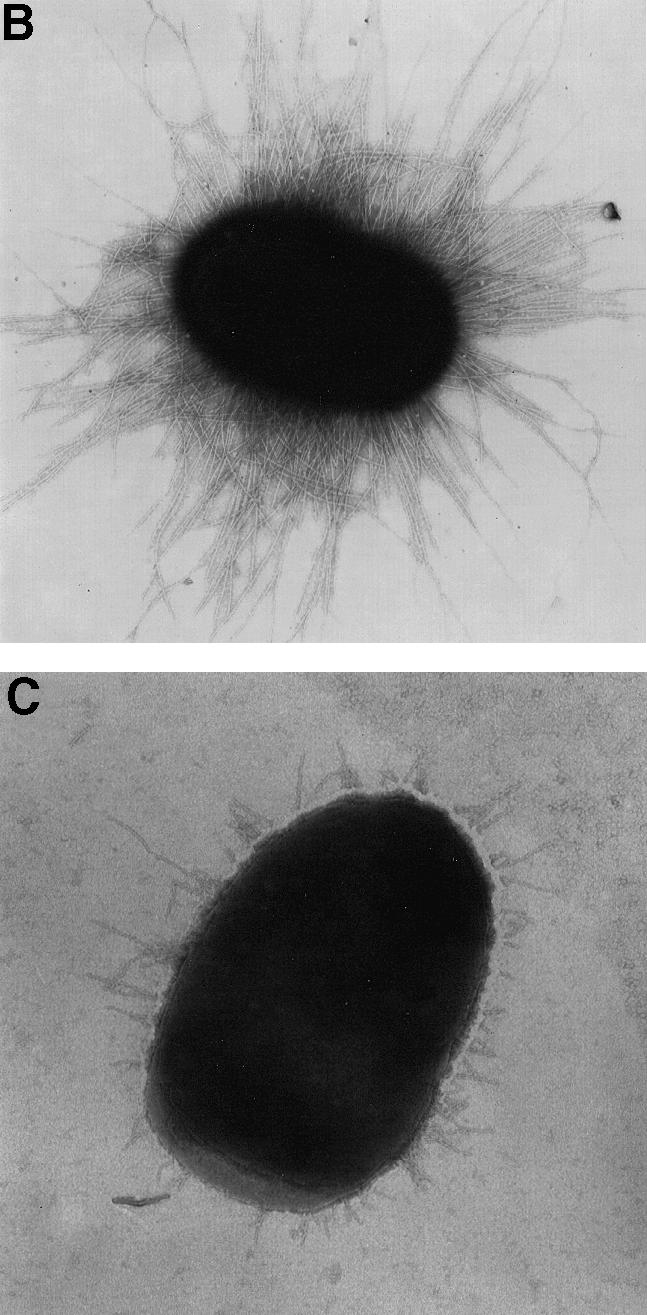
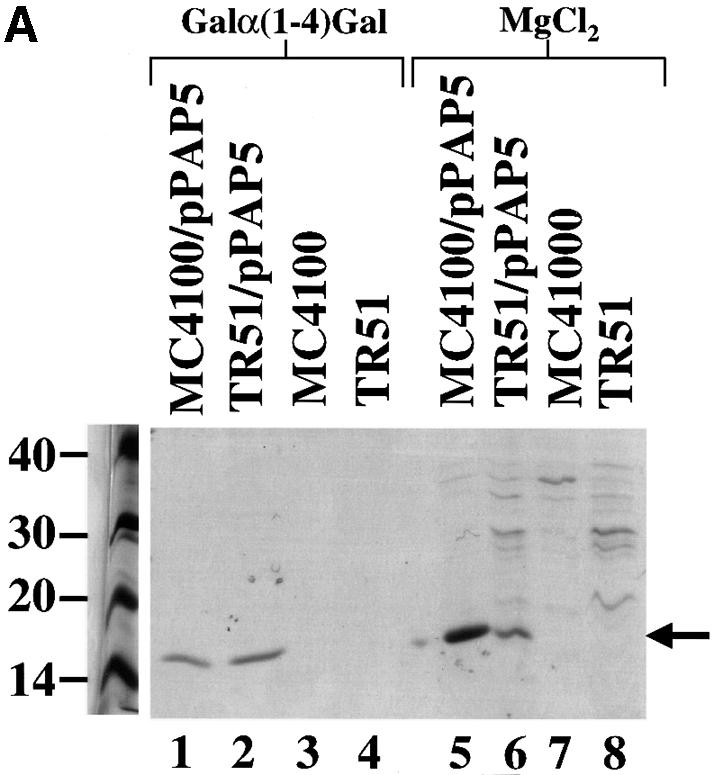
Fig. 1. Fewer and shorter P pili are assembled without the Cpx signaling pathway. (A) P pili were purified by Galα(1–4)Gal affinity chromatography in lanes 1–4 and by MgCl2 precipitation in lanes 5–8, run on SDS–PAGE and stained with Coomassie Blue. Pili were purified after 3 days passage on TSA plates from the following strains: wild-type strain alone, lanes 3 and 7 (MC4100); wild-type strain expressing P pili, lanes 1 and 5 (MC4100/pPAP5); cpxR null strain alone, lanes 4 and 8 (TR51); and cpxR null strain expressing P pili, lanes 2 and 6 (TR51/pPAP5). The arrow points to the PapA band. (B) Negative stain of wild-type cells expressing P pili (MC4100/pPAP5) at a magnification of 20 000. (C) Negative stain of cells with a cpxR null allele expressing P pili (TR51/pPAP5) at a magnification of 20 000.
None
Fig. 1. Fewer and shorter P pili are assembled without the Cpx signaling pathway. (A) P pili were purified by Galα(1–4)Gal affinity chromatography in lanes 1–4 and by MgCl2 precipitation in lanes 5–8, run on SDS–PAGE and stained with Coomassie Blue. Pili were purified after 3 days passage on TSA plates from the following strains: wild-type strain alone, lanes 3 and 7 (MC4100); wild-type strain expressing P pili, lanes 1 and 5 (MC4100/pPAP5); cpxR null strain alone, lanes 4 and 8 (TR51); and cpxR null strain expressing P pili, lanes 2 and 6 (TR51/pPAP5). The arrow points to the PapA band. (B) Negative stain of wild-type cells expressing P pili (MC4100/pPAP5) at a magnification of 20 000. (C) Negative stain of cells with a cpxR null allele expressing P pili (TR51/pPAP5) at a magnification of 20 000.
None
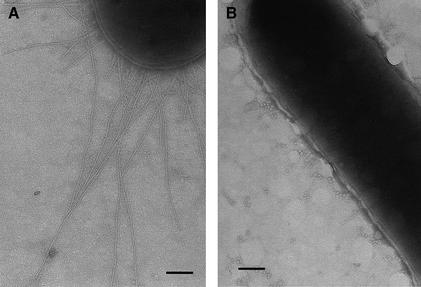
Fig. 2. Short P pili are assembled without the Cpx signaling pathway when expressed behind an inducible promoter. (A) Negative stain of wild-type cells expressing P pili behind the trc promoter (MC4100/pFJ29) at a magnification of 50 000. (B) Negative stain of cells with a cpxR null allele expressing P pili behind the trc promoter (TR51/pFJ29) at a magnification of 50 000. The bar represents 200 nm.
None
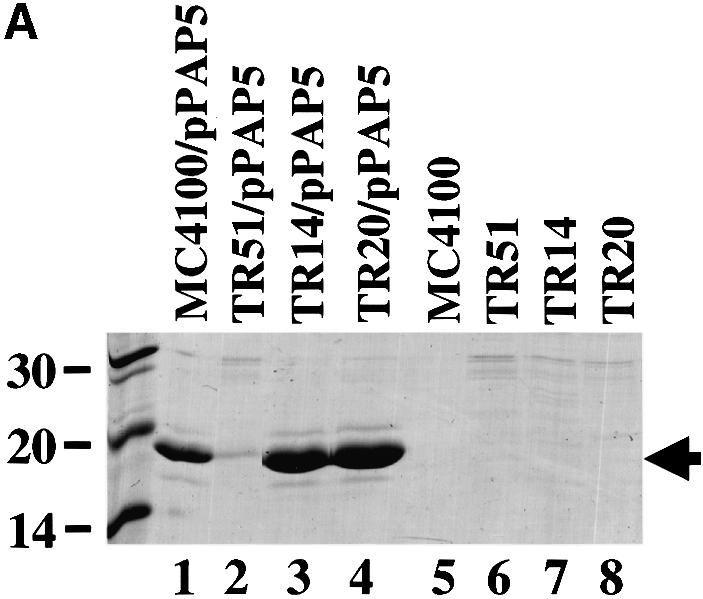
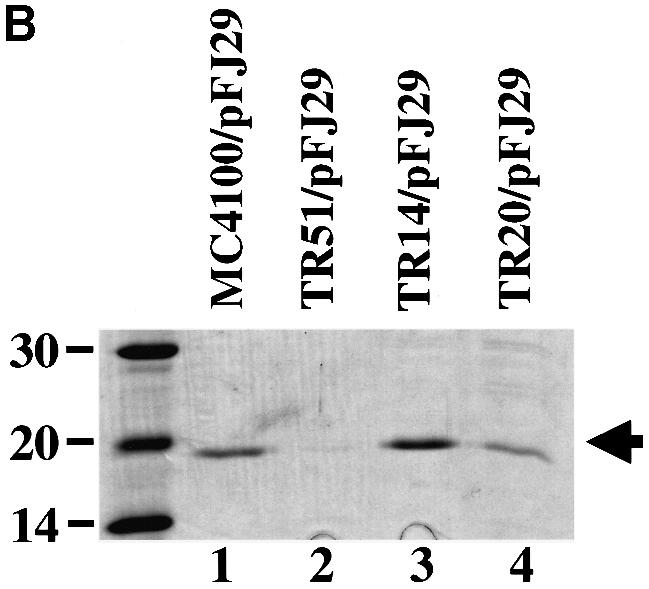
Fig. 3. P pilus assembly is increased in strains with signal-responsive cpx* mutations. (A) P pili were expressed from behind the natural promoter. MgCl2-precipitated pili were run on SDS–PAGE and stained with Coomassie Blue. Pili were purified after 3 days passage on TSA plates with the appropriate antibiotics from the following strains: wild type alone, lane 5 (MC4100), and expressing P pili, lane 1 (MC4100/pPAP5); cpxR null alone, lane 6 (TR51), and expressing P pili, lane 2 (TR51/pPAP5); TR14 alone, lane 7, and expressing P pili, lane 3 (TR14/pPAP5); and TR20 alone, lane 8, and expressing P pili, lane 4 (TR20/pPAP5). Verification of the PapA band was performed by western blot analysis using anti-pilus antiserum (data not shown). The arrow points to the PapA band. (B) P pili were expressed behind the trc promoter. MgCl2-precipitated pili were run on SDS–PAGE and stained with Coomassie Blue. Pili were purified after growth to mid-logarithmic phase in the following strains: wild type expressing P pili, lane 1 (MC4100/pFJ29); cpxR null expressing P pili, lane 2 (TR51/pFJ29); TR14 expressing P pili, lane 3 (TR14/pFJ29); TR20 expressing P pili, lane 4 (TR20/pFJ29). Verification of the PapA band was performed by western anlysis using anti-pilus antiserum (data not shown). The arrow points to the PapA band.
None
Fig. 3. P pilus assembly is increased in strains with signal-responsive cpx* mutations. (A) P pili were expressed from behind the natural promoter. MgCl2-precipitated pili were run on SDS–PAGE and stained with Coomassie Blue. Pili were purified after 3 days passage on TSA plates with the appropriate antibiotics from the following strains: wild type alone, lane 5 (MC4100), and expressing P pili, lane 1 (MC4100/pPAP5); cpxR null alone, lane 6 (TR51), and expressing P pili, lane 2 (TR51/pPAP5); TR14 alone, lane 7, and expressing P pili, lane 3 (TR14/pPAP5); and TR20 alone, lane 8, and expressing P pili, lane 4 (TR20/pPAP5). Verification of the PapA band was performed by western blot analysis using anti-pilus antiserum (data not shown). The arrow points to the PapA band. (B) P pili were expressed behind the trc promoter. MgCl2-precipitated pili were run on SDS–PAGE and stained with Coomassie Blue. Pili were purified after growth to mid-logarithmic phase in the following strains: wild type expressing P pili, lane 1 (MC4100/pFJ29); cpxR null expressing P pili, lane 2 (TR51/pFJ29); TR14 expressing P pili, lane 3 (TR14/pFJ29); TR20 expressing P pili, lane 4 (TR20/pFJ29). Verification of the PapA band was performed by western anlysis using anti-pilus antiserum (data not shown). The arrow points to the PapA band.
None
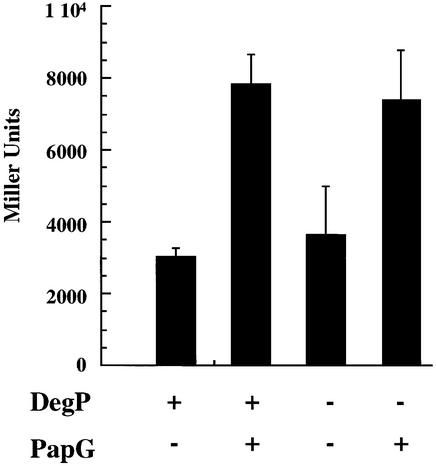
Fig. 4. The signal generated by subunits going OFF-pathway is independent of the DegP protease. Wild-type and degP null strains (KS272 and KS474, respectively) with cpxP–lacZ fusions (DH500 and DH501, respectively) were analyzed. Cells were grown shaking in Luria broth, and PapG (pHJ8) or the vector control (pMMB66) was induced for expression during early logarithmic growth. Aliquots removed during mid-logarithmic growth and Miller assays were performed. The results shown on the graph are averages and standard deviations from three independent assays.
None
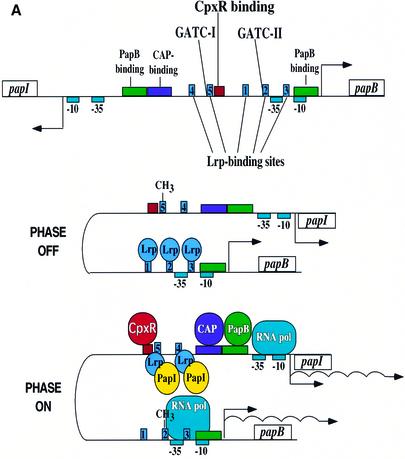
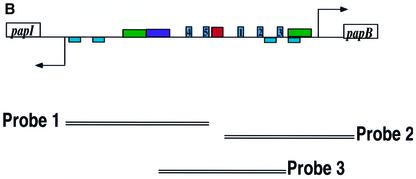
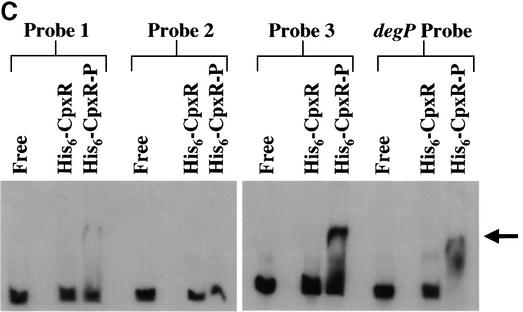
Fig. 5. CpxR-P binds to the pap promoter. (A) Schematic of the pap promoter region (top) and the model of transcriptional inactivation, phase OFF (center), and activation, phase ON (bottom) (adapted from van der Woude et al., 1996). Phase variation is affected by the action of DAM on the adenines in the two DNA GATC sequences, designated GATC-I and GATC-II, contained within the Lrp binding sites 5 and 2, respectively (explained in text). Abbreviations: CAP, catabolite activator protein; Lrp, leucine-responsive regulatory protein. The involvement of CpxR is discussed in the text. (B) Schematic of strategy for DNA probes used in EMSAs. Only probe 3 contains the putative CpxR binding site; probes 1 and 2 do not. A positive control probe, DegP, encoding the previously identified CpxR binding site in the degP promoter was also used in the EMSAs. (C) EMSAs of His6-CpxR binding to the putative site in the pap promoter. His6-CpxR was purified and phosphorylated. Unphosphorylated (His6-CpxR) or phosphorylated His6-CpxR (His6-CpxR-P) was incubated with DNA probes from (B) and run on 4% acrylamide gels.
None
Fig. 5. CpxR-P binds to the pap promoter. (A) Schematic of the pap promoter region (top) and the model of transcriptional inactivation, phase OFF (center), and activation, phase ON (bottom) (adapted from van der Woude et al., 1996). Phase variation is affected by the action of DAM on the adenines in the two DNA GATC sequences, designated GATC-I and GATC-II, contained within the Lrp binding sites 5 and 2, respectively (explained in text). Abbreviations: CAP, catabolite activator protein; Lrp, leucine-responsive regulatory protein. The involvement of CpxR is discussed in the text. (B) Schematic of strategy for DNA probes used in EMSAs. Only probe 3 contains the putative CpxR binding site; probes 1 and 2 do not. A positive control probe, DegP, encoding the previously identified CpxR binding site in the degP promoter was also used in the EMSAs. (C) EMSAs of His6-CpxR binding to the putative site in the pap promoter. His6-CpxR was purified and phosphorylated. Unphosphorylated (His6-CpxR) or phosphorylated His6-CpxR (His6-CpxR-P) was incubated with DNA probes from (B) and run on 4% acrylamide gels.
None
Fig. 5. CpxR-P binds to the pap promoter. (A) Schematic of the pap promoter region (top) and the model of transcriptional inactivation, phase OFF (center), and activation, phase ON (bottom) (adapted from van der Woude et al., 1996). Phase variation is affected by the action of DAM on the adenines in the two DNA GATC sequences, designated GATC-I and GATC-II, contained within the Lrp binding sites 5 and 2, respectively (explained in text). Abbreviations: CAP, catabolite activator protein; Lrp, leucine-responsive regulatory protein. The involvement of CpxR is discussed in the text. (B) Schematic of strategy for DNA probes used in EMSAs. Only probe 3 contains the putative CpxR binding site; probes 1 and 2 do not. A positive control probe, DegP, encoding the previously identified CpxR binding site in the degP promoter was also used in the EMSAs. (C) EMSAs of His6-CpxR binding to the putative site in the pap promoter. His6-CpxR was purified and phosphorylated. Unphosphorylated (His6-CpxR) or phosphorylated His6-CpxR (His6-CpxR-P) was incubated with DNA probes from (B) and run on 4% acrylamide gels.
None
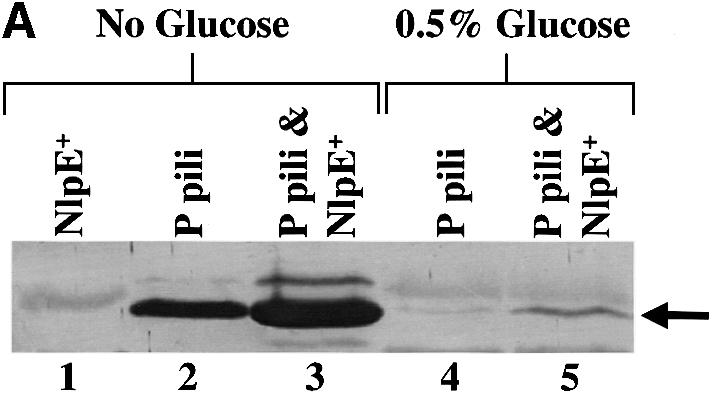
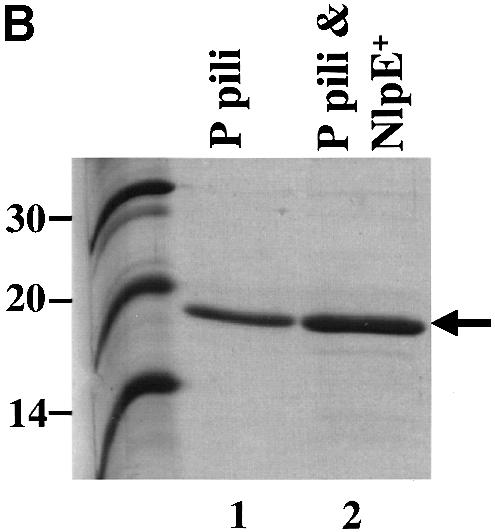
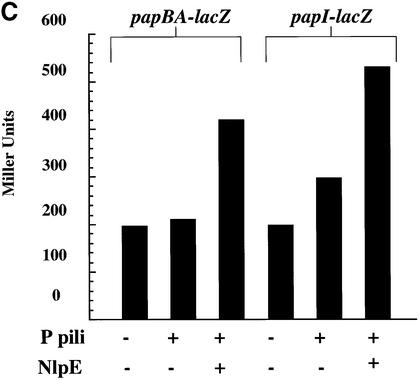
Fig. 6. Specific activation of the Cpx signaling pathway by overproduction of NlpE increases P pilus assembly and can relieve catabolite repression. (A) MgCl2-precipitated pili were run on SDS–PAGE and then immunoblotted by using anti-pilus antiserum. Pili were purified after overnight growth shaking in Luria broth with the appropriate antibiotics in the presence or absence of 0.5% glucose. Pili were purified without added glucose from the wild-type strain overexpressing NlpE, lane 1 (MC4100/pLD404); expressing P pili, lane 2 (MC4100/pRHU845); and expressing P pili while over expressing NlpE, lane 3 (MC4100/pRHU845/pLD404). Pili purified from cells grown with 0.5% glucose expressing only P pili, lane 4 (MC4100/pRHU845), and also overproducing NlpE, lane 5 (MC4100/pRHU845/pLD404). The arrow points to the PapA band. (B) MgCl2-precipitated pili were run on SDS–PAGE and then immunoblotted by using anti-pilus antiserum. Pili were purified after the bacteria had been passaged 3 days on TSA plates with the appropriate antibiotics. Pili were purified from the wild-type strain expressing only P pili, lane 1 (MC4100/pRHU845) or with the overproduction of NlpE, lane 2 (MC4100/pRHU845/pLD404). The arrow points to the PapA band. (C) The wild-type strain with papBA–lacZ and papI–lacZ expressing only P pili (CHJ101/pRHU845 and CHJ103/pRHU845, respectively) or with the overproduction of NlpE (CHJ101/pRHU845/pLD404 and CHJ103/pRHU845/pLD404) was analyzed. Aliquots were removed after overnight growth shaking in Luria broth with the appropriate antibiotics, and Miller assays were performed. The results shown on the graph are averages from two independent assays.
None
Fig. 6. Specific activation of the Cpx signaling pathway by overproduction of NlpE increases P pilus assembly and can relieve catabolite repression. (A) MgCl2-precipitated pili were run on SDS–PAGE and then immunoblotted by using anti-pilus antiserum. Pili were purified after overnight growth shaking in Luria broth with the appropriate antibiotics in the presence or absence of 0.5% glucose. Pili were purified without added glucose from the wild-type strain overexpressing NlpE, lane 1 (MC4100/pLD404); expressing P pili, lane 2 (MC4100/pRHU845); and expressing P pili while over expressing NlpE, lane 3 (MC4100/pRHU845/pLD404). Pili purified from cells grown with 0.5% glucose expressing only P pili, lane 4 (MC4100/pRHU845), and also overproducing NlpE, lane 5 (MC4100/pRHU845/pLD404). The arrow points to the PapA band. (B) MgCl2-precipitated pili were run on SDS–PAGE and then immunoblotted by using anti-pilus antiserum. Pili were purified after the bacteria had been passaged 3 days on TSA plates with the appropriate antibiotics. Pili were purified from the wild-type strain expressing only P pili, lane 1 (MC4100/pRHU845) or with the overproduction of NlpE, lane 2 (MC4100/pRHU845/pLD404). The arrow points to the PapA band. (C) The wild-type strain with papBA–lacZ and papI–lacZ expressing only P pili (CHJ101/pRHU845 and CHJ103/pRHU845, respectively) or with the overproduction of NlpE (CHJ101/pRHU845/pLD404 and CHJ103/pRHU845/pLD404) was analyzed. Aliquots were removed after overnight growth shaking in Luria broth with the appropriate antibiotics, and Miller assays were performed. The results shown on the graph are averages from two independent assays.
None
Fig. 6. Specific activation of the Cpx signaling pathway by overproduction of NlpE increases P pilus assembly and can relieve catabolite repression. (A) MgCl2-precipitated pili were run on SDS–PAGE and then immunoblotted by using anti-pilus antiserum. Pili were purified after overnight growth shaking in Luria broth with the appropriate antibiotics in the presence or absence of 0.5% glucose. Pili were purified without added glucose from the wild-type strain overexpressing NlpE, lane 1 (MC4100/pLD404); expressing P pili, lane 2 (MC4100/pRHU845); and expressing P pili while over expressing NlpE, lane 3 (MC4100/pRHU845/pLD404). Pili purified from cells grown with 0.5% glucose expressing only P pili, lane 4 (MC4100/pRHU845), and also overproducing NlpE, lane 5 (MC4100/pRHU845/pLD404). The arrow points to the PapA band. (B) MgCl2-precipitated pili were run on SDS–PAGE and then immunoblotted by using anti-pilus antiserum. Pili were purified after the bacteria had been passaged 3 days on TSA plates with the appropriate antibiotics. Pili were purified from the wild-type strain expressing only P pili, lane 1 (MC4100/pRHU845) or with the overproduction of NlpE, lane 2 (MC4100/pRHU845/pLD404). The arrow points to the PapA band. (C) The wild-type strain with papBA–lacZ and papI–lacZ expressing only P pili (CHJ101/pRHU845 and CHJ103/pRHU845, respectively) or with the overproduction of NlpE (CHJ101/pRHU845/pLD404 and CHJ103/pRHU845/pLD404) was analyzed. Aliquots were removed after overnight growth shaking in Luria broth with the appropriate antibiotics, and Miller assays were performed. The results shown on the graph are averages from two independent assays.

References

    1. Baga M., Normark,S., Hardy,J., O’Hanley,P., Lark,D., Olsson,O., Schoolnik,G. and Falkow,S. (1984) Nucleotide sequence of the gene encoding the papA pilus subunit of human uropathogenic Escherichia coli. J. Bacteriol., 157, 330–333. - PMC - PubMed
    1. Baga M., Goransson,M., Normark,S. and Uhlin,B.E. (1985) Transcriptional activation of a Pap pilus virulence operon from uropathogenic Escherichia coli. EMBO J., 4, 3887–3893. - PMC - PubMed
    1. Barnhart M.M., Pinkner,J., Soto,G., Sauer,F.G., Langermann,S., Waksman,G., Frieden,C. and Hultgren,S.J. (2000) PapD-like chaperones provide the missing information for folding of pilin proteins. Proc. Natl Acad. Sci. USA, 97, 7709–7714. - PMC - PubMed
    1. Blum G., Falbo,V., Caprioli,A. and Hacker,J. (1995) Gene clusters encoding the cytotoxic necrotizing factor type 1, Prs-fimbriae and α-hemolysin form the pathogenicity island II of the uropathogenic Escherichia coli strain J96. FEMS Microbiol. Lett., 126, 189–195. - PubMed
    1. Blyn L.B., Braaten,B.A., White,Z.C., Rolfson,D.H. and Low,D.A. (1989) Phase-variation of pyelonephritis-associated pili in Escherichia coli: evidence for transcriptional regulation. EMBO J., 8, 613–620. - PMC - PubMed

Publication types

MeSH terms