


Review
doi: 10.1172/JCI12672.
Helicobacter pylori genetic diversity and risk of human disease
Affiliations
- PMID: 11285290
- PMCID: PMC199587
- DOI: 10.1172/JCI12672
Item in Clipboard
Review
Helicobacter pylori genetic diversity and risk of human disease
J Clin Invest.
2001 Apr.
No abstract available
Figures
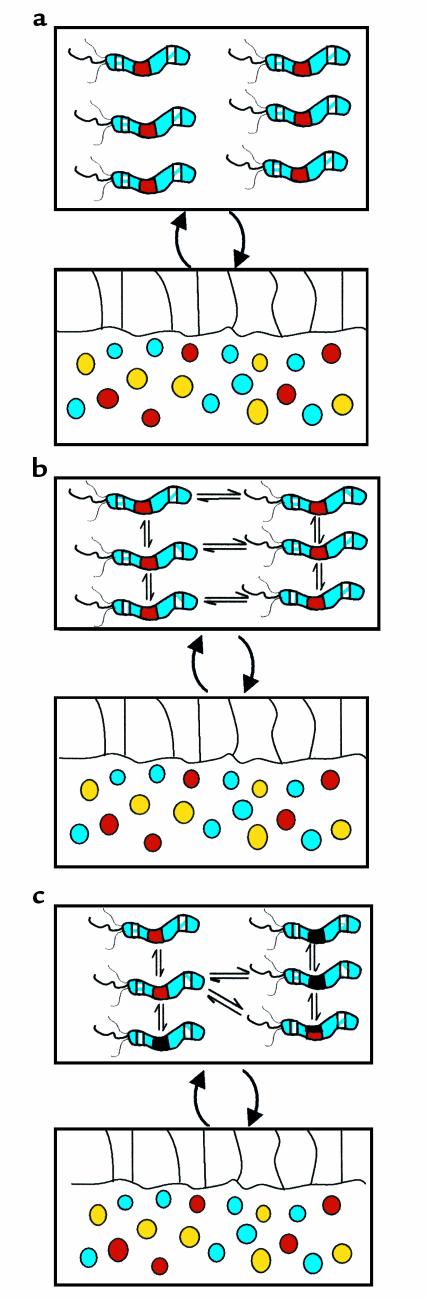
H. pylori polymorphisms affect the nature of the interaction with humans. In each panel, the H. pylori population is represented by the upper box, and the host mucosa (with epithelium and reactive neutrophils, monocytes, plasma cells, and lymphocytes) by the lower box. (a) All H. pylori cells are identical. Three polymorphic loci are shown. The lateral loci each are subject to phase variation, and each one may either be ON, encoding a full-length protein, or OFF, i.e., translation has been prematurely terminated. The middle locus represents a site in which two major alleles (represented as black and red) are present. Recombination events can permit the total or partial replacement of one locus by the other. In a, all H. pylori cells exert the same effect on the host since they are identical. (b) A single H. pylori population is present, but now individual cells are polymorphic with respect to the lateral loci. This H. pylori population will develop a different equilibrium with the host than does the population represented in a, because of its altered expression from the lateral loci. The altered host response in turn creates a different environment that selects for phenotypes different from those for a. The individual cells are thus in equilibrium with one another, and the relative proportion of one to another will be selected by the host signals. In the absence of exogenous perturbation, this model can move toward a stable equilibrium, but independent changes in the environment or periodic changes (selection) affecting the bacterial population may then move the equilibrium into new territory. (c) Two H. pylori populations are present that are recombining with one another. The dynamic equilibrium between host and the microbial population parallels that for b, except that the recombinational events change the overall equilibrium. With recombination, the variety of potential interactions expands greatly and allows a highly fluid response to host conditions. This polymorphic population can optimize overall fitness to the particular host, while remaining subject to the host selective pressures as transmitted by its signals in response to the bacterial signals. This model permits ongoing fine-adjustment of adaptation in multiple local niches.
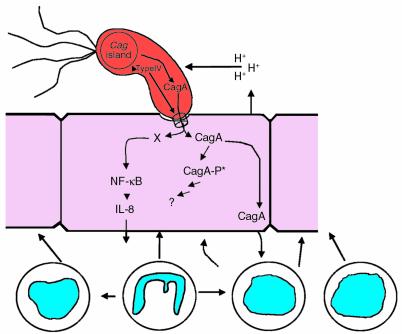
Role of the cag island in regulating gastric acidity. The conditions of a feedback system regulating both host response and bacterial transcription are potentially fulfilled by the interaction between cag+ strains and humans. Gastric acidity (represented by H+ ions) induces transcription of cagA (40). The type IV secretion system in the cag island (20) exports the cagA product into gastric epithelial cells, where it undergoes tyrosine phosphorylation (-P*) by a host-cell kinase (10). Although the exact role of the CagA phosphoprotein is not curreVntly known, signaling of the host by cag+ strains induces an increased leukocytic cellular response, as well as proinflammatory cytokines, including IL-1β (42). Because such inflammatory mediators can reduce gastric acidity, at least in part by their direct effects on the specialized epithelial cells involved in acid secretion, the H. pylori–host system shifts toward a new equilibrium value (lowered acidity, thus lowering cagA transcription). Thus all the components necessary for a simple “thermostat” have been refined. However, higher degrees of regulation can be added to this simple negative-feedback (homeostatic) model. Humans are polymorphic for IL-1β expression; thus host status helps determine the level of the equilibrium, which has important disease consequences (41). Genetic variation in the cag island may offer H. pylori populations one means to respond to long-term or local environmental changes. Because H. pylori are naturally competent, genetic determinants lost by some members of the population can be regained through transformation. DNA also may be exchanged via conjugation. Thus, metastable cag islands in a population of H. pylori cells may serve as high-gain “thermostats,” governing both H. pylori and host response dynamics.
