. 2001 May;21(9):3083-95.
doi: 10.1128/MCB.21.9.3083-3095.2001.

Role of NF-Y in in vivo regulation of the gamma-globin gene

Affiliations

Role of NF-Y in in vivo regulation of the gamma-globin gene

Z Duan et al. Mol Cell Biol. 2001 May.

Abstract

The duplicated CCAAT box is required for gamma gene expression. We report here that the transcriptional factor NF-Y is recruited to the duplicated CCAAT box in vivo. A mutation of the duplicated CCAAT box that severely disrupts the NF-Y binding also reduces the accessibility level of the gamma gene promoter, affects the assembly of basal transcriptional machinery, and increases the recruitment of GATA-1 to the locus control region (LCR) and the proximal promoter and the recruitment of transcription cofactor CBP/p300 to the LCR. These findings suggest that recruitment of NF-Y to the duplicated CCAAT box plays a role in the chromatin opening of the gamma gene promoter as well as in the communication between the gamma gene promoter and the LCR.


Figures
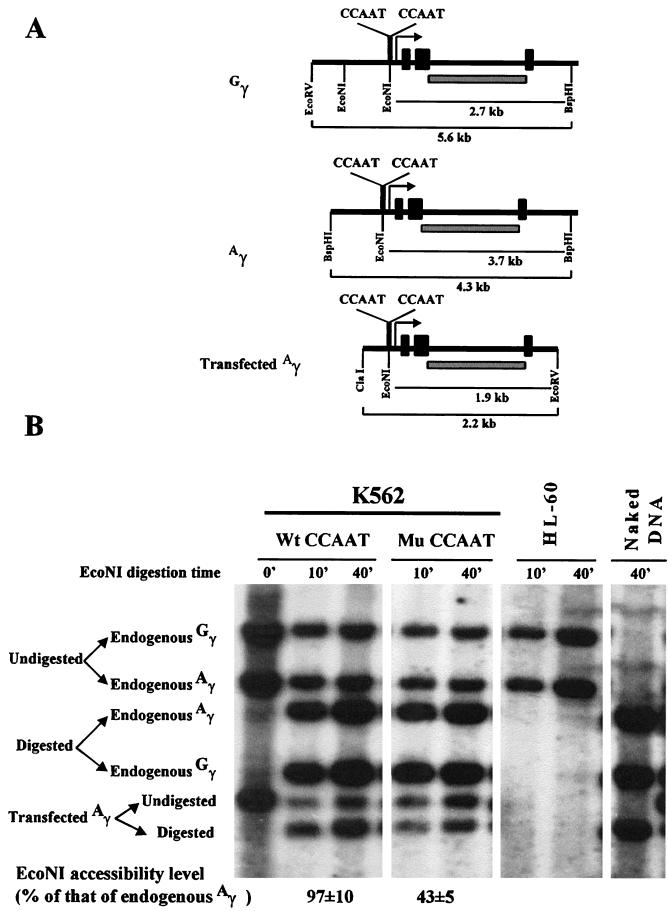
FIG. 1
FIG. 1
The CCAAT-to-GATCT mutation of the duplicated CCAAT box significantly reduces the EcoNI accessibility to the γ gene promoter in stably transfected K562 cells. (A) Schematic representation of the structure of the endogenous Gγ and Aγ genes and the stably transfected μLCRAγ constructs. The locations of EcoNI, EcoRV, ClaI, and BspHI sites and the fragments derived from each gene are shown. The location, in each gene, of the probe used for Southern blot hybridization is shown by a hatched bar. A bent arrow indicates the transcription initiation site. Solid rectangles indicate the exons. (B) A representative experiment of the EcoNI accessibility assay. Nuclei isolated from K562 cells stably transfected with μLCR(−382)Aγ (indicated as Wt CCAAT) or μLCR(−382)Aγ(mutCCAAT) (indicated as Mu CCAAT) were subjected to EcoNI accessibility assays. As described in Materials and Methods, genomic DNA was isolated from the EcoNI-treated or untreated nuclei and completely digested with BspHI, ClaI, and EcoRV. Southern blot hybridization was performed with the probe shown in panel A.
FIG. 2
FIG. 2
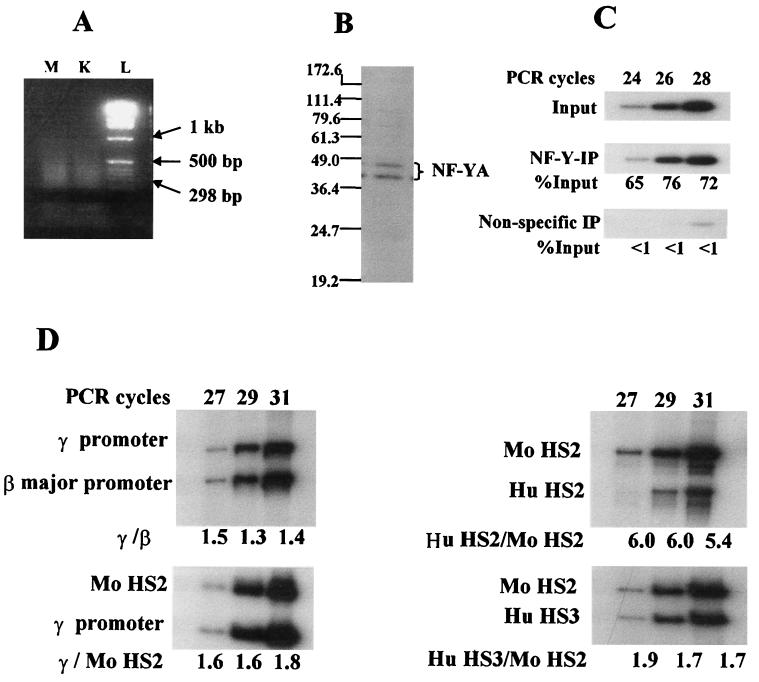
Optimization of the ChIP assay. (A) Ethidium bromide-stained agarose gel of input DNA isolated from the sonicated chromatin. M, chromatin of MEL cells; K, chromatin of K562 cells; L, DNA ladder. (B) Western blotting using the anti-NF-YA antibody. Note that the antibody detects the two 41- to 45-kDa isoforms of NF-YA. (C) PCR linearity determination with the γ promoter-amplifying primers. About 2 ng of anti-NF-YA antibody-immunoprecipitated DNA and about 4 ng of input DNA were used as templates. NF-Y-IP: anti-NF-YA-antibody immunoprecipitation; Non-specific-IP: nonspecific IgG immunoprecipitation. (D) Linearity determination in duplex PCR with the following primer combinations: γ promoter-amplifying primers plus β major promoter-amplifying primers; mouse HS2 region (Mo HS2)-amplifying primers plus γ promoter-amplifying primers; mouse HS2 region (Mo HS2)-amplifying primers plus human HS2 region (Hu HS2)-amplifying primers; mouse HS2 region (Mo HS2)-amplifying primers plus human HS3 region (Hu HS3)-amplifying primers. Note the constancy of the ratios of the signal over the internal control.
FIG. 3
FIG. 3
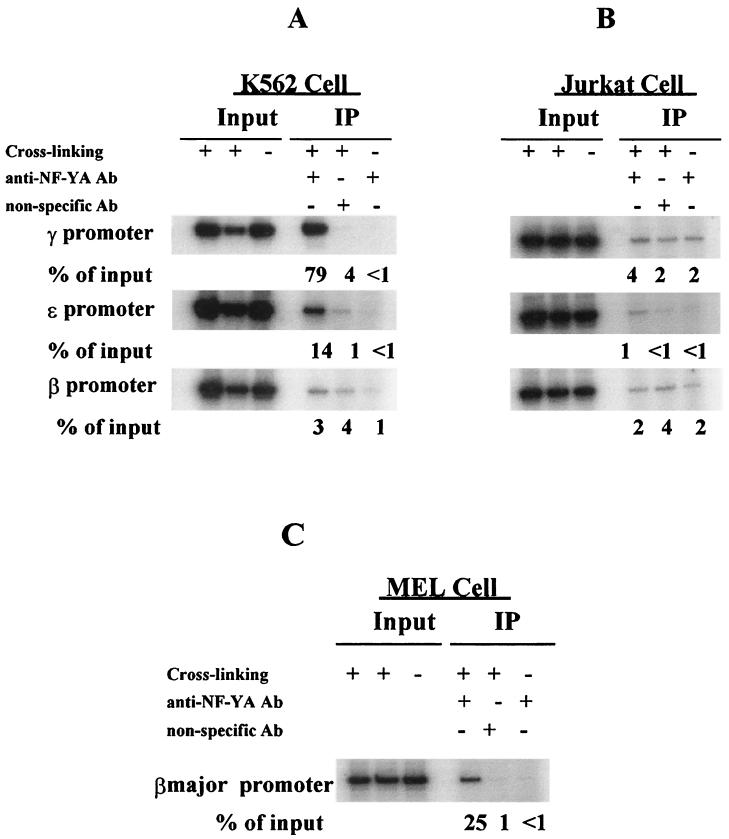
NF-Y binds to the γ gene promoter in vivo. ChIP assays were performed with NF-Y-specific polyclonal antibodies. Cells were cross-linked with 1% formaldehyde before soluble chromatin complex was produced. Input DNA (about 5 ng) and antibody-bound DNA (about 2 ng) were amplified by PCR and quantified with a PhosphorImager and Image Quant software. Un-cross-linked chromatin and nonspecific antibody (normal goat IgG) were used as control for background determination. Immunoprecipitated (IP) DNA levels were expressed as a percentage of the corresponding input DNA, respectively. (A) NF-Y specifically binds to the promoters of the γ and ɛ genes but not of the β gene of K562 cells. (B) NF-Y does not bind to the promoters of the endogenous β-like globin genes of Jurkat cells. (C) NF-Y binds to the βmajor gene promoter of MEL cells.
FIG. 4
FIG. 4
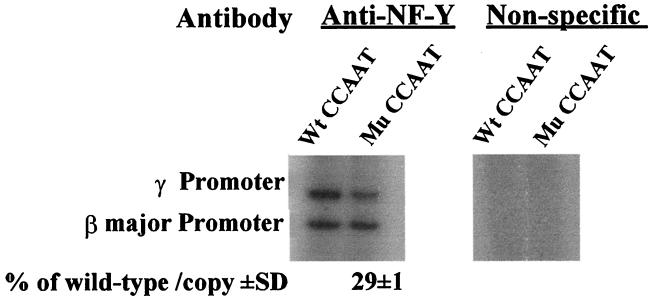
The CCAAT-to-GATCT mutation of the duplicated CCAAT box severely disrupts the recruitment of NF-Y to the γ gene promoter in stably transfected MEL cells. MEL cells stably transfected with either μLCR(−382)Aγ (wild type) or the μLCR(−382)Aγ(mCCAAT) construct were subjected to ChIP assays (as described in Materials and Methods). MEL cell pool 4 of Table 2, which contains the CCAAT box-mutated construct, was used. The recruitment level of NF-Y to the transfected γ gene promoter was assessed by duplex PCR in which the recruitment of NF-Y to the endogenous β major promoter was used as the internal control. The relative recruitment level of NF-Y to the mutated γ promoter was expressed as a percentage of its recruitment level of the wild-type γ promoter, which was calculated by the formula (γm-ChIP/γm-copy) / (γw-ChIP/γw-copy) × (βw-ChIP/βm-ChIP), where γm-ChIP is the intensity of the anti-NF-Y ChIP band of the mutant γ promoter, γm-copy is the copy number of the mutant γ promoter in the MEL cell pool, γw is the wild-type γ promoter, and βw-ChIP and βm-ChIP are the intensities of the anti-NF-Y ChIP band of the endogenous βmajor promoter of the MEL cell pool containing the wild-type or the CCAAT-box mutated γ construct, respectively. Non-specific antibody (normal IgG) was used as the negative control and for background determination. The mean value (percentage of wild type/copy ± standard deviation [SD]) of three independent experiments is shown.
FIG. 5
FIG. 5
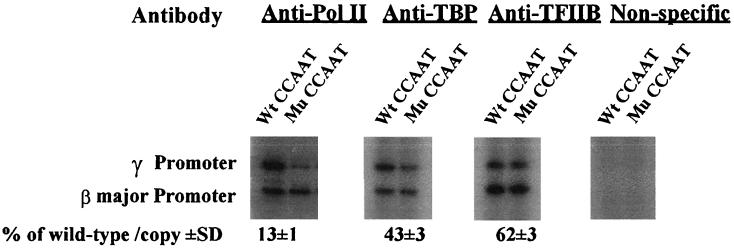
The CCAAT-to-GATCT mutation of the duplicated CCAAT box reduces the recruitment of the basal transcription machinery to the γ gene promoter in stably transfected MEL cells. MEL cell pool 4 of Table 2 was subjected to ChIP assays with antibodies against RNA Pol II, TFIID (TBP), and TFIIB. The relative recruitment level of a factor to the CCAAT box-mutated γ promoter was expressed as a percentage of its recruitment level to the wild-type γ promoter and was calculated as described in the legend of Fig. 4. The mean values (percentage of wild type/copy ± standard deviation [SD]) of three independent experiments are shown.
FIG. 6
FIG. 6
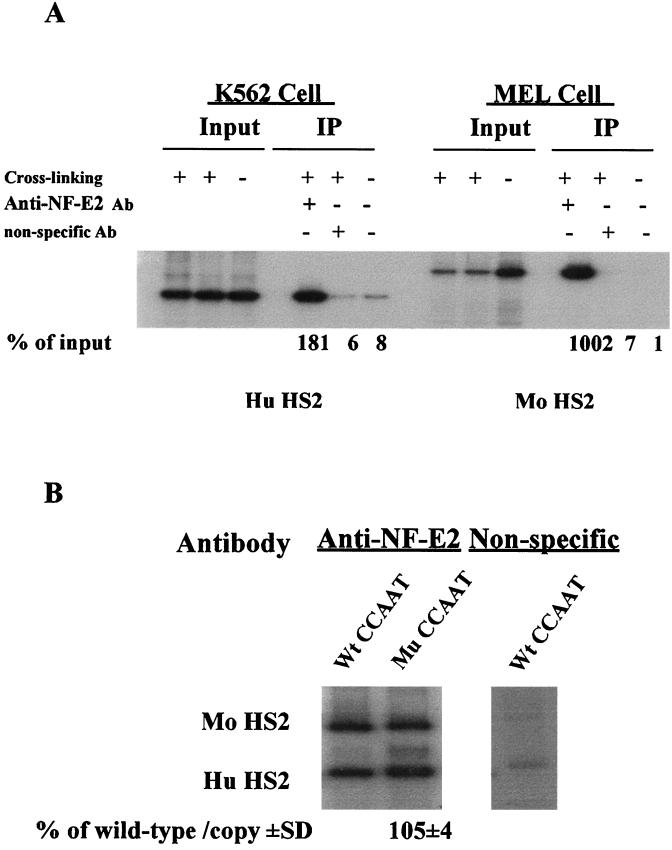
In vivo binding of NF-E2 to HS2 of the endogenous LCR and the μLCR of the mutant CCAAT construct. (A) In vivo recruitment of NF-E2 to the HS2 core region of the endogenous LCR in K562 and MEL cells. ChIP assays were performed using NF-E2/p45-specific antibody as described in Materials and Methods and in the legend to Fig. 2. The level of the immunoprecipitated (IP) DNA was expressed as a percentage of the corresponding input DNA. (B) The CCAAT box mutation does not affect the binding of NF-E2 to the HS2 core region of the transfected μLCR in stably transfected MEL cells. MEL cell pool 4 of Table 2 was subjected to ChIP assays with antibodies against NF-E2/p45. The relative recruitment level of NF-E2 to the μLCR HS2 core region of the CCAAT box-mutated γ construct was expressed as percentage of the recruitment level to the μLCR HS2 core region of the wild-type γ construct. The recruitment of NF-E2 to the HS2 core region of the endogenous mouse LCR was used as an internal control. The relative recruitment level was calculated as described in the legend to Fig. 4. The mean value (percentage of wild type/copy ± standard deviation [SD]) of three independent experiments is shown.
FIG. 7
FIG. 7
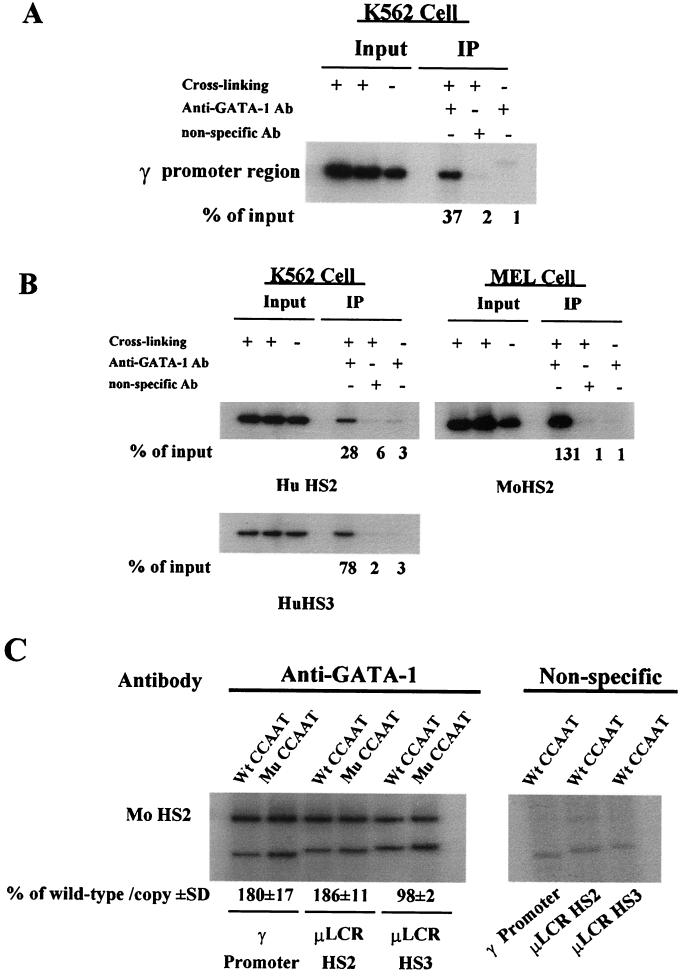
In vivo binding of GATA-1 to the γ gene promoter and to the core regions of HS2 and HS3 of the endogenous and transfected LCR. ChIP assays were performed with GATA-1-specific antibody. (A) Recruitment of GATA-1 to the endogenous γ gene promoter of K562 cells. (B) Recruitment of GATA-1 to the HS2 and HS3 core regions of the endogenous LCR of K562 cells and to the HS2 core region of MEL cells. (C) The mutation of the duplicated CCAAT box significantly increases the recruitment of GATA-1 to the μLCR HS2 core region and the γ gene promoter but does not affect the recruitment of GATA-1 to the μLCR HS3 core region. MEL cell pool 4 of Table 2 was used. The relative recruitment levels were calculated as described in the legend to Fig. 4. The recruitment of GATA-1 to the HS2 core region of the endogenous mouse LCR was used as an internal control. The mean values (percentage of wild type/copy ± standard deviation [SD]) of three independent experiments are shown.
FIG. 8
FIG. 8
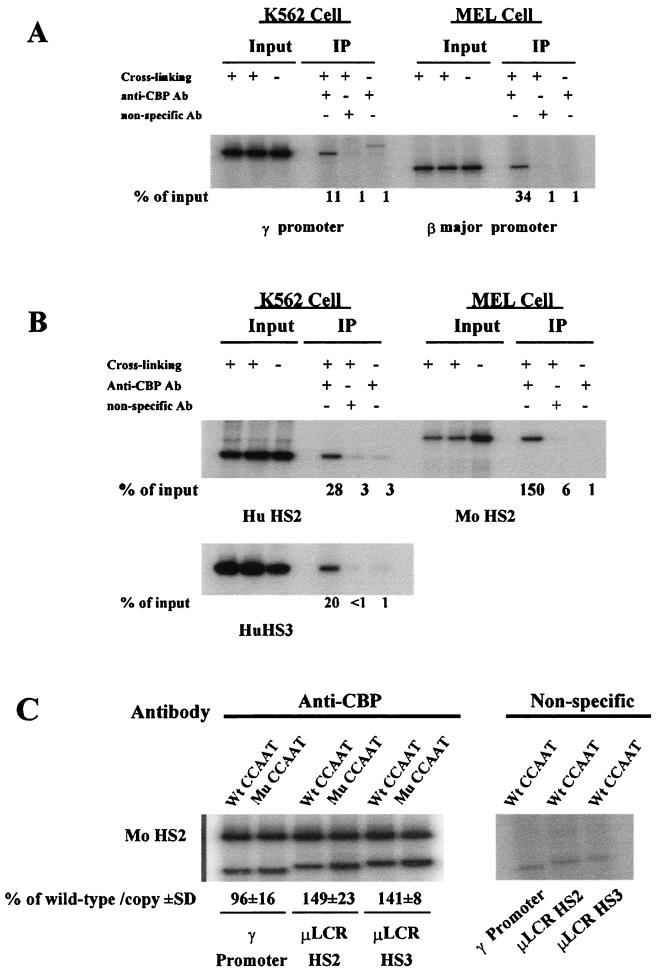
Recruitment of CBP/p300 to the γ and β gene promoters and to the core regions of HS2 and HS3 of the endogenous and transfected LCR. (A) Recruitment of CBP/p300 to the endogenous γ gene promoter region of K562 cells and the β major gene promoter of MEL cells. (B) Recruitment of CBP/p300 to the HS2 and HS3 core region of the endogenous LCR of K562 cells and to the HS2 core region of MEL cells. (C) The mutation of the duplicated CCAAT box does not apparently affect the recruitment of CBP/p300 to the γ gene promoter region but significantly increases the recruitment of CBP/p300 to the HS2 and HS3 core region of the μLCR in stably transfected MEL cells. MEL cell pool 4 of Table 2 was used. The relative recruitment levels were calculated as described in the legend to Fig. 4. The recruitment of CBP/p300 to the HS2 core region of the endogenous mouse LCR was used as an internal control. The mean values (percentage of wild type/copy ± standard deviation [SD]) of three independent experiments are shown.

References

    1. Armstrong J A, Bieker J J, Emerson B M. A SWI/SNF-related chromatin remodeling complex, E-RC1, is required for tissue-specific transcriptional regulation by EKLF in vitro. Cell. 1998;95:93–104. - PubMed
    1. Bellorini M, Lee D K, Dantonel J C, Zemzoumi K, Roeder R G, Tora L, Mantovani R. CCAAT binding NF-Y-TBP interactions: NF-YB and NF-YC require short domains adjacent to their histone fold motifs for association with TBP basic residues. Nucleic Acids Res. 1997;25:2174–2181. - PMC - PubMed
    1. Berry M, Grosveld F, Dillon N. A single point mutation is the cause of the Greek form of hereditary persistence of fetal haemoglobin. Nature. 1992;358:499–502. - PubMed
    1. Blobel G A. CREB-binding protein and p300: molecular integrators of hematopoietic transcription. Blood. 2000;95:745–755. - PubMed
    1. Bulger M, Goudine M. Looping versus linking: toward a model for long-distance gene activation. Genes Dev. 1999;13:2465–2477. - PubMed

Publication types

LinkOut - more resources