. 2001 May;21(9):3234-43.
doi: 10.1128/MCB.21.9.3234-3243.2001.

Hepatic nuclear factor 1-alpha directs nucleosomal hyperacetylation to its tissue-specific transcriptional targets

Affiliations

Hepatic nuclear factor 1-alpha directs nucleosomal hyperacetylation to its tissue-specific transcriptional targets

M Párrizas et al. Mol Cell Biol. 2001 May.

Abstract

Mutations in the gene encoding hepatic nuclear factor 1-alpha (HNF1-alpha) cause a subtype of human diabetes resulting from selective pancreatic beta-cell dysfunction. We have analyzed mice lacking HNF1-alpha to study how this protein controls beta-cell-specific transcription in vivo. We show that HNF1-alpha is essential for the expression of glut2 glucose transporter and L-type pyruvate kinase (pklr) genes in pancreatic insulin-producing cells, whereas in liver, kidney, or duodenum tissue, glut2 and pklr expression is maintained in the absence of HNF1-alpha. HNF1-alpha nevertheless occupies the endogenous glut2 and pklr promoters in both pancreatic islet and liver cells. However, it is indispensable for hyperacetylation of histones in glut2 and pklr promoter nucleosomes in pancreatic islets but not in liver cells, where glut2 and pklr chromatin remains hyperacetylated in the absence of HNF1-alpha. In contrast, the phenylalanine hydroxylase promoter requires HNF1-alpha for transcriptional activity and localized histone hyperacetylation only in liver tissue. Thus, different HNF1-alpha target genes have distinct requirements for HNF1-alpha in either pancreatic beta-cells or liver cells. The results indicate that HNF1-alpha occupies target gene promoters in diverse tissues but plays an obligate role in transcriptional activation only in cellular- and promoter-specific contexts in which it is required to recruit histone acetylase activity. These findings provide genetic evidence based on a live mammalian system to establish that a single activator can be essential to direct nucleosomal hyperacetylation to transcriptional targets.


Figures
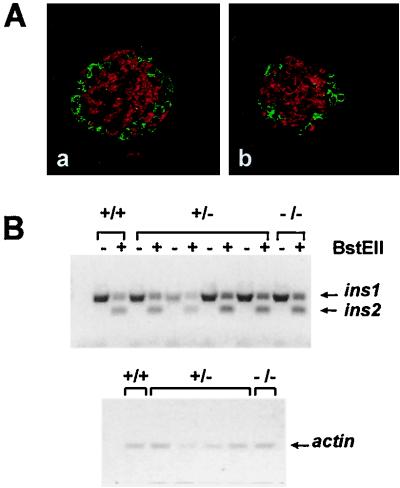
FIG. 1
FIG. 1
Microscopic islet structure and insulin mRNA content are not altered in pancreas tissue of hnf1−/− mice. (A) Representative paraffin-embedded pancreatic sections from 2-week-old control (a) and hnf1−/− (b) mice, immunostained with anti-insulin (red) and anti-glucagon (green) antisera. (B) Semiquantitative RT-PCR analysis of insulin mRNA levels in freshly isolated islets of 4-week-old control (+/+ and +/−) and hnf1−/− mice. Primers with full homology to the two mouse insulin genes were used for PCR. The two amplification products were distinguished by selective restriction of the insulin II gene with BstEII (upper panel). Insulin I and II mRNA content of hnf1−/− islets was not different from that of control islets. The same samples were simultaneously analyzed by RT-PCR for β-actin as a control for RNA loading (lower panel). PCRs were carried out at different numbers of cycles to ensure lineal amplification rates (not shown). These results are from a representative experiment from the analysis of four HNF1-α null mice, which yielded analogous results.
FIG. 2
FIG. 2
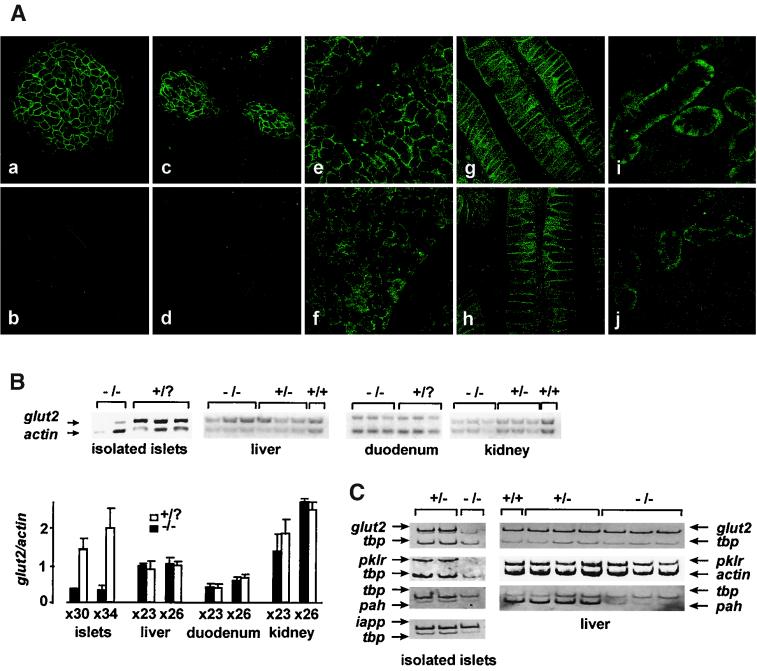
HNF1-α is essential for glut2 expression in differentiated β-cells but not other tissues. (A) Paraffin-embedded sections were immunostained with glut2 antiserum (green) and costained with insulin to identify β-cells (not shown). Pancreatic glut2 expression was readily apparent and restricted to β-cells in 2-week-old wild-type mice (a) but was absent in hnf1−/− mice (b). HNF1-α dependence of glut2 expression is already apparent in prenatal pancreas at E20 (c and d). However, no significant decrease in glut2 expression was detected in null mouse liver (f), duodenum (h), and kidney (j) tissues as compared with their respective wild-type controls (e, g, and i). (B) glut2 mRNA content was analyzed by semiquantitative multiplex RT-PCR from tissues of 4-week-old mice. Coamplification of actin and glut2 shows a marked decrease in glut2 mRNA content in hnf1−/− mouse purified islets but not in liver, duodenum, and kidney tissues (upper panel). The bar chart below shows a densitometric analysis comprising the results of two independent experiments. The experiment was performed at two different cycle numbers (23 and 26, or 30 and 36, as indicated under the bar graph) to ensure similar amplification rates for both products. (C) The fall of glut2 expression in islets parallels that of pklr and mirrors the loss of pah expression in liver tissue. Semiquantitative multiplex RT-PCR analysis was performed as described above for isolated islets and liver tissue from wild-type and hnf1-α-null mice. Coamplification with tbp as an internal control shows that both glut2 and pklr mRNA levels were decreased in hnf1−/− islets but were unaffected in liver tissue. pah showed a marked reduction of expression in liver tissue but no major decrease in islets from mutant mice. Islet amyloid polypeptide (iapp) mRNA levels were unaffected in hnf1−/− islets, indicating a comparable islet purity of the different samples.
FIG. 3
FIG. 3
Loss of glut2 is not associated with decreased expression of pdx1. (A) Paraffin-embedded pancreatic sections immunostained with anti-pdx1 (green color, a and b) antiserum do not display differences among hnf1−/− (b) and control (a) 2-week-old mice. Samples were coimmunostained for insulin to detect β-cells (shown in red). (B) Semiquantitative multiplex RT-PCR analysis was performed for freshly isolated islets to compare the mRNA levels of pdx1 in three wild-type and three null mice. Results were analyzed by densitometry, yielding pdx1/β-actin ratio values of 0.60 ± 0.1 versus 051 ± 0.07 arbitrary units (not significant).
FIG. 4
FIG. 4
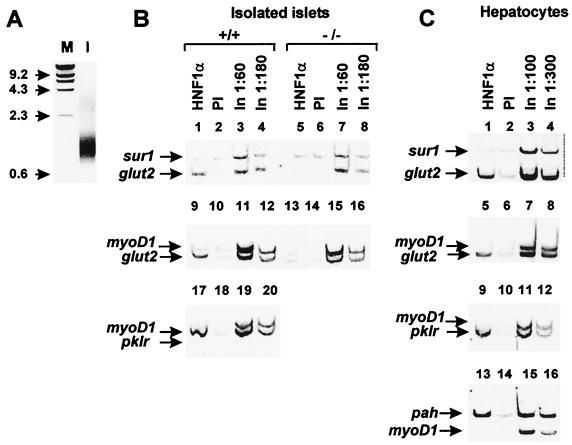
HNF1-α contacts the endogenous glut2 and pklr promoters in both pancreatic islets and hepatocytes in vivo. (A) Ethidium bromide-stained agarose gel indicating a representative example of sonicated DNA. M, molecular weight markers; I, sonicated islet DNA. (B and C) One hundred freshly isolated wild-type pancreatic islets or 3 × 10⁵ hepatocytes were fixed with formaldehyde and immunoprecipitated using either anti-HNF1-α antibody or nonimmune serum. The precipitated samples were analyzed by duplex PCR using primers for the glut2, pklr, or pah promoter together with either the sur1 or myoD1 promoter as negative control. The HNF1-α immunoprecipitated sample is selectively enriched in glut2 promoter chromatin in wild-type but not hnf1−/− islets (lanes 1 and 5 and 9 and 13, panel B). HNF1-α also contacts glut2 promoter chromatin in hepatocytes (lane 1, panel C). The pklr exon 1 sequence is similarly enriched in HNF1-α immunoprecipitated from both islets and liver cells (lane 17, panel B, and lane 5, panel C). The pah promoter is occupied by HNF1-α in hepatocytes (lane 13, panel C). Only trace amounts of these promoter fragments were precipitated with preimmune serum (PI). Diluted input DNA (In) samples were assayed in parallel to illustrate the amplification profile when all promoter fragments are present in equimolar amounts. The data shown here represent at least two PCR amplification assays from two independent immunoprecipitations for islets and three for hepatocytes, yielding essentially identical results.
FIG. 5
FIG. 5
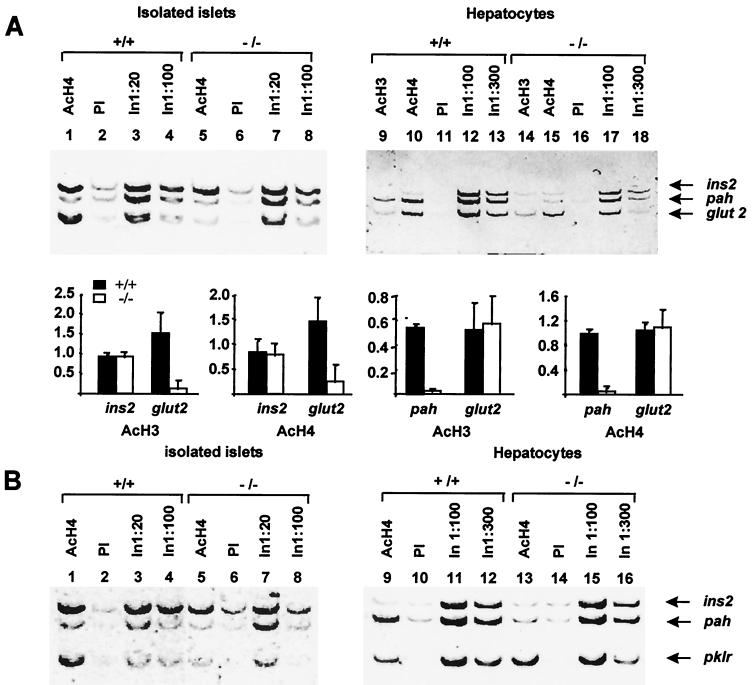
HNF1-α is essential for nucleosomal hyperacetylation of its tissue-specific transcriptional targets. Chromatin immunoprecipitation assays using anti-acetylated histone H3 and H4 antibodies were performed with wild-type (+/+) and hnf1−/− pancreatic islets and hepatocytes. The precipitated samples were analyzed by multiplex PCR using primers for the insulin (ins2), pah, pklr, and glut2 promoters. (A) Anti-acetylated histone H4 selectively precipitated ins2 and glut2 promoter DNA but not pah DNA in islets from wild-type mice (lane 1). In hnf1−/− islets anti-histone H4 immunoprecipitate was depleted of glut2 DNA with no major changes in ins2 and pah (lane 5). Wild-type hepatocytes showed high levels of histone H3 and H4 acetylation of pah and glut2 promoter chromatin but not of the insulin II promoter (lanes 9 and 10). In liver from mice lacking hnf1-α, pah chromatin was hypoacetylated while glut2 acetylation was unaffected (lanes 14 and 15). PI, preimmune serum; In, input DNA. The bar chart shows the densitometric analysis of the chromatin immunoprecipitation experiments described. Values for each promoter are densitometry results of PCR products expressed as the following equation: (immune serum − PI)/input DNA. (B) Anti-acetylated histone H4 selectively precipitated pklr chromatin in islets of wild-type but not hnf1−/− mice (lane 1 versus lane 5). In contrast, pklr chromatin remained acetylated in liver tissue in the absence of HNF1-α (lane 9 versus lane 13). The data represent two to three independent immunoprecipitations with at least two PCR experiments from each, yielding essentially identical results, except for anti-AcH3 and pklr in islets, which represent two PCRs from a single immunoprecipitation.

References

    1. Ahlgren U, Jonsson J, Jonsson L, Simu K, Edlund H. Beta-cell-specific inactivation of the mouse Ipf1/Pdx1 gene results in loss of the beta-cell phenotype and maturity onset diabetes. Genes Dev. 1998;12:1763–1768. - PMC - PubMed
    1. Berry M N, Friend D S. High yield preparation of isolated rat liver parenchymal cells: a biochemical and fine structural study. J Cell Biol. 1969;43:506–520. - PMC - PubMed
    1. Beutler E, Baronciani L. Mutations in pyruvate kinase. Hum Mutat. 1996;7:1–6. - PubMed
    1. Blumenfeld M, Maury M, Chouard T, Yaniv M, Condamine H. Hepatic nuclear factor 1 (HNF1) shows a wider distribution than products of its known target genes in developing mouse. Development. 1991;113:589–599. - PubMed
    1. Boyd K E, Farnham P J. Coexamination of site-specific transcription factor binding and promoter activity in living cells. Mol Cell Biol. 1999;19:8393–8399. - PMC - PubMed

Publication types

MeSH terms