. 2001 Apr 24;98(9):5234-9.
doi: 10.1073/pnas.061386098. Epub 2001 Apr 3.

Fit genotypes and escape variants of subgroup III Neisseria meningitidis during three pandemics of epidemic meningitis

Affiliations

Fit genotypes and escape variants of subgroup III Neisseria meningitidis during three pandemics of epidemic meningitis

P Zhu et al. Proc Natl Acad Sci U S A. .

Abstract

The genetic variability at six polymorphic loci was examined within a global collection of 502 isolates of subgroup III, serogroup A Neisseria meningitidis. Nine "genoclouds" were identified, consisting of genotypes that were isolated repeatedly plus 48 descendent genotypes that were isolated rarely. These genoclouds have caused three pandemic waves of disease since the mid-1960s, the most recent of which was imported from East Asia to Europe and Africa in the mid-1990s. Many of the genotypes are escape variants, resulting from positive selection that we attribute to herd immunity. Despite positive selection, most escape variants are less fit than their parents and are lost because of competition and bottlenecks during spread from country to country. Competition between fit genotypes results in dramatic changes in population composition over short time periods.


Figures
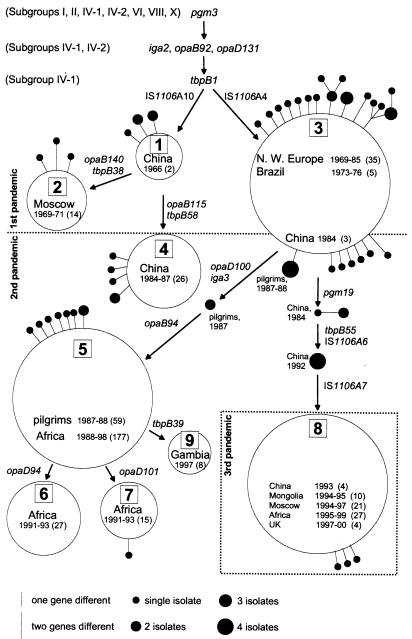
Figure 1
Figure 1
Parsimonious relationships among 57 genotypes in nine genoclouds of subgroup III. Large boxed numbers from 1 to 9 indicate the genocloud designations. Alleles inherited from common ancestors with other serogroup A subgroups are shown at the top, and subsequent changes are shown next to the arrows that indicate lines of descent. Numbers in parentheses indicate numbers of isolates of the frequent genotypes, which are also reflected to a limited extent by the sizes of the circles. Rare genotypes were parsimoniously grouped in genoclouds after consideration of genetic relationships, sources, and dates of isolation. They are indicated by filled dots whose sizes indicate the numbers of isolates. The lengths of the lines connecting the dots to the genocloud circles indicate the numbers of genetic changes from the frequent genotype. Intermediate strains that were not assigned to genoclouds are shown along the arrows leading from genocloud 3.
Figure 2
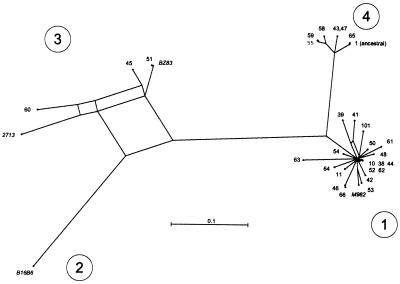
Figure 2
Splits graph (uncorrected Hamming distances) of relationships of ≈660-bp tbpB fragments. Large circled numbers indicate the allele families. The smaller numbers are tbpB allele numbers. tbpB1 is the ancestral allele in subgroups III and IV-1. tbp10 and tbp11 were previously found in subgroup IV-1 and commensal neisseriae, and tbpB101 was found in N. lactamica (13). tbpB38 through tbpB66 have been found only in subgroup III. Sequences from reference strains of N. meningitidis for families 1–3 (B16B6, 2713, BZ83, and M982) are italicized.
Figure 3
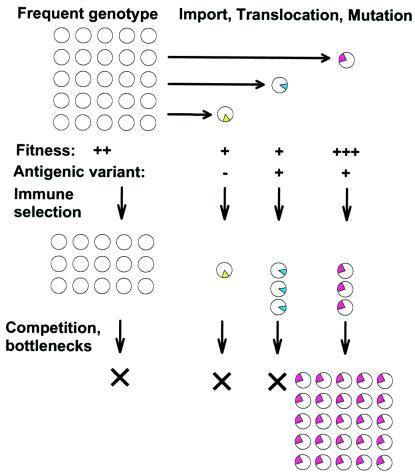
Figure 3
A model for the formation of rare genotypes and novel genoclouds. Rare genotypes arise by a variety of mechanisms, including import of DNA from unrelated bacteria, translocation of opa alleles, and single step mutations. Those variants that affect antigens and result in immune escape will multiply preferentially because of selection pressures by the host immune system. However, many of these variants also result in lessened fitness and are eliminated by competition and bottlenecks during spread from host to host and country to country. On rare occasions, antigenic variants with increased fitness can form new genoclouds and repeat the cycle.

References

    1. Vieusseux M. J Med Chirurg Pharm. 1806;11:163–182.
    1. Lapeyssonnie L. Bull W H O. 1963;28,Suppl.:53–114.
    1. Caugant D A. Acta Pathol Microbiol Immunol Scand. 1998;106:505–525. - PubMed
    1. Achtman M. Rev Med Microbiol. 1990;1:29–38.
    1. Wang J-F, Caugant D A, Li X, Hu X, Poolman J T, Crowe B A, Achtman M. Infect Immun. 1992;60:5267–5282. - PMC - PubMed

Publication types

MeSH terms

Associated data

LinkOut - more resources