. 2001 Apr 10;98(8):4409-13.
doi: 10.1073/pnas.071024998. Epub 2001 Apr 3.

Structure and function of the C-terminal PABC domain of human poly(A)-binding protein

Affiliations

Structure and function of the C-terminal PABC domain of human poly(A)-binding protein

G Kozlov et al. Proc Natl Acad Sci U S A. .

Abstract

We have determined the solution structure of the C-terminal quarter of human poly(A)-binding protein (hPABP). The protein fragment contains a protein domain, PABC [for poly(A)-binding protein C-terminal domain], which is also found associated with the HECT family of ubiquitin ligases. By using peptides derived from PABP interacting protein (Paip) 1, Paip2, and eRF3, we show that PABC functions as a peptide binding domain. We use chemical shift perturbation analysis to identify the peptide binding site in PABC and the major elements involved in peptide recognition. From comparative sequence analysis of PABC-binding peptides, we formulate a preliminary PABC consensus sequence and identify human ataxin-2, the protein responsible for type 2 spinocerebellar ataxia (SCA2), as a potential PABC ligand.


Figures

Figure 1
Figure 1
Amino acid sequences of PABC domains and ligands. (A) Sequence alignment of PABC domains from human PABP (h, Homo sapiens), fly PABP (d, Drosophila melanogaster), wheat PABP (w, Triticum aestivum), yeast PABP (y, Saccharomyces cerevisiae), and the rat (Rattus norvegicus) 100-kDa HECT E3 ubiquitin-protein ligase (100KD). The secondary structure and residue numbering are based on hPABP. Highly conserved residues are shown bold and underlined. (B) Sequence alignment of four PABC-binding peptides and the deduced consensus sequence. Peptides were derived from human Paip2, human Paip1, and human release factor RF3. Residues common to all four sequences are shown in red. (C) Putative PABC-sites in ataxin-2, an ataxin-2-related protein from Arabidopsis (MDC16.14), and two plant RRM-containing proteins (aF6N18.17, oRNA-BP). Numbers indicate the total number of amino acids in the protein and the first amino acid shown in the alignment.
Figure 2
Figure 2
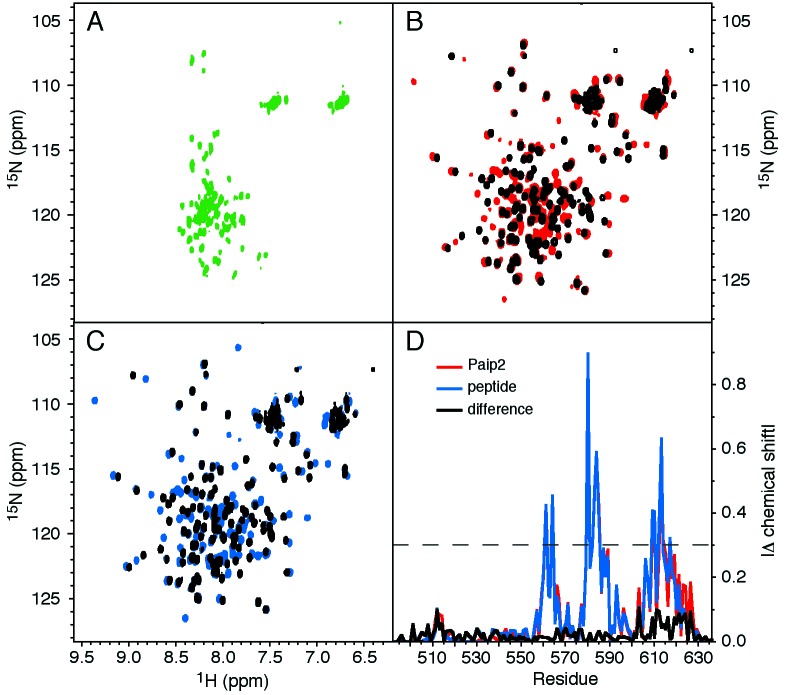
Paip2 binding to PABC. (A) 15N–1H correlation (heteronuclear single quantum correlation) spectra of 15N-labeled Paip2 showing the small chemical dispersion characteristic of an unfolded protein. (B) Spectra of 15N-labeled hPABP (498 to 636) in the absence (black) and presence (red) of unlabeled Paip2. (C) Spectra of 15N-labeled hPABP in the absence (black) and presence (blue) of a peptide corresponding to residues 106–127 of Paip2. (D) Magnitude of the chemical shift changes (|Δδ|) in ppm of hPABP plotted by residue (red, intact Paip2; blue, Paip2 peptide; and black, difference between Paip2 and peptide). The dashed line indicates the cutoff for residues shown in Fig. 3D.
Figure 3
Figure 3
Structure of the PABC domain and peptide-binding site. (A) Cα trace of hPABP (residues 498 to 636) colored according to residue flexibility (blue, 15N–1H heteronuclear NOE > 0.5; white, hNOE = 0; red, hNOE < −0.5). (B) Cα trace colored according to phylogenetic conservation (magenta, >80% identity; white, ≈50%; red, <20%) in a blast alignment of 40 unique PABC sequences (24). (C) Cα trace colored according the size of the amide chemical shift change (|Δδ|) on Paip2 binding (green, |Δδ| > 0.6; white, |Δδ| ≈ 0.35; red, |Δδ| < 0.1). Amide resonances for K35, V68, and M39 showed the largest changes. (D) Structure of the PABC domain. Thirty superimposed structures are shown with backbone rms deviation of 0.48 Å. Green balls represent amide groups whose chemical shifts change by more than 0.3 ppm. Ball diameter is proportional to the chemical shift change. Sidechains of the hydrophobic core of PABC are represented in light blue. (E) Secondary structure of PABC. The five helices are colored according to Fig. 1A. The conserved salt bridge between the sidechains of K35 and E42 is shown. (F) Molecular surface of PABC within 5 Å of residues with |Δδ| > 0.42. The deep hydrophobic cavity directly contacts the backbone amide of K35. Stacking by F22 could stabilize the binding of an aromatic ring in the pocket. Figures were generated with molscript (27), grasp (28), and render (29).
Figure 4
Figure 4
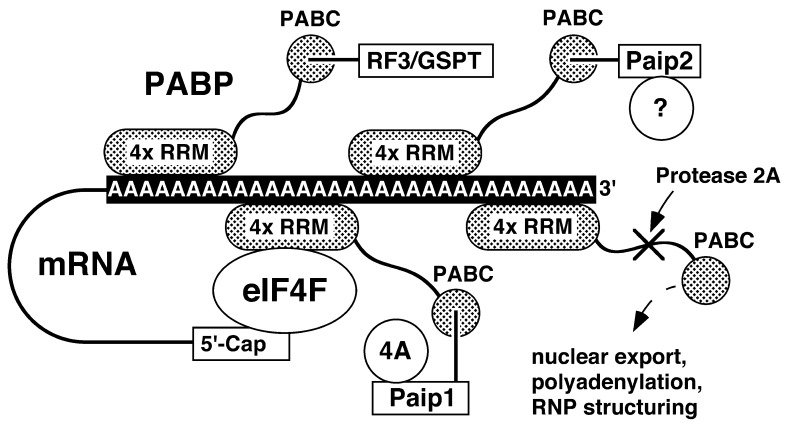
Model of the interactions identified and proposed for PABC. PABP consists of an N-terminal section of four RRMs linked by a long unfolded region to PABC. Multiple PABP molecules (shown in gray) bind to the poly(A) tail via their RRM domains to form an RNA protein (RNP) complex. Cyclization of the mRNA occurs through binding of eIF4F and the mRNA 5′ cap to the RRM domains of PABP. The PABC domain of PABP binds linear peptide sequences to recruit protein factors to the mRNA RNP complex. Known binding partners include Paip1, Paip2, and eRF3 (GSPT), which themselves act as linkers to recruit eIF4A (4A) and possibly other protein factors (?) to the mRNA (3, 25). The C terminus of PABP has also been reported to be involved in PABP dimerization (11), nuclear shuttling (12), mRNA stability (30), and polyadenylation (ref. ; dashed lines). Picornaviral protease 2 cleaves both eIF4F (not shown) and the linker region of PABP to shut off host cell protein synthesis (31, 32). A potyviral RNA-dependent RNA polymerase has also been shown to bind PABC from cucumber PABP (14).

Comment in

  • Delivering messages from the 3' end.
    Varani G. Varani G. Proc Natl Acad Sci U S A. 2001 Apr 10;98(8):4288-9. doi: 10.1073/pnas.091108098. Proc Natl Acad Sci U S A. 2001. PMID: 11296278 Free PMC article. No abstract available.

References

    1. Tarun S Z, Jr, Sachs A B. EMBO J. 1996;15:7168–7177. - PMC - PubMed
    1. Jacobson A. In: Translational Control. Hershey J W B, Mathews M B, Sonenberg N, editors. Plainview, NY: Cold Spring Harbor Lab. Press; 1996. pp. 451–480.
    1. Craig A W, Haghighat A, Yu A T, Sonenberg N. Nature (London) 1998;392:520–523. - PubMed
    1. Khaleghpour K. Ph.D. thesis. Montreal: McGill University; 2000. p. 200.
    1. Hoshino S, Imai M, Kobayashi T, Uchida N, Katada T. J Biol Chem. 1999;274:16677–16680. - PubMed

Publication types

Substances

Associated data