. 2001 Apr 10;98(8):4782-7.
doi: 10.1073/pnas.081594298. Epub 2001 Apr 3.

A postgermination developmental arrest checkpoint is mediated by abscisic acid and requires the ABI5 transcription factor in Arabidopsis

Affiliations

A postgermination developmental arrest checkpoint is mediated by abscisic acid and requires the ABI5 transcription factor in Arabidopsis

L Lopez-Molina et al. Proc Natl Acad Sci U S A. .

Abstract

Seed dormancy is a trait of considerable adaptive significance because it maximizes seedling survival by preventing premature germination under unfavorable conditions. Understanding how seeds break dormancy and initiate growth is also of great agricultural and biotechnological interest. Abscisic acid (ABA) plays primary regulatory roles in the initiation and maintenance of seed dormancy. Here we report that the basic leucine zipper transcription factor ABI5 confers an enhanced response to exogenous ABA during germination, and seedling establishment, as well as subsequent vegetative growth. These responses correlate with total ABI5 levels. We show that ABI5 expression defines a narrow developmental window following germination, during which plants monitor the environmental osmotic status before initiating vegetative growth. ABI5 is necessary to maintain germinated embryos in a quiescent state thereby protecting plants from drought. As expected for a key player in ABA-triggered processes, ABI5 protein accumulation, phosphorylation, stability, and activity are highly regulated by ABA during germination and early seedling growth.


Figures
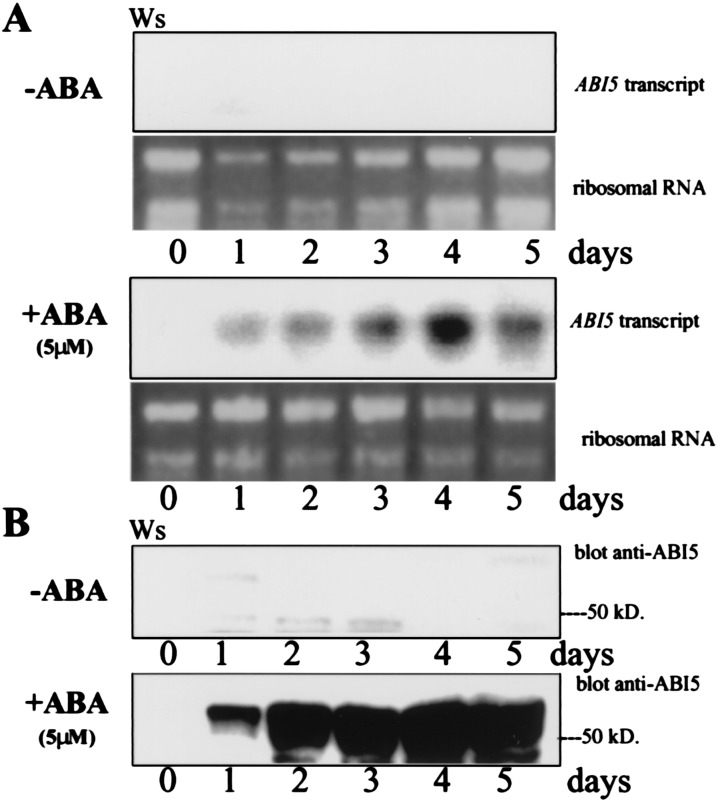
Figure 1
Figure 1
ABI5 protein and transcript accumulation is highly regulated by ABA. WT Ws seeds were kept in darkness at 4°C for 3 days with or without ABA (5 μM) and then transferred to constant light at 22°C for 1, 2, 3, 4, and 5 days (0 indicates the time immediately following transfer). Total protein and RNA were isolated. (A) Northern blot analyses. Each lane contained 3 μg total RNA. (B) Western blot analyses using antibodies to ABI5. Each lane contained 10 μg protein.
Figure 2
Figure 2
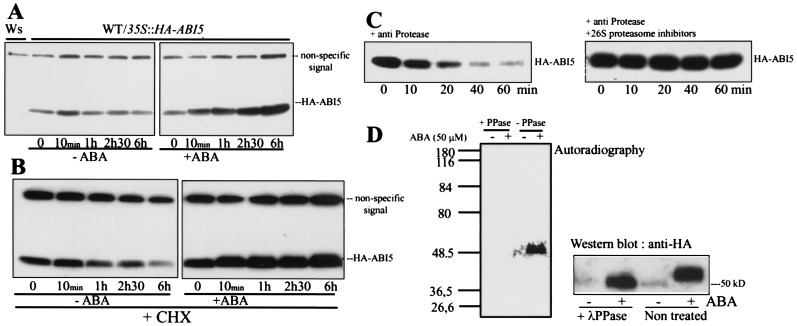
ABA stabilizes ABI5 protein. (A) Eight-day-old Ws/35SHA-ABI5 seedlings (T3 generation) transferred to MS medium with or without 50 μM ABA. Proteins were extracted at the time points indicated and ABI5 protein levels were monitored by Western blot analysis using antibodies to HA. Each lane contained 5 μg protein. (B) Eight-day-old Ws/35SHA-ABI5 seedlings were incubated in liquid MS medium supplemented with 100 μM cycloheximide for 15 h. After the treatment, 50 μM ABA was added to the medium and proteins were extracted at the times indicated. Equal amounts (5 μg) of protein were loaded on a 10% SDS/polyacrylamide (NOVEX) gel and analyzed by Western blot using an anti-HA antibody. (C) Extracts prepared from 8-day-old Ws/35SHA-ABI5 seedlings were treated with a mixture of anti-protease (complete Mini from Amersham Pharmacia) supplemented with 1 mM PMSF with or without proteasome inhibitors ALLN, MG115, MG132, and PS1 (10 μM each, Calbiochem), as described in Materials and Methods. An equal volume of SDS-loading buffer was added to stop the reactions. Equal amounts of sample were then analyzed by Western blots using rabbit antibody to HA. (D) Eight-day-old Ws/35SHA-ABI5 transgenic seedlings were treated in liquid MS medium with [32P]orthophosphoric acid (100 μCi) for 1 h 30 min. Seedlings were further treated with or without 50 μM ABA for 30 min. HA-ABI5 was immunoprecipitated by using rabbit antibody to HA coupled to beads. Beads were further treated with or without γ phosphatase. 90% of the sample was then analyzed by PhosphorImager (Bio-Rad); 10% of the sample was analyzed by Western blot using mouse monoclonal antibody to HA (Santa Cruz Biotechnology) as the first antibody.
Figure 3
Figure 3
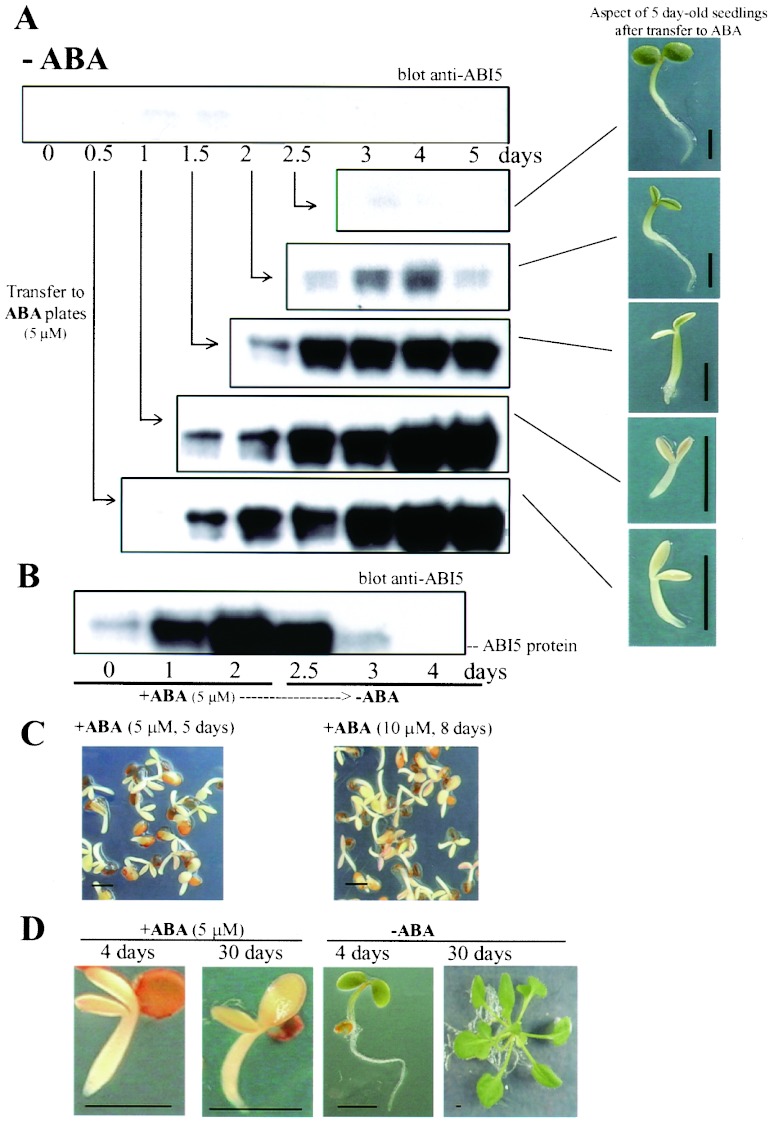
ABA regulates ABI5 accumulation within a narrow developmental window. (A) WT Ws seeds were kept in darkness at 4°C for 3 days without ABA and then transferred to 5 μM ABA plates at the indicated times poststratification. ABI5 levels were monitored by Western blot analysis. Photographs depict representative seedlings 5 days after the different treatments. (Scale bar, 0.5 mm.) (B) ABI5 protein level rapidly decreased on ABA removal. WT Ws seeds treated with ABA (5 μM) as described in Fig. 1B were transferred to plates without ABA, 2 days poststratification. ABI5 levels were monitored by Western blot analyses as described in Fig. 1. (C) WT Ws seeds eventually germinated in the presence of ABA (5 and 10 μM). (Scale bar, 0.5 mm.) (D) WT Ws seedlings 4 and 30 days poststratification in the presence or absence of ABA (5 μM). (Scale bar, 0.5 mm.)
Figure 4
Figure 4
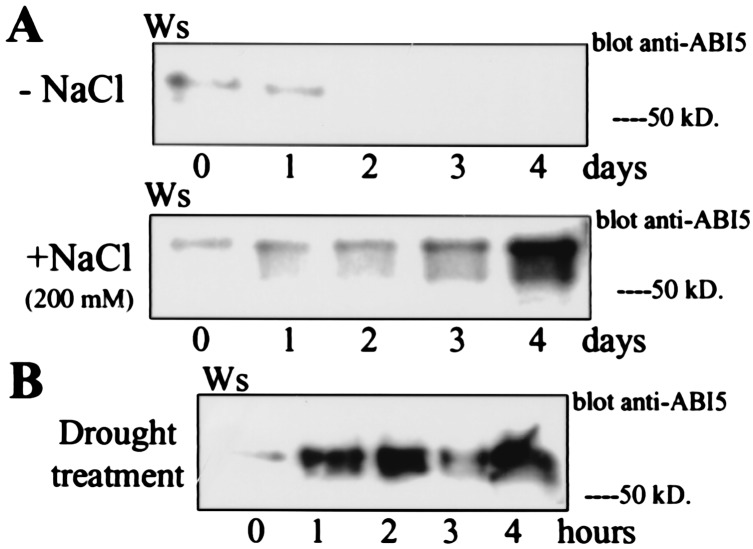
ABI5 protein accumulation is induced by salt and drought stress. (A) WT Ws seeds were kept in darkness at 4°C for 3 days with or without NaCl (200 mM) and then transferred to constant light at 22°C for 1, 2, 3, 4, and 5 days (0 indicates the time immediately following transfer). Western blot analyses using antibodies to ABI5 were performed as described in Fig. 1. (B) One-day-old seeds were transferred to absorbing paper for 1, 2, 3, and 4 h. Western blot analyses using antibodies to ABI5 were further performed as described in Fig. 1.
Figure 5
Figure 5
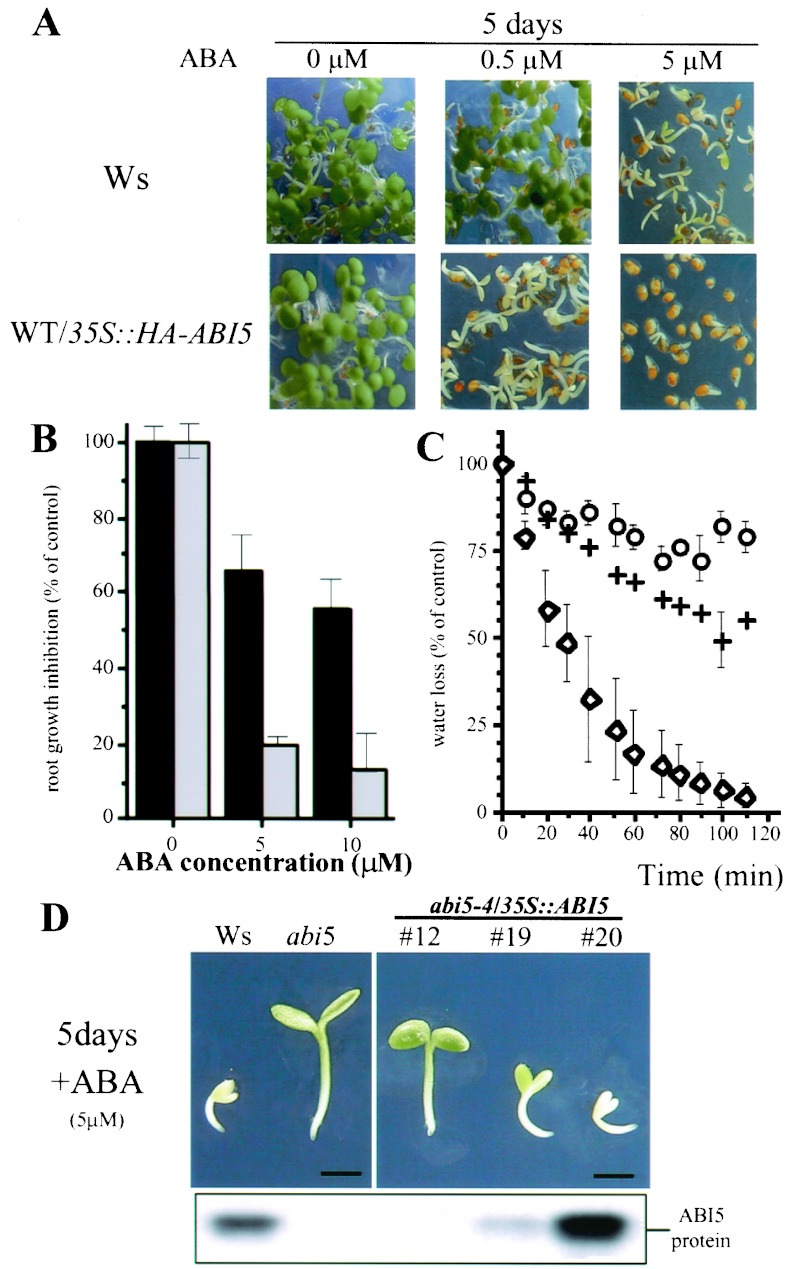
Transgenic plants overexpressing ABI5 are hypersensitive to ABA. (A) WT Ws and Ws/35SHA-ABI5 transgenic plants were grown for 5 days with 0, 0.5, and 5 μM ABA. Transgenic seeds were arrested in development at 0.5 μM ABA and only started to geminate after 5 days. WT Ws seeds were insensitive to 0.5 μM ABA and were fully germinated in 5 μM ABA after 5 days. (B) Inhibition of root growth by exogenous ABA is exacerbated in Ws/35SHA-ABI5 transgenic lines (dotted bars) as compared with WT Ws plants (black bars). Five-day-old seedlings grown in absence of ABA were transferred to 0, 5, and 10 μM ABA plates for 5 days. The root length of ABA-treated seedlings was expressed as a percentage of nontreated controls (n = 15). Bars indicate standard deviations. (C) Ws/35SHA-ABI5 (open circles) transgenic plants retained water more efficiently. Young rosette leaves from WT Ws control (crosses) and transgenic plants at the same developmental stage (one month) were excised and weighed at different times indicated (n = 3). abi1 measurements (lozenges) are included as a control for water loss. (D) Seeds from WT Ws, abi5-4 and 3 independent abi5-4 transgenic lines carrying a 35SHA-ABI5 transgene were treated with 5 μM ABA as described in Fig. 1. The picture depicts representative seedlings after 5 days. Western blots using anti-ABI5 antibodies were performed on the same plants. Each lane contained 5 μg protein.

References

    1. Himmelbach A, Iten M, Grill E. Philos Trans R Soc London B. 1998;353:1439–1444. - PMC - PubMed
    1. Kornneef M, Reuling G, Karssen C M. Physiol Plant. 1984;61:377–383.
    1. Finkelstein R R. Plant J. 1994;5:765–771.
    1. Lopez-Molina L, Chua N-H. Plant Cell Physiol. 2000;41:541–547. - PubMed
    1. Finkelstein R R, Lynch T J. Plant Cell. 2000;12:599–609. - PMC - PubMed

Publication types

MeSH terms