. 2001 May;69(5):3483-7.
doi: 10.1128/IAI.69.5.3483-3487.2001.

Enterotoxin plasmid from Clostridium perfringens is conjugative

Affiliations

Enterotoxin plasmid from Clostridium perfringens is conjugative

S Brynestad et al. Infect Immun. 2001 May.

Abstract

Clostridium perfringens enterotoxin is the major virulence factor involved in the pathogenesis of C. perfringens type A food poisoning and several non-food-borne human gastrointestinal illnesses. The enterotoxin gene, cpe, is located on the chromosome of food-poisoning isolates but is found on a large plasmid in non-food-borne gastrointestinal disease isolates and in veterinary isolates. To evaluate whether the cpe plasmid encodes its own conjugative transfer, a C. perfringens strain carrying pMRS4969, a plasmid in which a 0.4-kb segment internal to the cpe gene had been replaced by the chloramphenicol resistance gene catP, was used as a donor in matings with several cpe-negative C. perfringens isolates. Chloramphenicol resistance was transferred at frequencies ranging from 2.0 x 10(-2) to 4.6 x 10(-4) transconjugants per donor cell. The transconjugants were characterized by PCR, pulsed-field gel electrophoresis, and Southern hybridization analyses. The results demonstrated that the entire pMRS4969 plasmid had been transferred to the recipient strain. Plasmid transfer required cell-to-cell contact and was DNase resistant, indicating that transfer occurred by a conjugation mechanism. In addition, several fragments of the prototype C. perfringens tetracycline resistance plasmid, pCW3, hybridized with pMRS4969, suggesting that pCW3 shares some similarity to pMRS4969. The clinical significance of these findings is that if conjugative transfer of the cpe plasmid occurred in vivo, it would have the potential to convert cpe-negative C. perfringens strains in normal intestinal flora into strains capable of causing gastrointestinal disease.


Figures
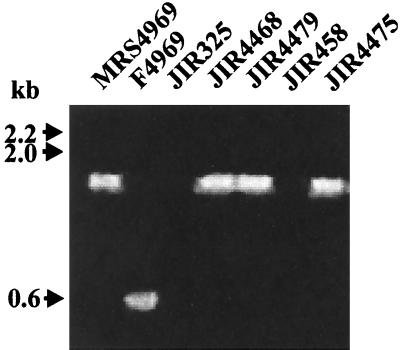
FIG. 1
FIG. 1
PCR analysis of transconjugants. Fresh cells from agar plates were resuspended in 100 μl of H2O and lysed in a microwave oven for 3 min. Three microliters of the supernatant was used in a standard PCR (50-μl volume) in a DNA thermal cycler (Perkin-Elmer) with 30 cycles of 30 s at 94°C, 30 s at 50°C, and 90 s at 72°C. The primers were cpeR (5′-CATCACCTAAGGACTGTTCT-3′) and cpeF (5′-TGTAGAATATGGATTTGGAAT-3′). The resultant products were separated by agarose gel electrophoresis. As shown, wild-type cpe-positive cells yielded a cpe band with a size of 544 bp, whereas a 1.7-kb band was present in strains with the cpeΩcatP region. Molecular sizes of the DNA markers are shown on the left.
FIG. 2
FIG. 2
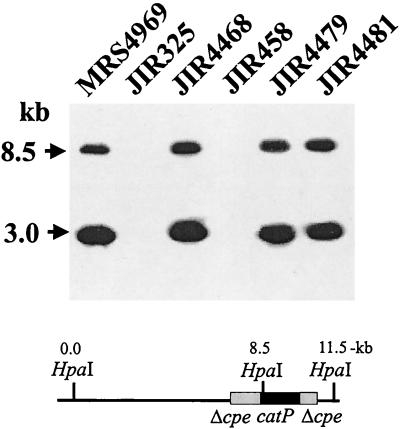
Southern blot of parent strains and transconjugants. C. perfringens DNA was isolated as described previously (14), digested with HpaI, separated by electrophoresis on a 1% agarose gel, and transferred by Southern blotting to positively charged nylon membranes (Roche Molecular Biochemicals). The membrane was then hybridized at 68°C overnight with a digoxigenin-labeled cpe probe. To prepare the probe, an ≈1.6-kb fragment containing the cpe gene and the regions ≈300-bp upstream and ≈200-bp downstream, was gel purified from EcoRI- and XbaI-digested pJRC200 DNA (14) and labeled by using a random-primed DNA labeling system (Boehringer Mannheim). After hybridization, the membrane was washed twice for 15 min each in wash solution (2× SSC [1× SSC is 0.15 M NaCl plus 0.015 M sodium citrate]–0.1% sodium dodecyl sulfate) at room temperature. The final washes were twice for 15 min each in 0.5× wash solution (0.5× SSC–0.1% sodium dodecyl sulfate) at 68°C. Hybridized probe was then detected by using a digoxigenin-chemiluminescence detection system with CSPD substrate (Roche Molecular Biochemicals). Molecular sizes of the DNA markers are shown on the left. The map shows the relevant cpeΩcatP region of pMRS4969.
FIG. 3
FIG. 3
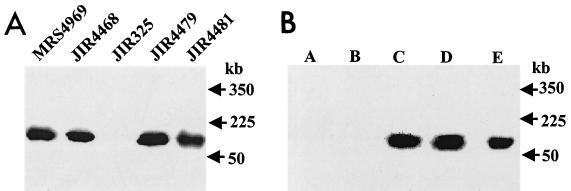
PFGE/Southern hybridization analysis of undigested genomic DNA from parent strains and transconjugants. (A) Total undigested DNA from the strains indicated was separated by pulsed-field gel electrophoresis as previously described (5), with a Bio-Rad CHEF-DR II apparatus, where pulse times were ramped from 50 to 90 s over a period of 22 h. The gel was Southern blotted and probed with a 1.6-kb digoxigenin-labeled cpe-specific probe. Molecular sizes of the DNA markers are shown on the right. (B) Total undigested DNA from transconjugant JIR4479 was separated by pulsed-field gel electrophoresis, and the gels were Southern blotted and separately probed with the five digoxigenin-labeled ClaI fragments (lanes A through E) originally derived from pCW3 (see Fig. 4). For reference, the molecular sizes of the λ DNA standards (Bio-Rad) are shown on the right.
FIG. 4
FIG. 4
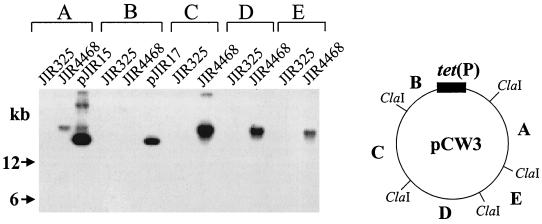
Hybridization to pCW3-derived probes. Total DNA isolated from strains JIR325 and JIR4468 was digested with BamHI, Southern blotted, and probed separately with the five pCW3-derived ClaI fragments that are present in the recombinant plasmids (1) pJIR15 (A), pJIR17 (B), pJIR16 (C), pJIR18 (D), and pJIR32 (E), as indicated. The pCW3 circular map shows the location of the five ClaI fragments (A through E).

References

    1. Abraham L J, Rood J I. Cloning and analysis of the Clostridium perfringens tetracycline resistance plasmid, pCW3. Plasmid. 1985;13:155–162. - PubMed
    1. Abraham L J, Rood J I. Molecular analysis of transferable tetracycline resistance plasmids from Clostridium perfringens. J Bacteriol. 1985;161:636–640. - PMC - PubMed
    1. Abraham L J, Wales A J, Rood J I. Worldwide distribution of the conjugative Clostridium perfringens tetracycline resistance plasmid, pCW3. Plasmid. 1985;14:37–46. - PubMed
    1. Berryman D I, Lyristis M, Rood J I. Cloning and sequence analysis of ermQ, the predominant macrolide-lincosamide-streptogramin B resistance gene in Clostridium perfringens. Antimicrob Agents Chemother. 1994;38:1041–1046. - PMC - PubMed
    1. Billington S J, Wieckowski E U, Sarkar M R, Bueschel D, Songer J G, McClane B A. Clostridium perfringens type E animal enteritis isolates with highly conserved, silent enterotoxin gene sequences. Infect Immun. 1998;66:4531–4536. - PMC - PubMed

Publication types