. 2001 Apr;12(4):1147-60.
doi: 10.1091/mbc.12.4.1147.

Depletion of acyl-coenzyme A-binding protein affects sphingolipid synthesis and causes vesicle accumulation and membrane defects in Saccharomyces cerevisiae

Affiliations
Free PMC article

Depletion of acyl-coenzyme A-binding protein affects sphingolipid synthesis and causes vesicle accumulation and membrane defects in Saccharomyces cerevisiae

B Gaigg et al. Mol Biol Cell. 2001 Apr.
Free PMC article

Abstract

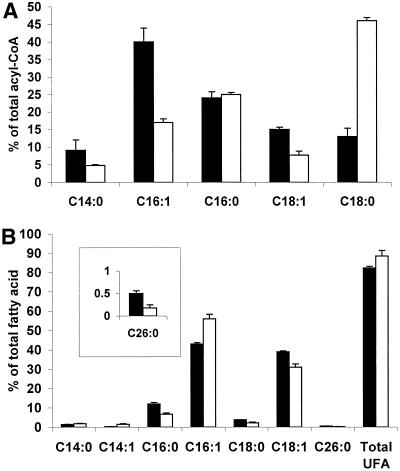
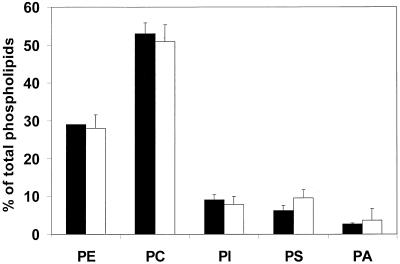
Deletion of the yeast gene ACB1 encoding Acb1p, the yeast homologue of the acyl-CoA-binding protein (ACBP), resulted in a slower growing phenotype that adapted into a faster growing phenotype with a frequency >1:10(5). A conditional knockout strain (Y700pGAL1-ACB1) with the ACB1 gene under control of the GAL1 promoter exhibited an altered acyl-CoA profile with a threefold increase in the relative content of C18:0-CoA, without affecting total acyl-CoA level as previously reported for an adapted acb1Delta strain. Depletion of Acb1p did not affect the general phospholipid pattern, the rate of phospholipid synthesis, or the turnover of individual phospholipid classes, indicating that Acb1p is not required for general glycerolipid synthesis. In contrast, cells depleted for Acb1p showed a dramatically reduced content of C26:0 in total fatty acids and the sphingolipid synthesis was reduced by 50-70%. The reduced incorporation of [(3)H]myo-inositol into sphingolipids was due to a reduced incorporation into inositol-phosphoceramide and mannose-inositol-phosphoceramide only, a pattern that is characteristic for cells with aberrant endoplasmic reticulum to Golgi transport. The plasma membrane of the Acb1p-depleted strain contained increased levels of inositol-phosphoceramide and mannose-inositol-phosphoceramide and lysophospholipids. Acb1p-depleted cells accumulated 50- to 60-nm vesicles and autophagocytotic like bodies and showed strongly perturbed plasma membrane structures. The present results strongly suggest that Acb1p plays an important role in fatty acid elongation and membrane assembly and organization.


Figures
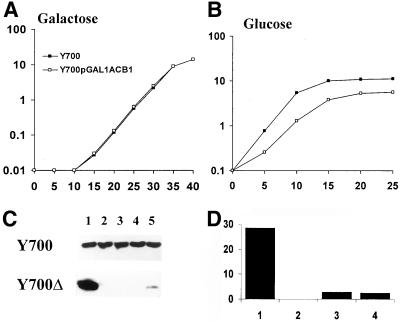
Figure 1
Figure 1
Growth curves of Y700 and Y700pGAL1-ACB1 in YNB-galactose (A) and YNB-glucose (B) media. The growth was followed spectrophotometrically by measuring the cell density at 600 nm. (C) Acb1p levels in Y700 and Y700pGAL1-ACB1 in cells grown in YNB-galactose for 48 h (lane 1) and in YNB-glucose for 24 h (lane 2), diluted into fresh YNB-glucose medium to OD 0.1 and grown to OD 0.2 (lane 3) and OD 0.5 (lane 4) and for 36 h (lane 5). (D) Quantitative data obtained by PhosphorImager analysis of a Northern blot of ACB1 mRNA of Y700pGAL1ACB1 and Y700 cells. Lane 1, Y700pGAL1ACB1 grown in galactose; lane 2, Y700pGAL1ACB1 grown in glucose; lane 3, Y700 grown in galactose; lane 4, Y700 grown in glucose. The y-axis is in arbitrary PhosphorImager units × 10−5. For experimental details, see MATERIALS AND METHODS
Figure 2
Figure 2
(A) Acyl-CoA composition of Y700 (black columns) and Y700pGAL1ACB1 (open columns). The cells were grown in YNB-glucose for 24 h, diluted into fresh YNB-glucose medium to OD 0.05, grown to OD 0.2, harvested, and analyzed as described in MATERIALS AND METHODS. Values are means ± SEM of four independent experiments. (B) Total fatty acid composition of Y700 (black columns) and Y700pGAL1-ACB1 (open columns). The cells were analyzed as described for A. Values are means ± SEM of six independent experiments and indicate total amounts of fatty acids/absorbance units of cells. UFA, unsaturated fatty acid (C14:1+C16:1+C18:1).
Figure 3
Figure 3
PL composition of Y700 (black columns) and Y700pGAL1-ACB1 (open columns). Cells were labeled for six generations with 10 mCi [32P]Pi/ml and analyzed as described in MATERIALS AND METHODS. Values are means ± SD of three independent experiments.
Figure 4
Figure 4
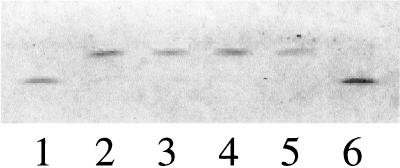
Determination of yeast ACBP ligand-binding specificity by isoelectric focusing. Yeast ACBP was incubated with threefold excess of different acyl-CoAs and focused on an isoelectric focusing gel. Binding of acyl-CoA is identified by band shift. Lane 1, without ligand; lane 2, C16:0-CoA; lane 3, C18:0-CoA; lane 4, C20:0-CoA; lane 5, C22:0-CoA; lane 6, C24:0-CoA.
Figure 5
Figure 5
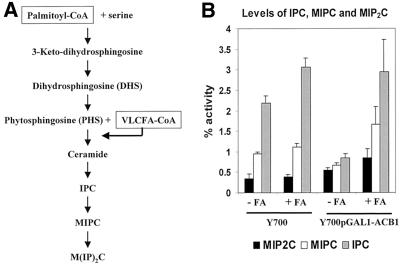
Sphingolipid synthesis. (A) General outline of the sphingolipid synthesis pathway in S. cerevisiae. (B) Cells grown in glucose for 24 h were labeled with [3H]myo-inositol to steady state in the presence (+) or absence (−) of fatty acid (FA; 500 μM C16:0/0.05% Brij), and levels of the three major classes of sphingolipids were determined by scintillation counting and HPTLC. Levels are given as percentages ± SEM of total lipid − extractable [3H]myo-inositol activity (n = 3–6).
Figure 6
Figure 6
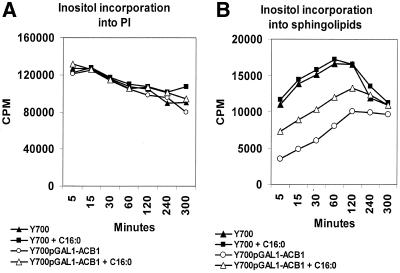
Incorporation of [3H]myo-inositol into PI and sphingolipids. (A) Cells were pulse labeled for 15 min and chased for 5 h. Cells were harvested at the indicated times, lipids were extracted, and total [3H]myo-inositol incorporation was determined by scintillation counting. (B) After mild alkaline hydrolysis and re-extraction, the amount of [3H]myo-inositol in the sphingolipids was determined. Data are means (±SEM) of three independent determinations.
Figure 7
Figure 7
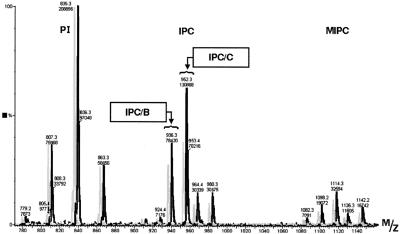
Mass spectrometric determination of PI, IPC, and MIPC in plasma membrane lipids from Y700 (gray) and Y700pGAL1-ACB1 (black). IPC/C contains PHS C18 and a C26OH fatty acid; IPC/B (or IPC/B′) contains phytospingosine C18 and a C26 fatty acid or dihydrosphingosine C18 and a C26OH fatty acid.
Figure 8
Figure 8
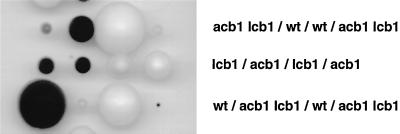
Tetrad analysis of a cross between Y700pGAL1-ACB1 and lcb1–100. Genotype of the spores is indicated to the right. Note the reduced growth on glucose of pGAL1-ACB1 lcb1–100 double mutants after growth at 30°C for 6 d.
Figure 9
Figure 9
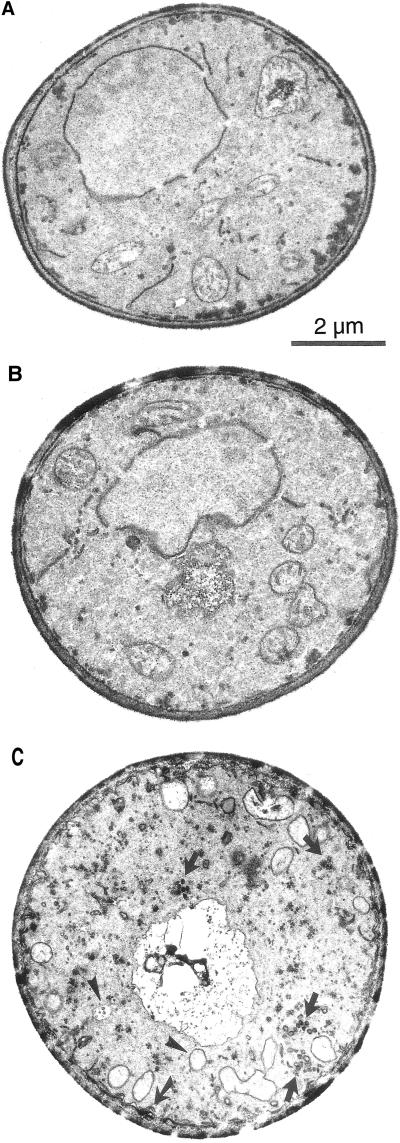
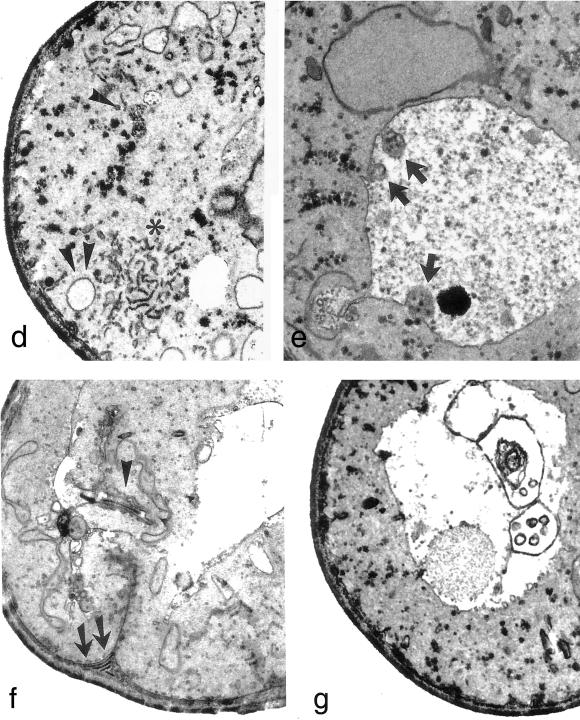
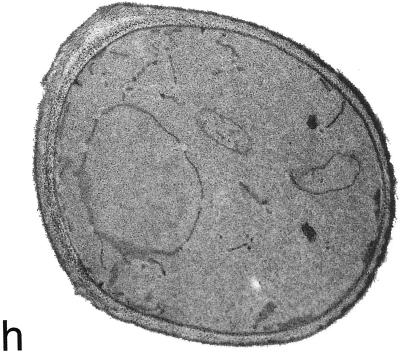
(cont).Acb1p-depleted cells exhibit severe membrane alterations. Wild-type and Acb1p-depleted cells were grown in galactose (a and b, respectively) and in glucose media (h and c–g, respectively) and were prepared for electron microscopy. When grown on glucose, Acb1p-depleted cells accumulate vesicles of variable sizes (c, arrow), autophagocytotic bodies (c and d, arrowheads), randomly organized dense membrane areas (d, star), vacuolar inclusions of vesicles containing autophagocytotic like bodies (e, arrows), large invaginations of plasma membrane and accumulation of membrane material in the cytosol (f, arrowhead), and accumulation of membrane material in the vacuole (g).
Figure 9
Figure 9
(cont).Acb1p-depleted cells exhibit severe membrane alterations. Wild-type and Acb1p-depleted cells were grown in galactose (a and b, respectively) and in glucose media (h and c–g, respectively) and were prepared for electron microscopy. When grown on glucose, Acb1p-depleted cells accumulate vesicles of variable sizes (c, arrow), autophagocytotic bodies (c and d, arrowheads), randomly organized dense membrane areas (d, star), vacuolar inclusions of vesicles containing autophagocytotic like bodies (e, arrows), large invaginations of plasma membrane and accumulation of membrane material in the cytosol (f, arrowhead), and accumulation of membrane material in the vacuole (g).
Figure 9
Figure 9
(cont).Acb1p-depleted cells exhibit severe membrane alterations. Wild-type and Acb1p-depleted cells were grown in galactose (a and b, respectively) and in glucose media (h and c–g, respectively) and were prepared for electron microscopy. When grown on glucose, Acb1p-depleted cells accumulate vesicles of variable sizes (c, arrow), autophagocytotic bodies (c and d, arrowheads), randomly organized dense membrane areas (d, star), vacuolar inclusions of vesicles containing autophagocytotic like bodies (e, arrows), large invaginations of plasma membrane and accumulation of membrane material in the cytosol (f, arrowhead), and accumulation of membrane material in the vacuole (g).
Figure 10
Figure 10
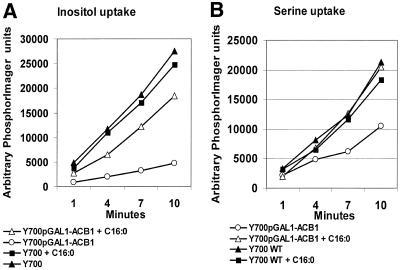
Uptake of radiolabeled inositol and serine from the medium. Y700pGAL1-ACB1 and Y700 were grown to early log phase in the presence of inositol, harvested, and resuspended in PBS to an OD of 1.0. (For details, see MATERIALS AND METHODS). After addition of radiolabeled inositol (A) or serine (B), uptake was stopped by transferring the cells to ice-cold PBS containing excess unlabeled inositol or serine, at the times indicated. Cells were collected by vacuum filtration, the filter paper was dried (for details, see MATERIALS AND METHODS), and the 3H activity of each cell spot was quantified by phosphorimaging.
Figure 11
Figure 11
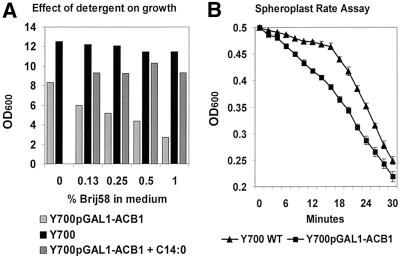
Test of cell envelope integrity. (A) Y700pGAL1-ACB1 and Y700 were diluted to OD 0.1 and grown in the presence of different concentrations of the detergent Brij58. After 16 h the OD600 of each culture was determined. (B) Y700pGAL1-ACB1 and Y700 were resuspended to OD 0.5 and treated with Zymolyase while the optical density was monitored. Data shown ± SEM (n = 3).

References

    1. Bagnat M, Karanen S, Shevchenko A, Simons K. Lipid rafts function in biosyntetic delivery of proteins to the cell surface in yeast. Proc Natl Acad Sci USA. 2000;97:3254–3259. - PMC - PubMed
    1. Borsting C, Hummel R, Schultz ER, Rose TM, Pedersen MB, Knudsen J, Kristiansen K. Saccharomyces carlsbergensis contains two functional genes encoding the acyl-CoA binding protein, one similar to the ACB1 gene from S. cerevisiae and one identical to the ACB1 gene from S. monacensis. Yeast. 1997;13:1409–1421. - PubMed
    1. Choi JY, Stukey J, Hwang SY, Martin CE. Regulatory elements that control transcription activation and unsaturated fatty acid-mediated repression of the Saccharomyces cerevisiae OLE1 gene. J Biol Chem. 1996;271:3581–3589. - PubMed
    1. Færgeman NJ, Knudsen J. Role of long-chain fatty acyl-CoA esters in the regulation of metabolism and in cell signaling. Biochem J. 1997;323:1–12. - PMC - PubMed
    1. Færgeman NJ, Sigurskjold BW, Kragelund BB, Andersen KV, Knudsen J. Thermodynamics of ligand binding to acyl-coenzyme A binding protein studied by titration calorimetry. Biochemistry. 1996;35:14118–14126. - PubMed

Publication types

MeSH terms