


Visualizing the solvent-inaccessible core of a group II intron ribozyme
- PMID: 11296237
- PMCID: PMC125427
- DOI: 10.1093/emboj/20.8.2051
Visualizing the solvent-inaccessible core of a group II intron ribozyme
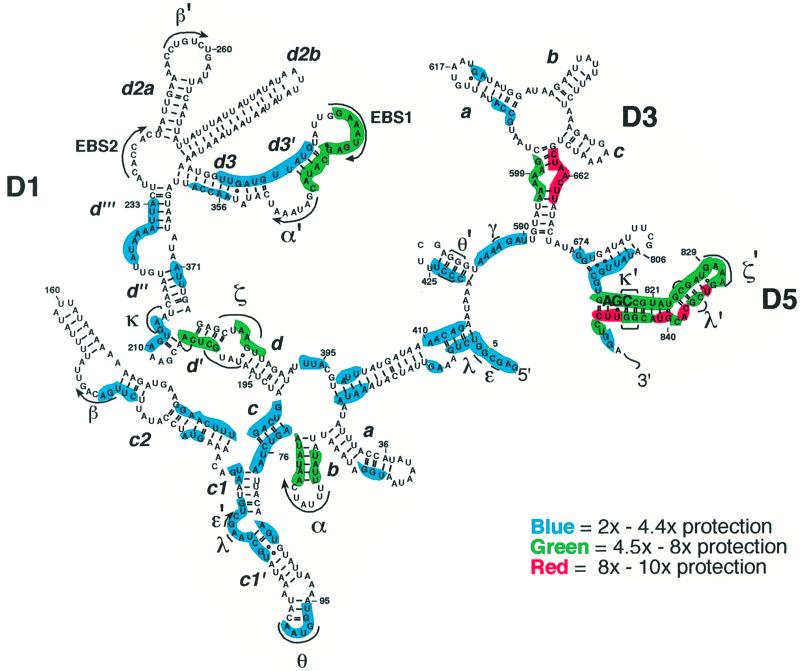
Abstract
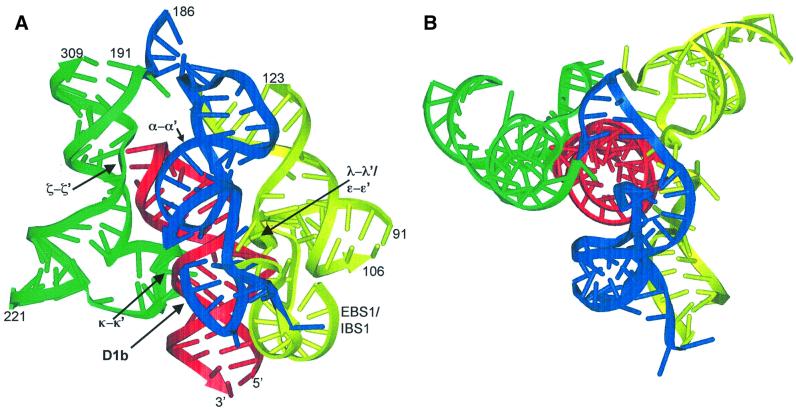
Group II introns are well recognized for their remarkable catalytic capabilities, but little is known about their three-dimensional structures. In order to obtain a global view of an active enzyme, hydroxyl radical cleavage was used to define the solvent accessibility along the backbone of a ribozyme derived from group II intron ai5gamma. These studies show that a highly homogeneous ribozyme population folds into a catalytically compact structure with an extensively internalized catalytic core. In parallel, a model of the intron core was built based on known tertiary contacts. Although constructed independently of the footprinting data, the model implicates the same elements for involvement in the catalytic core of the intron.
Figures
References
-
- Abramovitz D.L., Friedman,R.A. and Pyle,A.M. (1996) Catalytic role of 2′-hydroxyl groups within a group II intron active site. Science, 271, 1410–1413. - PubMed
-
- Ban N., Nissen,P., Hansen,J., Moore,P.B. and Steitz,T.A. (2000) The complete atomic structure of the large ribosomal subunit at 2.4 Å resolution. Science, 289, 905–920. - PubMed
Publication types
MeSH terms
Substances
Grants and funding
LinkOut - more resources
Full Text Sources
