Comparative Study
. 2001 Apr 1;15(7):833-8.
doi: 10.1101/gad.873401.

Diethylstilbestrol regulates trophoblast stem cell differentiation as a ligand of orphan nuclear receptor ERR beta

Affiliations
Comparative Study

Diethylstilbestrol regulates trophoblast stem cell differentiation as a ligand of orphan nuclear receptor ERR beta

G B Tremblay et al. Genes Dev. .

Abstract

The orphan nuclear receptor ERR beta is expressed in undifferentiated trophoblast stem cell lines and extraembryonic ectoderm, and genetic ablation of ERR beta results in abnormal trophoblast proliferation and precocious differentiation toward the giant cell lineage. Here, we show that the synthetic estrogen diethylstilbestrol (DES) promotes coactivator release from ERR beta and inhibits its transcriptional activity. Strikingly, treatment of trophoblast stem cells with DES led to their differentiation toward the polyploid giant cell lineage. In addition, DES-treated pregnant mice exhibited abnormal early placenta development associated with an overabundance of trophoblast giant cells and an absence of diploid trophoblast. These results define a novel pathway for DES action and provide evidence for steroidlike control of trophoblast development.


Figures
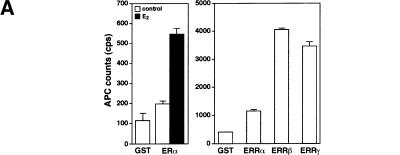
Figure 1
Figure 1
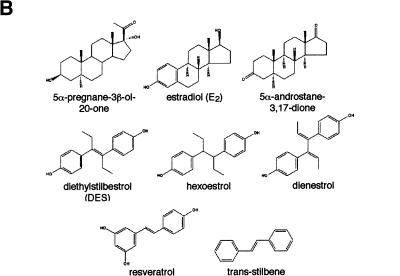
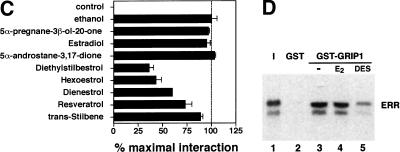
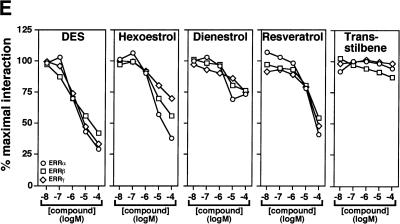
DES interacts with ERRα, ERRβ, and ERRγ and promotes the release of a GRIP1 RID fragment. (A) FRET assays were used to screen for compounds that could either inhibit or stimulate receptor–coactivator interactions. Biotinylated GRIP1/RID was incubated in the absence or presence of GST–ERα or GST–ERRα, GST–ERRβ and GST–ERRγ and energy transfer measured by time-resolve fluorescence. ERα required E2 (10−8 M) for maximal interaction whereas the ERRs interacted with GRIP1/RID constitutively in this assay. All data are expressed as counts per second ±S.E.M. (B) Chemical structures of selected steroids and DES-like compounds used in this report. (C) Ability of selected compounds to inhibit ERRα interactions with GRIP1/RID in a FRET assay. All compounds were tested at 10 μM. The sample containing ethanol represents 100% interaction.. All data are expressed as the percentage of the maximal interaction ±S.E.M. (D) DES inhibits interaction between ERRγ and GRIP1/RID in a GST pull-down assay. Purified GST–GRIP1/RID was incubated with [35S]methionine-labeled ERRγ in the presence of ethanol (lane 3), 1 μM E2 (lane 4) or 10 μM DES (lane 5), washed of unbound proteins, electrophoresed on a polyacrylamide gel and exposed to film overnight. (Input; lane 1) 10% of the total labeled protein used in each binding reaction; (GST; lane 2) negative control containing an equal amount of GST protein alone. (E) Dose-response study of the inhibition of ERR–GRIP1/RID interactions by DES, hexoestrol, dienestrol, resveratrol, and trans-stilbene. Maximal interaction was set as the interaction between receptor and coactivator in the presence of ethanol.
Figure 1
Figure 1
DES interacts with ERRα, ERRβ, and ERRγ and promotes the release of a GRIP1 RID fragment. (A) FRET assays were used to screen for compounds that could either inhibit or stimulate receptor–coactivator interactions. Biotinylated GRIP1/RID was incubated in the absence or presence of GST–ERα or GST–ERRα, GST–ERRβ and GST–ERRγ and energy transfer measured by time-resolve fluorescence. ERα required E2 (10−8 M) for maximal interaction whereas the ERRs interacted with GRIP1/RID constitutively in this assay. All data are expressed as counts per second ±S.E.M. (B) Chemical structures of selected steroids and DES-like compounds used in this report. (C) Ability of selected compounds to inhibit ERRα interactions with GRIP1/RID in a FRET assay. All compounds were tested at 10 μM. The sample containing ethanol represents 100% interaction.. All data are expressed as the percentage of the maximal interaction ±S.E.M. (D) DES inhibits interaction between ERRγ and GRIP1/RID in a GST pull-down assay. Purified GST–GRIP1/RID was incubated with [35S]methionine-labeled ERRγ in the presence of ethanol (lane 3), 1 μM E2 (lane 4) or 10 μM DES (lane 5), washed of unbound proteins, electrophoresed on a polyacrylamide gel and exposed to film overnight. (Input; lane 1) 10% of the total labeled protein used in each binding reaction; (GST; lane 2) negative control containing an equal amount of GST protein alone. (E) Dose-response study of the inhibition of ERR–GRIP1/RID interactions by DES, hexoestrol, dienestrol, resveratrol, and trans-stilbene. Maximal interaction was set as the interaction between receptor and coactivator in the presence of ethanol.
Figure 1
Figure 1
DES interacts with ERRα, ERRβ, and ERRγ and promotes the release of a GRIP1 RID fragment. (A) FRET assays were used to screen for compounds that could either inhibit or stimulate receptor–coactivator interactions. Biotinylated GRIP1/RID was incubated in the absence or presence of GST–ERα or GST–ERRα, GST–ERRβ and GST–ERRγ and energy transfer measured by time-resolve fluorescence. ERα required E2 (10−8 M) for maximal interaction whereas the ERRs interacted with GRIP1/RID constitutively in this assay. All data are expressed as counts per second ±S.E.M. (B) Chemical structures of selected steroids and DES-like compounds used in this report. (C) Ability of selected compounds to inhibit ERRα interactions with GRIP1/RID in a FRET assay. All compounds were tested at 10 μM. The sample containing ethanol represents 100% interaction.. All data are expressed as the percentage of the maximal interaction ±S.E.M. (D) DES inhibits interaction between ERRγ and GRIP1/RID in a GST pull-down assay. Purified GST–GRIP1/RID was incubated with [35S]methionine-labeled ERRγ in the presence of ethanol (lane 3), 1 μM E2 (lane 4) or 10 μM DES (lane 5), washed of unbound proteins, electrophoresed on a polyacrylamide gel and exposed to film overnight. (Input; lane 1) 10% of the total labeled protein used in each binding reaction; (GST; lane 2) negative control containing an equal amount of GST protein alone. (E) Dose-response study of the inhibition of ERR–GRIP1/RID interactions by DES, hexoestrol, dienestrol, resveratrol, and trans-stilbene. Maximal interaction was set as the interaction between receptor and coactivator in the presence of ethanol.
Figure 1
Figure 1
DES interacts with ERRα, ERRβ, and ERRγ and promotes the release of a GRIP1 RID fragment. (A) FRET assays were used to screen for compounds that could either inhibit or stimulate receptor–coactivator interactions. Biotinylated GRIP1/RID was incubated in the absence or presence of GST–ERα or GST–ERRα, GST–ERRβ and GST–ERRγ and energy transfer measured by time-resolve fluorescence. ERα required E2 (10−8 M) for maximal interaction whereas the ERRs interacted with GRIP1/RID constitutively in this assay. All data are expressed as counts per second ±S.E.M. (B) Chemical structures of selected steroids and DES-like compounds used in this report. (C) Ability of selected compounds to inhibit ERRα interactions with GRIP1/RID in a FRET assay. All compounds were tested at 10 μM. The sample containing ethanol represents 100% interaction.. All data are expressed as the percentage of the maximal interaction ±S.E.M. (D) DES inhibits interaction between ERRγ and GRIP1/RID in a GST pull-down assay. Purified GST–GRIP1/RID was incubated with [35S]methionine-labeled ERRγ in the presence of ethanol (lane 3), 1 μM E2 (lane 4) or 10 μM DES (lane 5), washed of unbound proteins, electrophoresed on a polyacrylamide gel and exposed to film overnight. (Input; lane 1) 10% of the total labeled protein used in each binding reaction; (GST; lane 2) negative control containing an equal amount of GST protein alone. (E) Dose-response study of the inhibition of ERR–GRIP1/RID interactions by DES, hexoestrol, dienestrol, resveratrol, and trans-stilbene. Maximal interaction was set as the interaction between receptor and coactivator in the presence of ethanol.
Figure 2
Figure 2
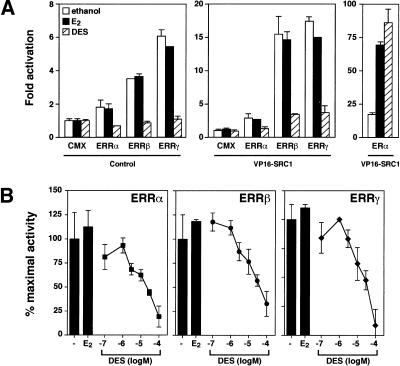
DES inhibits the constitutive transcriptional activity of ERRα, ERRβ and ERRγ. (A) COS-1 cells were transfected with 100 ng each of pCMX-ERR or pCMX-ERα and either pCMX-VP16 (left) or pCMX-VP16–SRC1 (middle) fusion plasmids as indicated and treated with 0.1% ethanol (vehicle), 100 nM E2 or 10 μM DES. Luciferase activity was determined and expressed as fold activation over basal transcription in the presence of empty expression vectors. (B) Dose-dependent inhibition of ERRα, ERRβ and ERRγ transcriptional activity by DES. The data are presented as the percentage of the remaining activity in the presence of 0.1% ethanol (vehicle). E2 (10 μM) was used as a control. Results represent the mean of at least three duplicate transfections ±S.E.M.
Figure 3
Figure 3
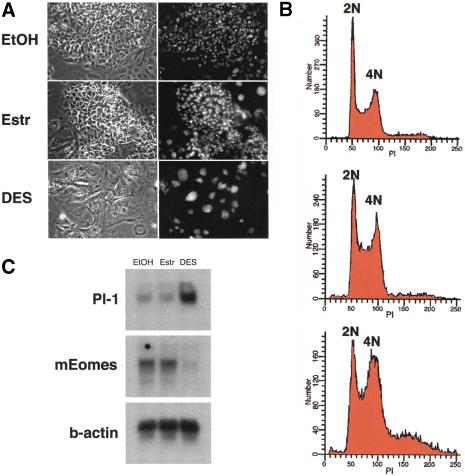
Effect of DES on trophoblast stem cell lines in culture. (A) Representative microphotographs of trophoblast stem cells cultured in the presence of ethanol (top), 10 μM E2 (middle) and 10 μM DES (bottom). Large nuclei stained with Hoechst 33342 (right) are characteristic of giant cells. (B) DNA content was analyzed by flow cytometry studies of cells stained with prodidium iodide (PI). Trophoblast stem cells were analyzed 6 d after treatment. Diploid (2N) and tetraploid (4N) DNA contents are indicated. (C) RNA analysis of trophoblast stem cells cultured in the presence and absence of estradiol or DES. The cells were treated for 4 d with vehicle alone (EtOH), or E2 (estr) and DES at a final concentration of 10 μM.
Figure 4
Figure 4
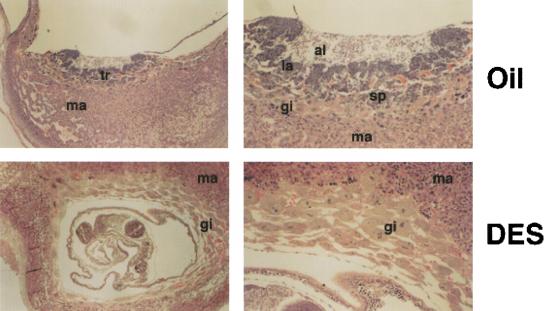
Effect of DES on the morphology of trophoblast tissues. Pregnant mice were treated daily with oil or DES on day 4.5 to 8.5 d.p.c. and placentas were examined at 9.5 d.p.c. In the treated animals (DES), diploid trophoblast cells were absent and secondary giant cells formed multiple layers. Panels at right are higher magnification of panels at left. (al) Allantois; (gi) giant cells; (la) labyrinthine trophoblast; (ma) maternal deciduas; (sp) spongiotrophoblast; (tr) trophoblast.

References

    1. Barak Y, Nelson MC, Ong ES, Jones YZ, Ruiz-Lozano P, Chien KR, Koder A, Evans RM. PPARγ is required for placental, cardiac, and adipose tissue development. Mol Cell. 1999;4:585–595. - PubMed
    1. Berger S, Bleich M, Schmid W, Cole TJ, Peters J, Watanabe H, Kriz W, Warth R, Greger R, Schütz G. Mineralocorticoid receptor knockout mice: Pathophysiology of Na+ metabolism. Proc Natl Acad Sci. 1998;95:9424–9429. - PMC - PubMed
    1. Blumberg B, Evans RM. Orphan nuclear receptors: New ligands and new possibilities. Genes & Dev. 1998;12:3149–3155. - PubMed
    1. Blumberg B, Sabbagh W, Jr, Juguilon H, Bolado J, Jr, van Meter CM, Ong ES, Evans RM. SXR, a novel steroid and xenobiotic-sensing nuclear receptor. Genes & Dev. 1998;12:3195–3205. - PMC - PubMed
    1. Ciruna BG, Rossant J. Expression of the T-box gene Eomesodermin during early mouse development. Mech Dev. 1999;81:199–203. - PubMed

Publication types

MeSH terms

LinkOut - more resources