Identification of the cytochrome P450 enzymes involved in the N-demethylation of sildenafil
- PMID: 11298070
- PMCID: PMC2015027
- DOI: 10.1046/j.1365-2125.2001.00318.x
Identification of the cytochrome P450 enzymes involved in the N-demethylation of sildenafil
Abstract
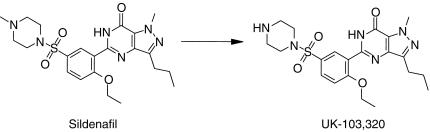
Aims: To characterize the cytochrome P450 (CYP) enzymes responsible for the N-demethylation of sildenafil to its main metabolite, UK-103 320, to investigate the potential inhibitory effects of sildenafil on CYP enzymes and to evaluate the potential of selected drugs to affect sildenafil metabolism.
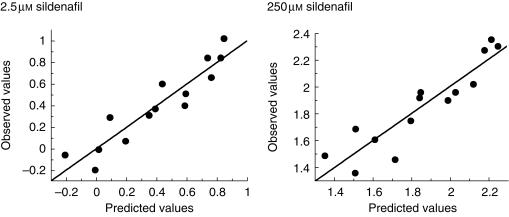
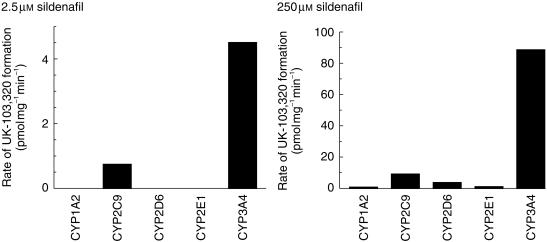
Methods: The metabolic pathways of sildenafil N-demethylation were studied using human liver microsomes, as well as microsomes expressing individual human CYP enzymes. Further studies to identify the individual enzymes were performed at 2.5 and 250 microM sildenafil, and employed a combination of chemical inhibition, correlation analysis, and metabolism by expressed recombinant CYP enzymes. In addition, the effect of sildenafil on the activity of the six major drug metabolizing enzymes was investigated.
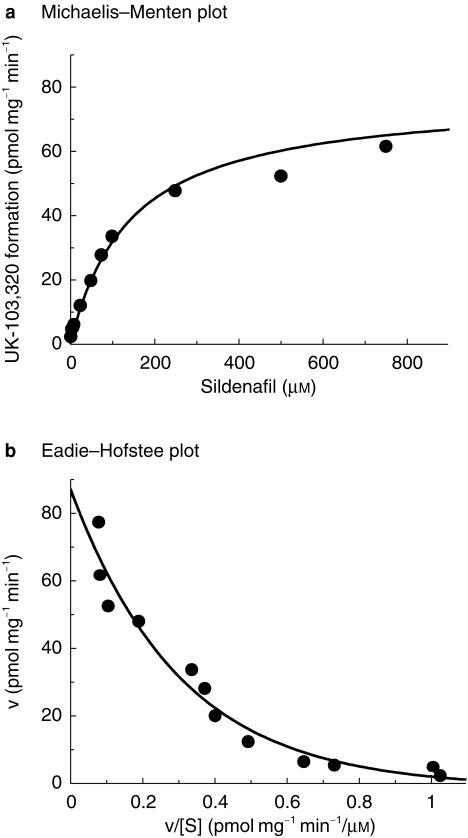
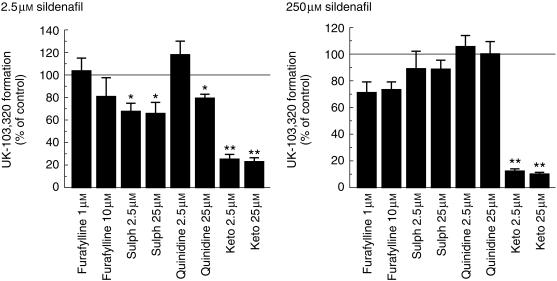
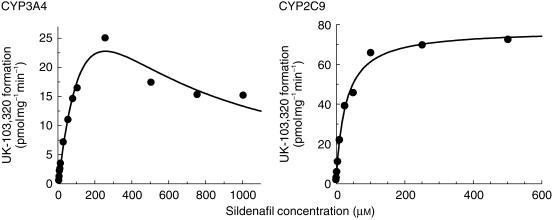
Results: Sildenafil conversion was found to be mediated by at least two CYP enzymes, for which the mean kinetic parameters were Km1 = 6(+/-3 microM), Km2 = 81(+/-45 microM), Vmax1 = 22(+/-9 pmol) and Vmax2 = 138(+/-77 pmol) UK-103 320 formed min(-1) mg(-1). At 250 microM sildenafil, N-demethylation was primarily mediated through the low-affinity, high-Km enzyme (approximately 83%), whilst at 2.5 microM there was a greater role for the high-affinity, low-Km enzyme (approximately 61%). Ketoconazole strongly inhibited metabolism at both sildenafil concentrations and was the only significant inhibitor at 250 microM sildenafil. At the lower sildenafil concentration, sulphaphenazole and quinidine also inhibited formation of UK-103 320. Overall, 75% or more of the N-demethylation of sildenafil at any concentration is probably attributable to CYP3A4. These results were supported by experiments using expressed human CYP enzymes, in which only CYP3A4 and CYP2C9 exhibited substantial sildenafil N-demethylase activity (respective Km values of 221 microM and 27 microM). Sildenafil metabolism was inhibited by potent CYP3A4 inhibitors which are used clinically, but was found to be only a weak inhibitor of drug metabolizing enzymes itself, the strongest inhibition occurring against CYP2C9 (Ki = 80 microM).
Conclusions: Evidence is provided for CYP3A4 and to a lesser extent CYP2C9-mediated metabolism of sildenafil. There is the possibility that elevated plasma concentrations of sildenafil could occur with coadministration of known inhibitors of CYP2C9 or CYP3A4. Since peak plasma concentrations of clinical doses of sildenafil are only 200 ng ml(-1) ( approximately 0.4 microM) it is very unlikely that sildenafil will significantly alter the plasma concentration of other compounds metabolized by cytochrome P450 enzymes.
Figures
References
-
- Terrett NK, Bell AS, Brown D, Ellis P. Sildenafil (Viagra™), a potent and selective inhibitor of type 5 cGMP phosphodiesterase with utility for the treatment of male erectile dysfunction. Bioorg Med Chem Let. 1996;6:239–248.
-
- Ballard SA, Burslem FSM, Gingell CJG, et al. In vitro profile of UK-92,480, an inhibitor of cyclic GMP-specific phosphodiesterase 5 for the treatment of male erectile dysfunction. J Urol. 1996;155:676A.
-
- Boolell M, Gepi-Attee S, Gingell JC, Allen MJ. Sildenafil, a novel effective treatment for male erectile dysfunction. Br J Urol. 1996;78:257–261. - PubMed
-
- Walker DK, Ackland MJ, James GC, et al. Pharmacokinetics and metabolism of sildenafil in mouse, rat, rabbit and man. Xenobiotica. 1999;29:297–310. - PubMed
-
- Omuro T, Sato R. The carbon monoxide-binding pigment of liver microsomes. I. Evidence for its hemoprotein nature. J Biol Chem. 1964;239:2370–2378. - PubMed
MeSH terms
Substances
LinkOut - more resources
Full Text Sources
Miscellaneous