. 2001 Apr;125(4):1891-900.
doi: 10.1104/pp.125.4.1891.

Molecular characterization of tomato 3-dehydroquinate dehydratase-shikimate:NADP oxidoreductase

Affiliations

Molecular characterization of tomato 3-dehydroquinate dehydratase-shikimate:NADP oxidoreductase

M Bischoff et al. Plant Physiol. 2001 Apr.

Abstract

Analysis of cDNAs encoding the bifunctional 3-dehydroquinate dehydratase-shikimate:NADP oxidoreductase (DHQase-SORase) from tomato (Lycopersicon esculentum) revealed two classes of cDNAs that differed by 57 bp within the coding regions, but were otherwise identical. Comparison of these cDNA sequences with the sequence of the corresponding single gene unequivocally proved that the primary transcript is differentially spliced, potentially giving rise to two polypeptides that differ by 19 amino acids. Quantitative real-time polymerase chain reaction revealed that the longer transcript constitutes at most 1% to 2% of DHQase-SORase transcripts. Expression of the respective polypeptides in Escherichia coli mutants lacking the DHQase or the SORase activity gave functional complementation only in case of the shorter polypeptide, indicating that skipping of a potential exon is a prerequisite for the production of an enzymatically active protein. The deduced amino acid sequence revealed that the DHQase-SORase is most likely synthesized as a precursor with a very short (13-amino acid) plastid-specific transit peptide. Like other genes encoding enzymes of the prechorismate pathway in tomato, this gene is elicitor-inducible. Tissue-specific expression resembles the patterns obtained for 3-deoxy-D-arabino-heptulosonate 7-phosphate synthase 2 and dehydroquinate synthase genes. This work completes our studies of the prechorismate pathway in that cDNAs for all seven enzymes (including isozymes) of the prechorismate pathway from tomato have now been characterized.


Figures
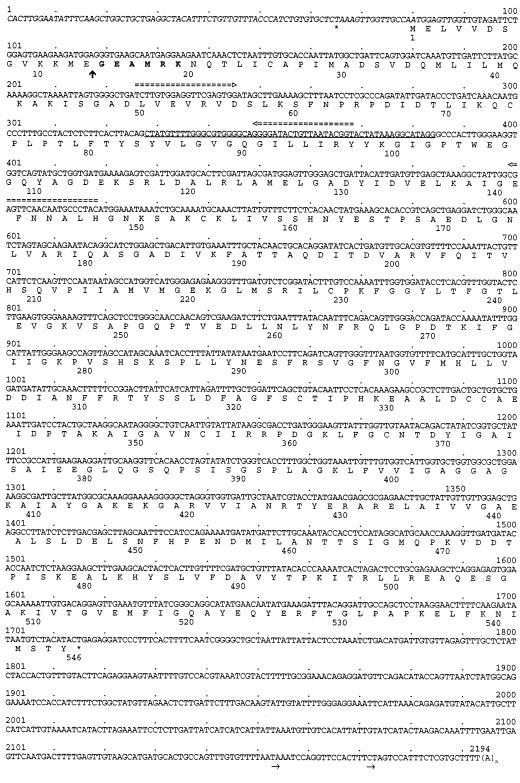
Figure 1
Figure 1
Nucleotide and deduced amino acid sequences of a cDNA encoding DHQase-SORase from tomato. The nucleotide sequence shown in italics (bp 1–88) was obtained by 5′-RACE. The underlined nucleotide sequence was missing in some of the analyzed cDNA clones. Horizontal arrows mark polyadenylation sites of different cDNA clones with shorter 3′-untranslated regions. In the 5′-untranslated region, the stop codon in frame with the coding region is indicated by an asterisk. The proposed cleavage site of the plastid-specific transit peptide is indicated by a vertical arrow. The tomato sequence similar to the N terminus of mature tobacco DHQase-SORase (GEAMTR, Bonner and Jensen, 1994) is shown in bold face. Double-line arrows indicate the oligonucleotide primers that were used in the reverse transcriptase (RT)-PCR experiment.
Figure 2
Figure 2
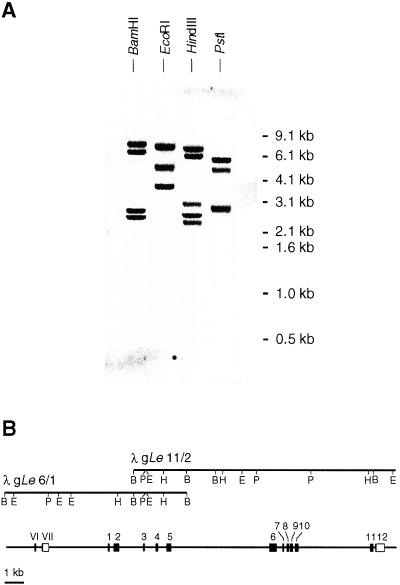
Southern-blot analysis of chromosomal tomato DNA (A) and schematic representation of the tomato DHQase-SORase gene (B). A, High-Mr DNA was digested with the restriction enzymes BamHI, EcoRI, HindIII, or PstI and subjected to Southern-blot analysis using the complete cDNA cDHQase-SORase1 as probe. A 1-kb ladder (Gibco-BRL, Cleveland) was used as size marker. B, The subcloned fragments of two genomic phage clones (λgLe6/1 and λLe11/2) are indicated with their respective restriction sites for BamHI (B), EcoRI (E), HindIII (H), and PstI (P) and shown in the top. In the bottom, the structure of the tomato DHQase-SORase gene (LeDHQase-SORase) is shown. Boxes represent exons and translated regions are indicated by black boxes. The exons of the DHQase-SORase gene are numbered from 1 to 12. Exons VI and VII from the LeSodCc2 encoding a superoxide dismutase C-terminal domain are located directly upstream of the DHQase-SORase gene.
Figure 3
Figure 3
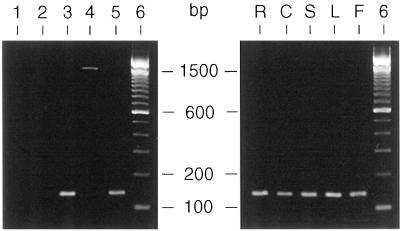
Detection of the LeDHQase-SORase2 transcript by RT-PCR. A single-stranded cDNA was generated by reverse transcription from tomato total RNA (2 μg) using an oligonucleotide complementary to exon 4 as a primer. The cDNA was used as template in the PCR using a pair of primers corresponding to 20 nucleotides of exons 2 and 3, respectively (lanes 3, R, C, S, L, and F). Control reactions in lanes 1 and 2 lacked the 5′- and 3′-PCR primers, respectively. In the control reactions shown in lanes 4 and 5, 100 ng of tomato genomic DNA and 1 ng of the LeDHQase-SORase2 cDNA were used as PCR templates, respectively. Tomato total RNA was isolated from roots (R), cotyledons (C), stems (S), leaves (3,L), and flowers (F). A 100-bp DNA ladder was used as size marker (lane 6).
Figure 4
Figure 4
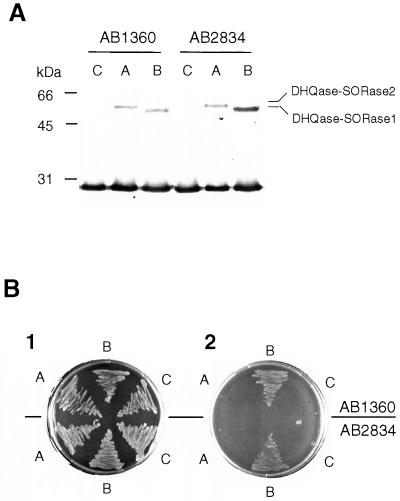
Expression of DHQase-SORase1 and 2 in E. coli. A, Western-blot analysis of expression. Crude bacterial culture extracts of strains AB1360 (DHQase-deficient) and AB2834 (SORase-deficient) carrying plasmids directing the expression of DHQase-SORase2 (A), DHQase-SORase1 (B), or an unrelated protein (DHQ-synthase, C) were analyzed on protein gel blots using a polyclonal antiserum raised against tomato DHQase-SORase2 expressed in E. coli. The band at 30 kD represents an endogenous E. coli protein and indicates equal loading of the gel. B, Complementation of E. coli strains deficient for the DHQase or SORase activity, respectively. Plasmids directing the expression of DHQase-SORase2 (A), DHQase-SORase1 (B) from tomato, or an unrelated protein (DHQ-synthase, C) were used to complement the E. coli strains AB1360 (DHQase-deficient) and AB2834 (SORase-deficient). Cells were plated on rich (1) or minimal (2) medium, respectively, containing ampicillin (100 mg/L).
Figure 5
Figure 5
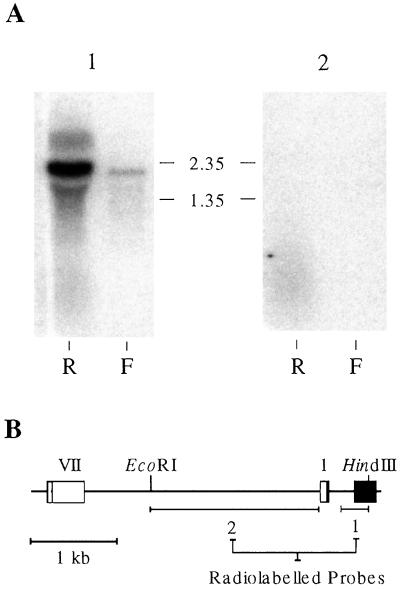
Northern-blot analysis with probes corresponding to transcribed and 5′-untranscribed regions of the tomato DHQase-SORase gene. A, Total RNA from tomato roots (R) and flowers (F) was subjected to northern-blot analysis using radiolabeled probes corresponding to the transcribed (1) and 5′-untranscribed (2) regions, respectively, of the DHQase-SORase gene. RNAs of different lengths (Gibco-BRL) were used as size markers (nucleotides × 10−3). B, Schematic representation of the probes used for the northern-blot analysis. The exons are numbered as in Figure 2.
Figure 6
Figure 6
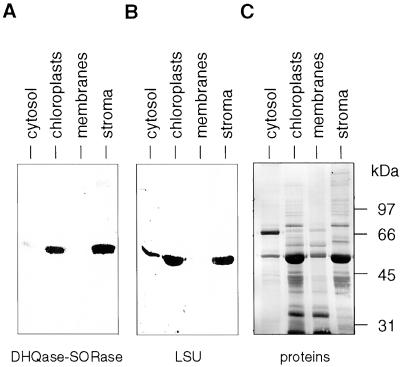
Subcellular localization of the tomato DHQase-SORase. Western-blot analyses (SDS-PAGE, 10% [w/v] acrylamide) were performed with subcellular fractions obtained from tomato seedlings. A, Western blot immunodecorated with an antiserum raised against the tomato DHQase-SORase2. B, Western-blot analysis using an antiserum against the large subunit of the RUBISCO from pea. C, Proteins stained with amido black. The “low range” markers (Bio-Rad, Hercules, CA) were used as size markers (kD).
Figure 7
Figure 7
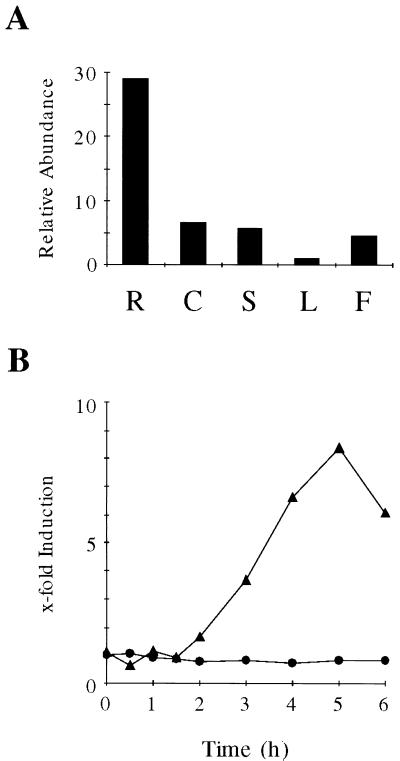
Expression profiles of the tomato DHQase-SORase gene. The relative abundance of DHQase-SORase-specific transcripts was determined by a dot-blot assay, and the signals were quantified with a PhosphorImager and normalized to the transcript level observed in leaves. The cDNA DHQase-SORase2 was used as radiolabeled probe. A, Profile of organ-specific expression. B, Elicitor-induced expression. Cultured tomato cells were incubated with (▴) or without (●) a fungal elicitor for the time periods indicated.

References

    1. Aebi M, Hornig H, Padgett RA, Reiser J, Weissmann C. Sequence requirements for splicing of higher eukaryotic nuclear pre-mRNA. Cell. 1986;47:555–565. - PubMed
    1. Ausubel FM, Brent R, Kingston RE, Moore DD, Seidman JG, Smith JA, Struhl K. Current Protocols in Molecular Biology. Chichester, UK: John Wiley & Sons; 1994.
    1. Bentley R. The shikimate pathway: a metabolic tree with many branches. Crit Rev Biochem Mol Biol. 1990;25:307–384. - PubMed
    1. Bischoff M, Rösler J, Raesecke H-R, Görlach J, Amrhein N, Schmid J. Cloning of a cDNA encoding a 3-dehydroquinate synthase from a higher plant, and analysis of the organ-specific and elicitor-induced expression of the corresponding gene. Plant Mol Biol. 1996;31:69–76. - PubMed
    1. Bonner CA, Jensen RA. Cloning of a cDNA encoding the bifunctional dehydroquinase-shikimate dehydrogenase of aromatic-amino-acid biosynthesis in Nicotiana tabacum. Biochem J. 1994;302:11–14. - PMC - PubMed

Publication types

MeSH terms

Substances

LinkOut - more resources