


Latency and duration of stimulation of human muscle protein synthesis during continuous infusion of amino acids
- PMID: 11306673
- PMCID: PMC2278544
- DOI: 10.1111/j.1469-7793.2001.0575f.x
Latency and duration of stimulation of human muscle protein synthesis during continuous infusion of amino acids
Abstract
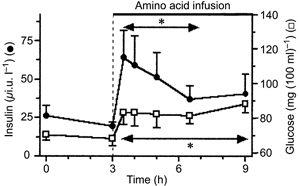
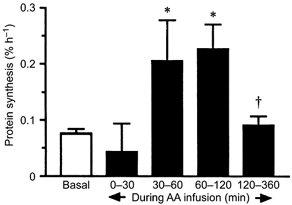
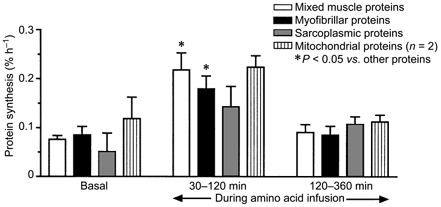
1. The aim of this study was to describe the time course of the response of human muscle protein synthesis (MPS) to a square wave increase in availability of amino acids (AAs) in plasma. We investigated the responses of quadriceps MPS to a approximately 1.7-fold increase in plasma AA concentrations using an intravenous infusion of 162 mg (kg body weight)(-1) h(-1) of mixed AAs. MPS was estimated from D3-leucine labelling in protein after a primed, constant intravenous infusion of D3-ketoisocaproate, increased appropriately during AA infusion. 2. Muscle was separated into myofibrillar, sarcoplasmic and mitochondrial fractions. MPS, both of mixed muscle and of fractions, was estimated during a basal period (2.5 h) and at 0.5-4 h intervals for 6 h of AA infusion. 3. Rates of mixed MPS were not significantly different from basal (0.076 +/- 0.008 % h(-1)) in the first 0.5 h of AA infusion but then rose rapidly to a peak after 2 h of approximately 2.8 times the basal value. Thereafter, rates declined rapidly to the basal value. All muscle fractions showed a similar pattern. 4. The results suggest that MPS responds rapidly to increased availability of AAs but is then inhibited, despite continued AA availability. These results suggest that the fed state accretion of muscle protein may be limited by a metabolic mechanism whenever the requirement for substrate for protein synthesis is exceeded.
Figures
References
-
- Bennet WM, Connacher AA, Scrimgeour CM, Jung RT, Rennie MJ. Euglycemic hyperinsulinemia augments amino acid uptake by human leg tissues during hyperaminoacidemia. American Journal of Physiology. 1990;259:E185–194. - PubMed
-
- Bennet WM, Connacher AA, Scrimgeour CM, Smith K, Rennie MJ. Increase in anterior tibialis muscle protein synthesis in healthy man during mixed amino acid infusion: studies of incorporation of [1-13C]leucine. Clinical Science. 1989;76:447–454. - PubMed
-
- Biolo G, Williams BD, Fleming RYD, Wolfe RR. Insulin action on muscle protein kinetics and amino acid transport during recovery after resistance exercise. Diabetes. 1999;48:949–957. - PubMed
-
- Chinkes D, Klein S, Zhang XJ, Wolfe RR. Infusion of labeled KIC is more accurate than labeled leucine to determine human muscle protein synthesis. American Journal of Physiology. 1996;270:E67–71. - PubMed
Publication types
MeSH terms
Substances
Grants and funding
LinkOut - more resources
Full Text Sources
Other Literature Sources
Medical
