. 2001 May;59(5):965-73.

BAY36-7620: a potent non-competitive mGlu1 receptor antagonist with inverse agonist activity

Affiliations

BAY36-7620: a potent non-competitive mGlu1 receptor antagonist with inverse agonist activity

F Y Carroll et al. Mol Pharmacol. 2001 May.

Abstract

L-Glutamate (Glu) activates at least eight different G protein-coupled receptors known as metabotropic glutamate (mGlu) receptors, which mostly act as regulators of synaptic transmission. These receptors consist of two domains: an extracellular domain in which agonists bind and a transmembrane heptahelix region involved in G protein activation. Although new mGlu receptor agonists and antagonists have been described, few are selective for a single mGlu subtype. Here, we have examined the effects of a novel compound, BAY36-7620 [(3aS,6aS)- 6a-Naphtalen-2-ylmethyl-5-methyliden-hexahydro-cyclopental[c]furan-1-on], on mGlu receptors (mGlu1-8), transiently expressed in human embryonic kidney 293 cells. BAY36-7620 is a potent (IC(50) = 0.16 microM) and selective antagonist at mGlu1 receptors and inhibits >60% of mGlu1a receptor constitutive activity (IC(50) = 0.38 microM). BAY36-7620 is therefore the first described mGlu1 receptor inverse agonist. To address the mechanism of action of BAY36-7620, Glu dose-response curves were performed in the presence of increasing concentrations of BAY36-7620. The results show that BAY36-7620 largely decreases the maximal effect of Glu. Moreover, BAY36-7620 did not displace the [(3)H]quisqualate binding from the Glu-binding pocket, further indicating that BAY36-7620 is a noncompetitive mGlu1 antagonist. Studies of chimeric receptors containing regions of mGlu1 and regions of DmGluA, mGlu2, or mGlu5, revealed that the transmembrane region of mGlu1 is necessary for activity of BAY36-7620. Transmembrane helices 4 to 7 are shown to play a critical role in the selectivity of BAY36-7620. This specific site of action of BAY36-7620 differs from that of competitive antagonists and indicates that the transmembrane region plays a pivotal role in the agonist-independent activity of this receptor. BAY36-7620 will be useful to further delineate the functional importance of the mGlu1 receptor, including its putative agonist-independent activity.


Figures
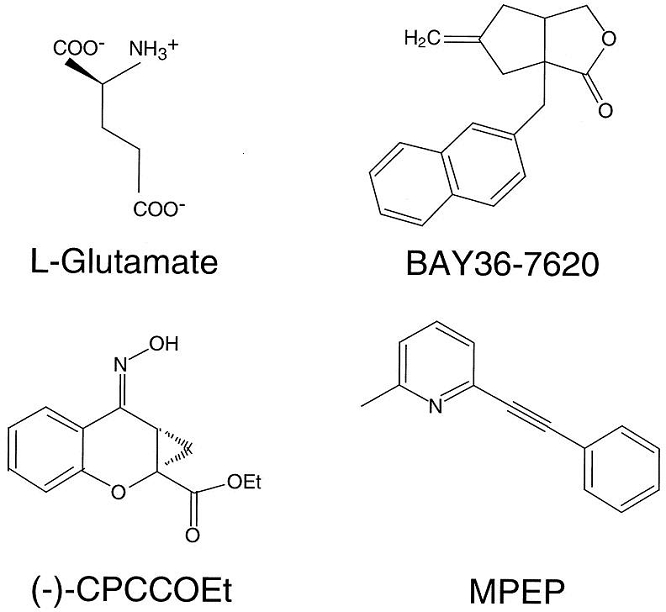
Fig. 1
Fig. 1
Chemical structure of BAY36-7620 ((3aS,6aS)-6a-Naphtalen-2-ylmethyl-5-methyliden-hexahydro-cyclopental[c]furan-1-on), MPEP (2-Methyl-6-6(phenylethynyl)pyridine), CPCCOEt (7-Hydroxyiminocyclopropan[b]chromen-1a-carboxylic acid ethyl ester) and L-glutamate.
Fig. 2
Fig. 2
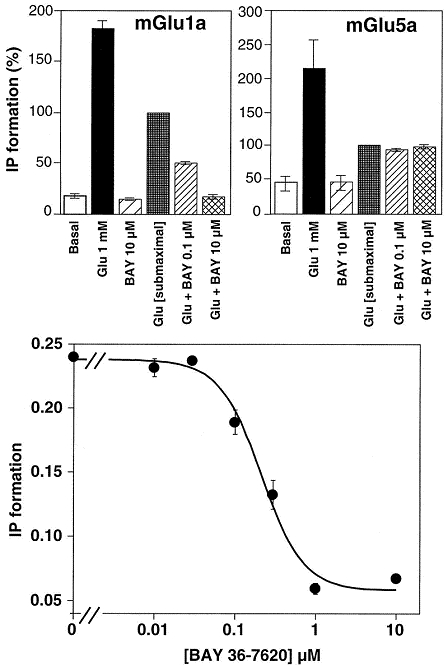
BAY36-7620 alone has no effect on mGlu1 or mGlu5 receptors, however inhibits Glu-induced activation of mGlu1 but not mGlu5. A: BAY36-7620 is selective for mGlu1a over mGlu5a. IP accumulation was measured in HEK 293 cells transiently expressing mGlu1a, or 5a which were incubated with BAY36-7620 (10 μM), or Glu 1μM and 3μM respectively, in the presence of 0.1 & 10 μM BAY36-7620. The data are expressed as the percentage of IP formation measured with a submaximal Glu concentration. Data represent the mean ± s.e.m. of 4-16 experiments performed in triplicate. B: BAY36-7620 inhibits mGlu1 activation in a concentration-dependent manner. IP production by mGlu1 receptors transiently expressed in HEK 293 cells when activated with 1 μM of Glu, in the presence of increasing concentrations of BAY36-7620. Data are expressed as the ratio of IP formation over the radioactivity present in the solubilized fraction of the membranes. A representative of an experiment performed seven times in triplicate is shown.
Fig. 3
Fig. 3
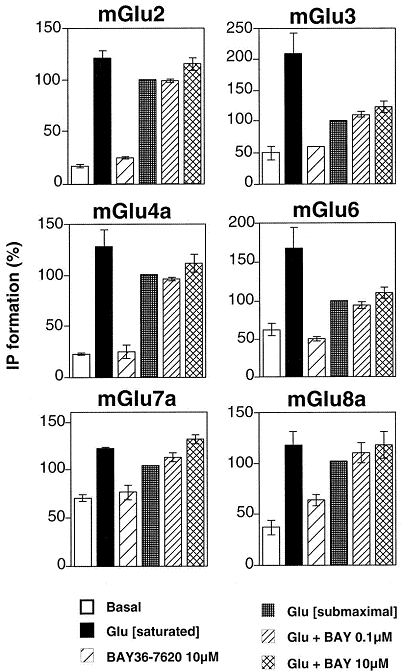
BAY36-7620 has no effect on Group II & III mGlu receptors. IP accumulation was measured in HEK 293 cells transiently expressing mGlu2, 3, 4a, 6, 7a or 8a incubated with saturating concentrations of Glu [1 mM for mGlu1, 2, 3, , 5, 6 & 8 and 10 mM for mGlu7], with BAY36-7620 (10 μM), or with submaximal concentrations of Glu [20μM, 3μM, 30μM, 40μM, 5mM & 20μM respectively], in the presence and absence of 10 μM BAY36-7620. The data are expressed as the percentage of IP formation measured with a submaximal Glu concentration.. Data represent the mean ± s.e.m. of 2-3 experiments performed in triplicate.
Fig. 4
Fig. 4
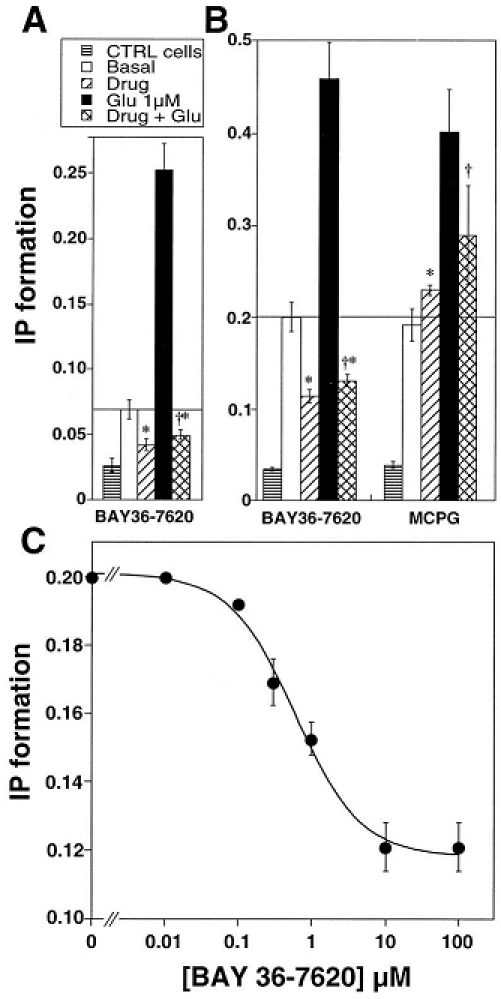
BAY36-7620 is an inverse agonist at mGlu1a. A: Constitutive activity in HEK293 cells over-expressing mGlu1a is significantly inhibited by 10μM BAY36-7620 alone and reduces Glu-stimulated IP accumulation significantly below basal levels. Control cells were mock transfected with carrier protein pRK6 alone, B: BAY36-7620 (10μM) significantly inhibited basal and Glu-induced IP stimulation, to a level significantly lower than basal in HEK293 cells expressing mGlu1 and Gαq, whereas MCPG (3mM) whilst significantly attenuating the Glu-stimulated response did not inhibit constitutive activity in HEK293 cells expressing mGlu1a and Gαq. Control cells were mock transfected with carrier protein pRK6 and Gαq, C: Inhibition of constitutive activity by BAY36-7620 (0.01-100μM) in HEK293 cells expressing mGlu1a and Gαq, is concentration-dependent. Data are expressed as the ratio of IP formation over the radioactivity present in the solubilized fraction of the membranes and represent the mean ± s.e.m. of 2-6 experiments performed in triplicate. One-way ANOVA followed by post-hoc students T-tests were performed – for clarity, only pertinent differences are shown; * = significantly different from basal levels, † = significantly different from Glu 1μM, α =0.05.
Fig. 5
Fig. 5
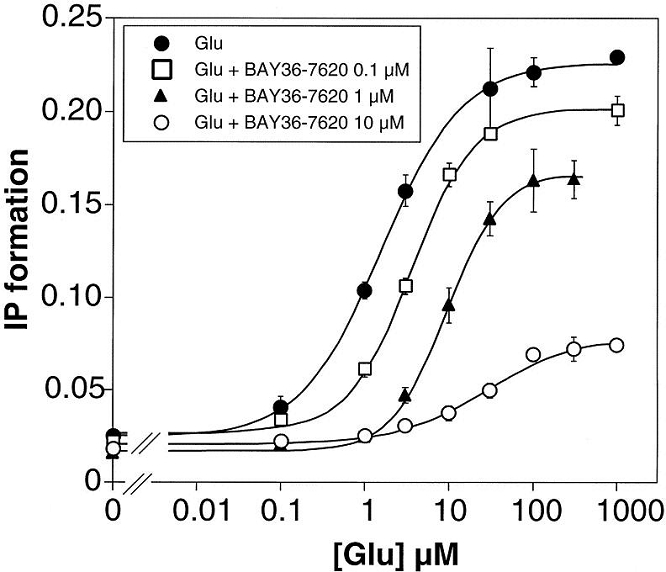
Schild analysis of the effect of BAY36-7620 on Glu activation of mGlu1 reveals that BAY36-7620 is a non-competitive antagonist of mGlu1. Full Glu concentration-responses were performed in the absence or presence of BAY36-7620 0.1; 1, & 10 μM on mGlu1a transiently expressed in HEK 293 cells. Data are expressed as the ratio of IP formation over the radioactivity present in the solubilized fraction of the membranes and a representative of an experiment performed three times in triplicate is shown.
Fig. 6
Fig. 6
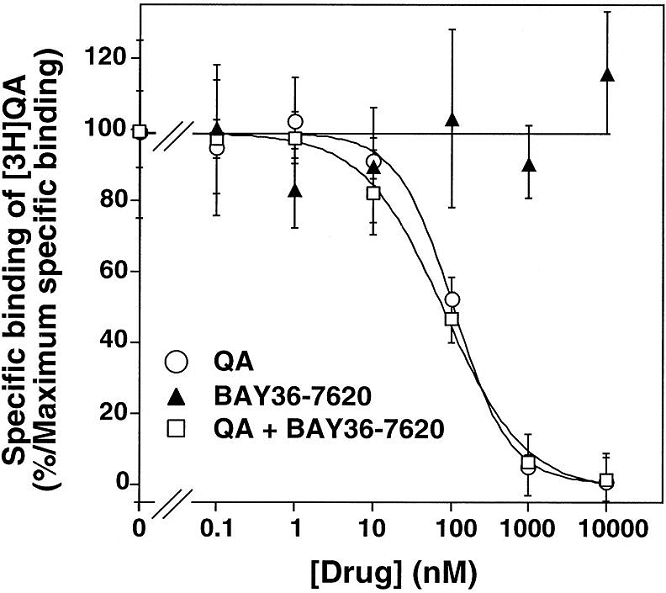
BAY36-7620 does not affect [3H]QA binding. Binding of 600nM [3H]QA in HEK293 cells transiently transfected with mGlu1a was displaced by cold QA, but not by BAY36-7620. The presence of BAY36-7620 does affect the displacement of [3H]QA by cold QA. The presented data are from a representative experiment among four experiments performed in triplicate.
Fig. 7
Fig. 7
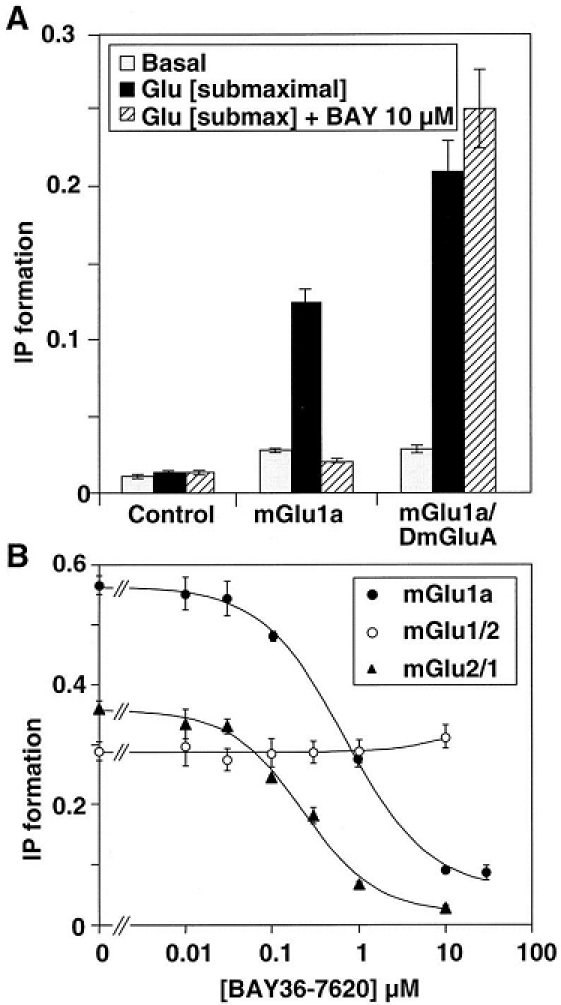
BAY36-7620 interacts with the transmembrane region of mGlu1a. A: The mGlu1/DmGluRA chimeric receptor is not inhibited by BAY36-7620. The mGlu1/DmGluRA chimeric receptor and mGlu1a were expressed in HEK 293 cells and stimulated by 3μM and 1μM Glu respectively, in the presence and absence of 10μM BAY36-7620. Control cells were mock transfected with carrier protein pRK6 alone. Data are expressed as the ratio of IP formation over the radioactivity present in the solubilized fraction of the membranes and represent the mean ± s e.m. of 3 experiments performed in triplicate. B: BAY36-7620 inhibits Glu-induced IP production in HEK293 cells transfected with mGlu1a and the 2/1 mGlu chimera, but has no effect on the 1/2 mGlu chimera. Data are expressed as the ratio of IP formation over the radioactivity present in the solubilized fraction of the membranes and a representative of an experiment performed three times in triplicate is shown.
Fig. 8
Fig. 8
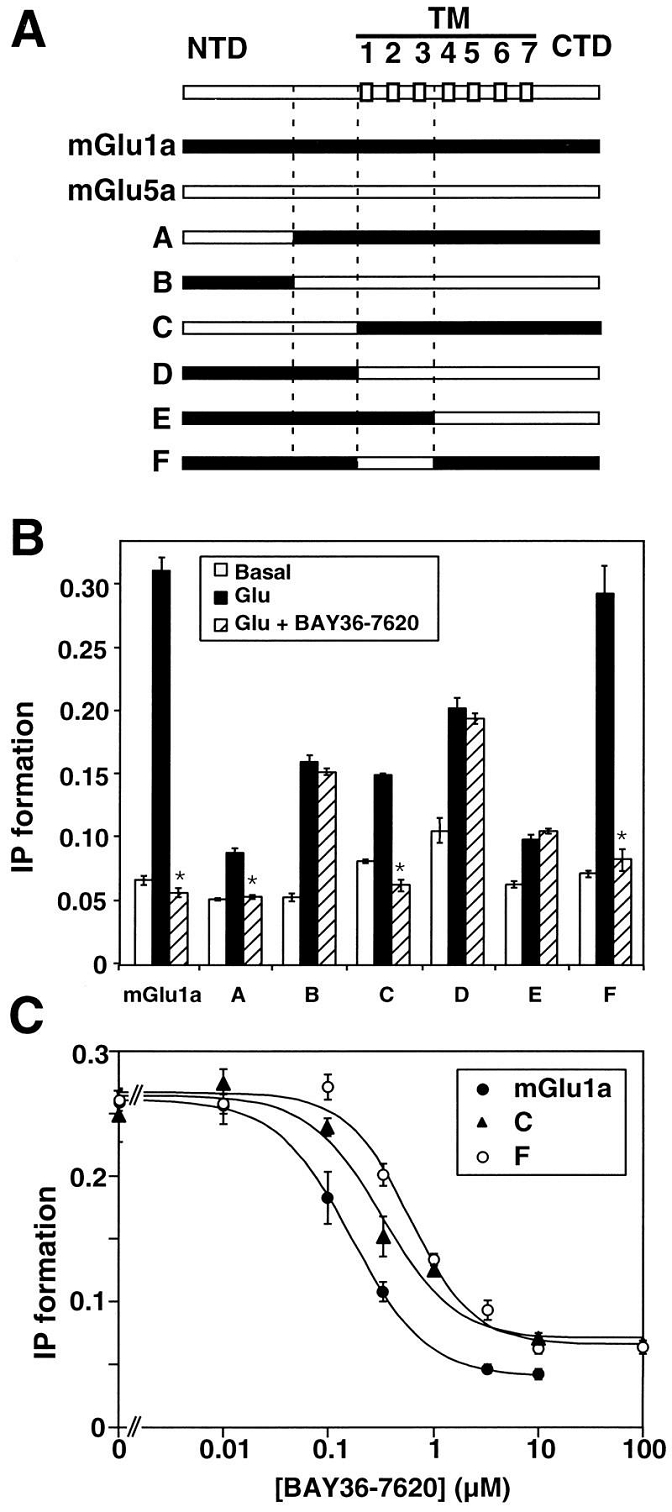
The last four TM of mGlu1a are essential for the specificity of BAY36-7620. A: Schematic diagram of chimeric receptor constructs between mGlu1 and mGlu5, B: Chimeric receptors between mGlu1 & mGlu5 when expressed in HEK293 cells are responsive to Glu 3μM, but differ in their responsiveness to the antagonist BAY36-7620 (10μM). Data are expressed as the ratio of IP formation over the radioactivity present in the solubilized fraction of the membranes and represent the mean ± s. e. m. of 2-7 experiments performed in triplicate. C: The concentration-dependent antagonist effect of BAY36-7620 is similar in mGlu1a and chimeras C & F in which the last four TM and C terminal of mGlu1a remain common. Data are expressed as the ratio of IP formation over the radioactivity present in the solubilized fraction of the membranes and correspond to a representative experiment performed in triplicate. Identical data were obtained in two additional independent experiments. Students T-tests were performed on each chimera to ascertain the ability of BAY36-7620 to reduce the Glu-stimulated response. * = a significant attenuation, α = 0.05.

References

    1. Albert PR, Sajedi N, Lemonde S, Ghahremani MH. Constitutive Gi2-dependent activation of adenylyl cyclase type II by the 5-HT1A receptor. J Biol Chem. 1999;274:35469–35474. - PubMed
    1. Arvanitakis L, Geras-Raaka E, Gershengorn MC. Constitutively signaling G-protein-coupled receptors and human disease. Trends in Endocrinology and Metabolism. 1998;9:27–31. - PubMed
    1. Barker EL, Westphal RS, Schmidt D, Sander-Bush E. Constitutively active 5-hydroxytryptamine 2C receptors reveal novel inverse agonist activity of receptor ligands. J Biol Chem. 1994;269:11687–11690. - PubMed
    1. Bessis A-S, Bertrand H-O, Galvez T, De Colle C, Pin J-P, Acher F. 3D-model of the extracellular domain of the type 4a metabotropic glutamate receptor: new insights into the activation process. Prot Sci. 2000 In press. - PMC - PubMed
    1. Bockaert J, Pin JP. Molecular tinkering of G protein-coupled receptors: an evolutionary success. EMBO J. 1999;18:1723–9. - PMC - PubMed

Publication types

LinkOut - more resources