. 2001 Apr 24;98(9):5181-6.
doi: 10.1073/pnas.081275298. Epub 2001 Apr 17.

Erythropoietin induces tumor regression and antitumor immune responses in murine myeloma models

Affiliations

Erythropoietin induces tumor regression and antitumor immune responses in murine myeloma models

M Mittelman et al. Proc Natl Acad Sci U S A. .

Abstract

Recombinant human erythropoietin (rHuEpo) has been used successfully in the treatment of cancer-related anemia. Clinical observations with several patients with multiple-myeloma treated with rHuEpo has shown, in addition to the improved quality of life, a longer survival than expected, considering the poor prognostic features of these patients. Based on these observations, we evaluated the potential biological effects of rHuEpo on the course of tumor progression by using murine myeloma models (MOPC-315-IgAlambda(2) and 5T33 MM-IgG(2b)). Here we report that daily treatment of MOPC-315 tumor-bearing mice with rHuEpo for several weeks induced complete tumor regression in 30-60% of mice. All regressors that were rechallenged with tumor cells rejected tumor growth, and this resistance was tumor specific. The Epo-triggered therapeutic effect was shown to be attributed to a T cell-mediated mechanism. Serum Ig analysis indicated a reduction in MOPC-315 lambda light chain in regressor mice. Intradermal inoculation of 5T33 MM tumor cells followed by Epo treatment induced tumor regression in 60% of mice. The common clinical manifestation of myeloma bone disease in patients with multiple-myeloma was established in these myeloma models. Epo administration to these tumor-bearing mice markedly prolonged their survival and reduced mortality. Therefore, erythropoietin seems to act as an antitumor therapeutic agent in addition to its red blood cell-stimulating activity.


Figures
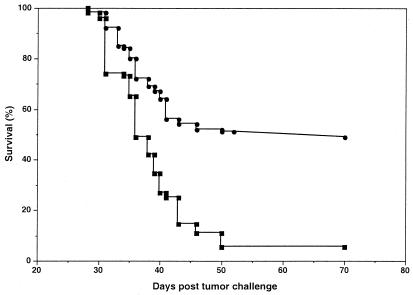
Figure 1
Figure 1
Induction of tumor regression by Epo. Composite results of five independent experiments, comparing survival of tumor cell-inoculated mice treated with Epo (begun 11–13 days after tumor-cell challenge) with survival of control mice treated with the diluent. Mean complete tumor regression was observed in 31 of 61 mice (51%) vs. 3 of 55 (5.4%) in the controls (P < 0.05, Kolmogorov–Smirnov test, one tail). Square, MOPC-315 + diluent; circle, MOPC-315 + Epo.
Figure 2
Figure 2
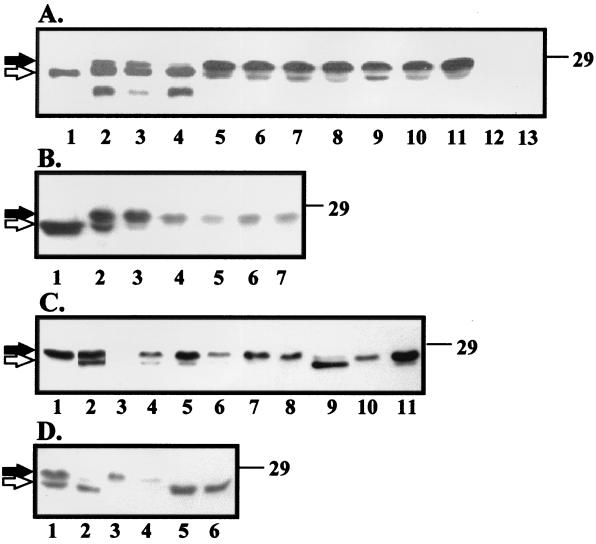
Western blot analysis of sera from tumor-injected mice. (A) Western blot analysis of serum proteins from MPC-11- and MOPC-315-injected mice. Sera (2 μl diluted 1:1 in 0.9% NaCl) from progressor mice injected with MOPC-315 (lanes 2–4), a spontaneous regressor mouse (lane 5), regressor mice treated with EPO (lanes 6–11), MPC11-injected mouse (lane 12), and a control (nontreated) mouse (lane 13), as well as purified Ig from MOPC-315 (lane 1) were resolved by SDS/10% PAGE, and immunoblotted with rabbit anti-mouse λ light chain antibodies (ICN). The enhanced chemiluminescence (ECL) method was used for detection essentially as described (19). The 29-kDa molecular mass marker is depicted on the right. (B) Profile of λ light chain in regressor mice, with respect to time of regression. Regressor mice were bled 2, 6, 12, and 15 months after MOPC-315 cell injection (lanes 3–6, respectively). Serum from an old (12 months) age-matched control (lane 7), purified Ig from MOPC-315 cells (lane 1), and serum from a progressor (lane 2) are depicted for comparison. Sera were resolved by SDS/10% PAGE and analyzed by Western blotting with rabbit anti-mouse λ light chain antibodies, by using ECL for detection. (C) Profile of λ light chain with respect to the viability of injected tumor cells and the time after injection. Representatives of three groups of five mice each on which the experiment was performed are depicted. Mice were bled before tumor-cell injection (lane 3) and 14 days after injection with 104 live cells (lanes 4 and 6), with 106 cells irradiated with 10 Gy (lane 8), or with 0.3 ml of ascitic fluid from an MOPC-315-bearing mouse (lane 10). Mice were bled a third time, 14 days after the second bleed (lanes 5 and 7; lane 9 and lane 11, respectively). Sera from regressor (lane 1) and progressor (lane 2) mice are depicted for comparison. Western blot analysis was performed as described. (D) Binding of sera from mice to 2,4-dinitrophenyl (DNP)-Sepharose. Western blot analysis with rabbit anti-mouse λ light chain antibodies. Sera from mice (5 μl) were incubated with 20 μl of DNP-Sepharose (1:1 slurry) for 1 h at 4°C. The beads were washed three times in PBS containing 0.5% Triton X-100, 0.5% deoxycholate, and 0.1% SDS, followed by two washes in PBS. Samples were then eluted with Laemmli sample buffer and separated on SDS/10% PAGE, followed by Western blot analysis. Lanes 1, 3, and 5 represent sera from progressor and regressor mice as well as MOPC-315 Ig before absorption on DNP-Sepharose. Lanes 2, 4, and 6 represent the eluted samples, respectively.
Figure 3
Figure 3
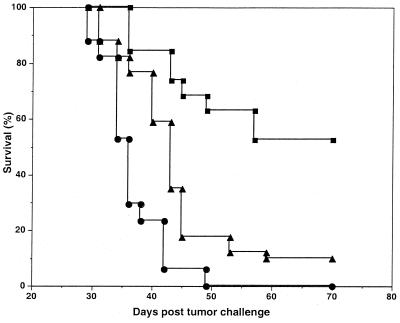
Phenotype of the effector cells. Normal BALB/c mice or mice depleted of CD4+ or CD8+ cells (after two i.v. injections of mAb within 10 days) were injected s.c. with 104 MOPC-315 cells. After tumor-cell challenge (11–13 days), mice were treated with Epo. Tumor regression was observed in 50% of mice in the Epo-treated control group. In contrast, 90–100% tumor growth was observed in Epo-treated mice depleted of CD4+ or CD8+ cells. Square, normal + Epo; circle, anti-CD8 mAb + Epo; triangle, anti-CD4 mAb + Epo.
Figure 4
Figure 4
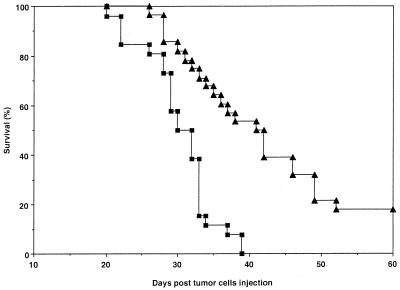
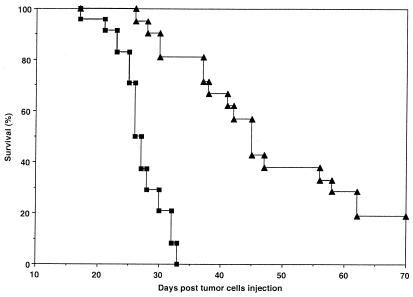
Myeloma bone disease. Female BALB/c mice exposed to 3 Gy whole-body irradiation were injected i.v. with 5 × 10² MOPC-315. After tumor-cell injections (24 h), mice were treated with Epo (solid triangle) or diluent (solid square). The Epo significantly prolonged the survival of treated mice (P = 0.0021, Mann–Whitney U test).
Figure 5
Figure 5
Tumor regression in the 5T myeloma model. A quantity (106) of 5T33 MM cells was injected intradermally into C57BL/KaLwRij mice. When palpable tumors were observed (19 days later), the mice were treated either with diluent (solid squares) or Epo (solid triangles).
Figure 6
Figure 6
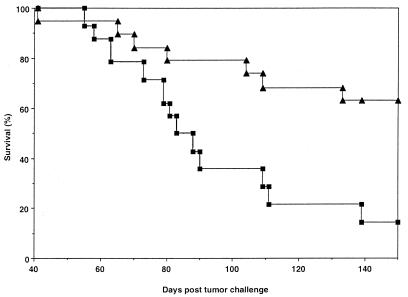
Bone disease in the 5T33 MM model. C57BL/KaLwRij mice were injected i.v. with 5 × 10⁴ 5T33 MM cells. The mice were treated with diluent (solid squares) or Epo (solid triangle) 7 days later. Epo treatment significantly prolonged the survival of treated mice (P < 0.0001, Mann–Whitney U test).

References

    1. Spivak J L, Pham T H, Isaacs M A, Hankins W D. Blood. 1991;77:1228–1233. - PubMed
    1. Lin F K, Suggs S, Lin C H, Brawne J K. Proc Natl Acad Sci USA. 1985;82:7580–7584. - PMC - PubMed
    1. Eschbach J W, Kelly M R, Haley N R, Abels R I, Adamson J W. N Engl J Med. 1989;321:158–163. - PubMed
    1. Ludwig H, Fritz E, Kotzmann H, Hocker P, Gisslinger H, Barnas U. N Engl J Med. 1990;322:1693–1699. - PubMed
    1. Spivak J L. Blood. 1994;84:997–1004. - PubMed

MeSH terms