


Segregation analyses of 1,476 population-based Australian families affected by prostate cancer
- PMID: 11309686
- PMCID: PMC1226101
- DOI: 10.1086/320114
Segregation analyses of 1,476 population-based Australian families affected by prostate cancer
Abstract
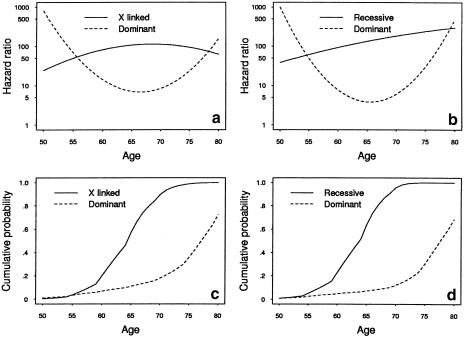
Segregation analyses aim to detect genetic factors that have a major effect on an individual's risk of disease and to describe them in terms of mode of inheritance, age-specific cumulative risk (penetrance), and allele frequency. We conducted single- and two-locus segregation analyses of data from 1,476 men with prostate cancer diagnosed at age <70 years and ascertained through population registries in Melbourne, Sydney, and Perth, Australia, and from their brothers, fathers, and both maternal and paternal lineal uncles. Estimation and model selection were based on asymptotic likelihood theory and were performed through use of the software MENDEL. All two-locus models gave better fits than did single-locus models, even if lineal uncles were excluded or if we censored data (age and disease status) for relatives at 1992, when prostate-specific-antigen testing started to have a major impact on the incidence of prostate cancer in Australia. Among the genetic models that we considered, the best-fitting ones included a dominantly inherited increased risk that was greater, in multiplicative terms, at younger ages, as well as a recessively inherited or X-linked increased risk that was greater, in multiplicative terms, at older ages. The recessive and X-linked effects were strongly confounded, and it was not possible to fit them together. Penetrance to age 80 years was approximately 70% (95% confidence interval [CI] 57%-85%) for the dominant effect and virtually 100% for the recessive and X-linked effects. Approximately 1/30 (95% CI 1/80-1/12) men would carry the dominant risk, and 1/140 (95% CI 1/220-1/90) would carry the recessive risk or 1/200 (95% CI 1/380-1/100) would carry the X-linked risk. Within discussed limitations, these analyses confirm the genetic heterogeneity, of prostate cancer susceptibility, that is becoming evident from linkage analyses, and they may aid future efforts in gene discovery.
Figures
References
Electronic-Database Information
-
- Online Mendelian Inheritance in Man (OMIM), http://www.ncbi.nlm.nih.gov/Omim/ (for BRCA1 [MIM 113705], CTRB1 [MIM 118890], CaP [176807], HPCX [MIM 300147], BRCA2 [MIM 600185], HPC1 [MIM 601518], PCaP [MIM 602759], CAPB [MIM 603688], and HPC2/ELAC2 [MIM 605367])
References
-
- Akaike H (1974) A new look at the statistical model identification. IEEE Transactions on Automatic Control AU-19:716–722
-
- Benichou J (1997) Absolute risk. In: Armitage P, Colton T (eds) Encyclopedia of biostatistics. John Wiley & Sons, Chichester, pp 11–27
-
- Bishop DT, Cannon-Albright L, McLellan T, Gardner EJ, Skolnick MH (1988) Segregation and linkage analysis of nine Utah breast cancer pedigrees. Genet Epidemiol 5:151–169 - PubMed
-
- Bishop DT, Kiemeney LA (1997) Family studies and the evidence for genetic susceptibility to prostate cancer. Semin Cancer Biol 8:45–51 - PubMed
Publication types
MeSH terms
Substances
Grants and funding
LinkOut - more resources
Full Text Sources
Other Literature Sources
Medical
Molecular Biology Databases
