. 2001 May;75(10):4594-603.
doi: 10.1128/JVI.75.10.4594-4603.2001.

Recombinant bovine/human parainfluenza virus type 3 (B/HPIV3) expressing the respiratory syncytial virus (RSV) G and F proteins can be used to achieve simultaneous mucosal immunization against RSV and HPIV3

Affiliations

Recombinant bovine/human parainfluenza virus type 3 (B/HPIV3) expressing the respiratory syncytial virus (RSV) G and F proteins can be used to achieve simultaneous mucosal immunization against RSV and HPIV3

A C Schmidt et al. J Virol. 2001 May.

Abstract

Recombinant bovine/human parainfluenza virus type 3 (rB/HPIV3), a recombinant bovine PIV3 (rBPIV3) in which the F and HN genes were replaced with their HPIV3 counterparts, was used to express the major protective antigens of respiratory syncytial virus (RSV) in order to create a bivalent mucosal vaccine against RSV and HPIV3. The attenuation of rB/HPIV3 is provided by the host range restriction of the BPIV3 backbone in primates. RSV G and F open reading frames (ORFs) were placed under the control of PIV3 transcription signals and inserted individually into the rB/HPIV3 genome in the promoter-proximal position preceding the nucleocapsid protein gene. The recombinant PIV3 expressing the RSV G ORF (rB/HPIV3-G1) was not restricted in its replication in vitro, whereas the virus expressing the RSV F ORF (rB/HPIV3-F1) was eightfold restricted compared to its rB/HPIV3 parent. Both viruses replicated efficiently in the respiratory tract of hamsters, and each induced RSV serum antibody titers similar to those induced by RSV infection and anti-HPIV3 titers similar to those induced by HPIV3 infection. Immunization of hamsters with rB/HPIV3-G1, rB/HPIV3-F1, or a combination of both viruses resulted in a high level of resistance to challenge with RSV or HPIV3 28 days later. These results describe a vaccine strategy that obviates the technical challenges associated with a live attenuated RSV vaccine, providing, against the two leading viral agents of pediatric respiratory tract disease, a bivalent vaccine whose attenuation phenotype is based on the extensive host range sequence differences of BPIV3.


Figures
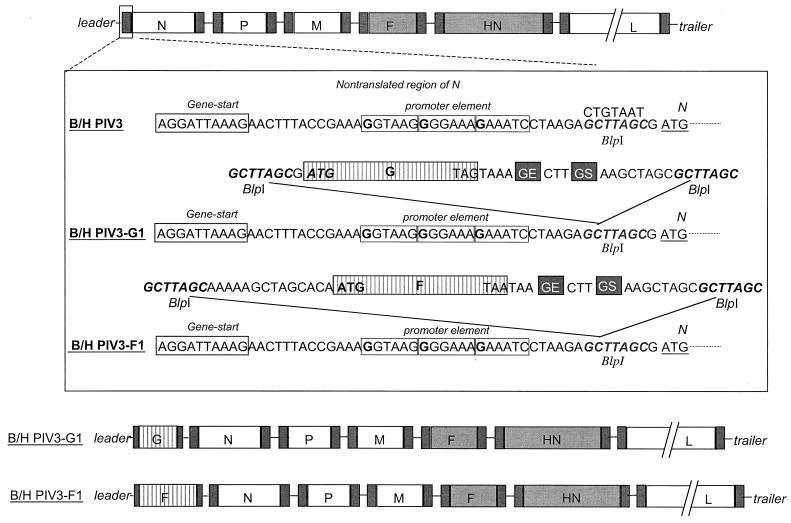
FIG. 1
FIG. 1
Insertion of RSV G or F as an additional, promoter-proximal gene. The B/HPIV3 antigenomic cDNA was modified by introduction of a unique BlpI site (bold italics; the original sequence is shown on top) in the nontranslated region of the N gene preceding the start codon of the N ORF. PCR mutagenesis was used to add a PIV3 gene end (GE), intergenic region, and gene start (GS) signal immediately downstream of the G and F ORF stop signals, and BlpI sites were added on either side of the insert. The sequence AAGTAAGAAAAA was used as the gene end signal, and AGGATTAAAG was used as the gene start signal. Elements of the viral promoter that, by analogy to Sendai virus (56), are present in the N gene nontranslated region are indicated by the three boxed hexamers, with G residues in boldface.
FIG. 2
FIG. 2
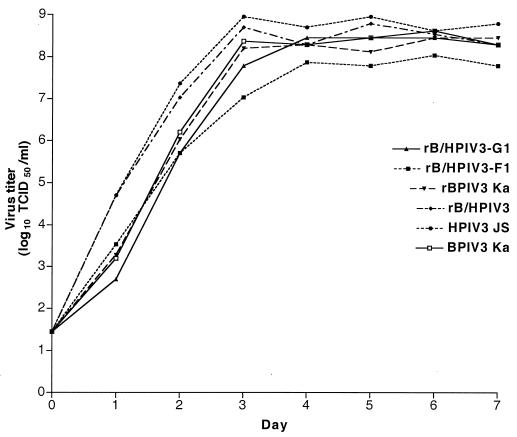
Multicycle replication of rB/HPIV3-G1, rB/HPIV3-F1, and their parental viruses in simian LLC-MK2 cells. Triplicate cultures of LLC-MK2 cells were infected at an MOI of 0.01 with rB/HPIV3-G1, rB/HPIV3-F1, rB/HPIV3, rBPIV3, BPIV3, and HPIV3. Aliquots of cell culture medium were taken at 24-h intervals, and virus titers were determined by serial dilution. Titers are shown as mean log10 TCID50/ml of triplicate samples. The limit of detection of this assay is 101.45 TCID50/ml.
FIG. 3
FIG. 3
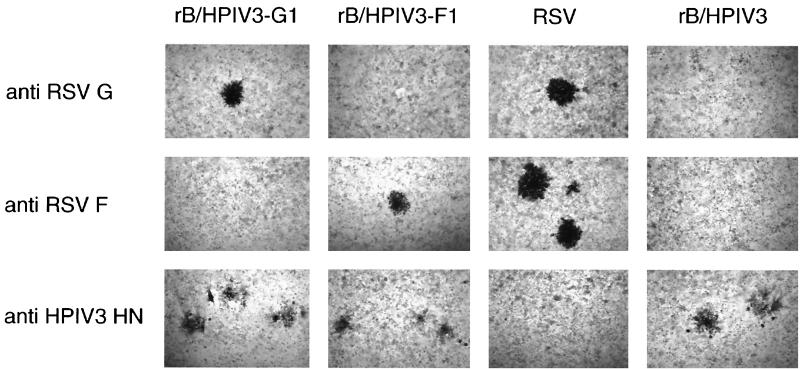
rB/HPIV3-G1 and rB/HPIV3-F1 express RSV G and F glycoproteins, respectively. HEp-2 cells were infected with serial dilutions of the indicated virus and incubated for 5 days under methylcellulose. The wells were fixed, and viral plaques were stained in an immunoperoxidase assay using the indicated antibodies: RSV G-specific MAbs 1187 and 131-2g; RSV F-specific MAbs 1129, 1269, and 1243 (4); and HPIV3 HN-specific MAb 454/11 (11).
FIG. 4
FIG. 4
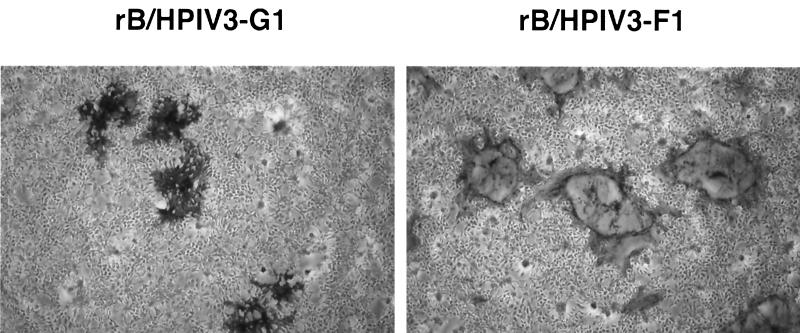
rB/HPIV3-G1 and rB/HPIV3-F1 plaque morphology in Vero cell monolayers. Vero cell monolayers were infected with serial dilutions of rB/HPIV3-G1 or rB/HPIV3-F1, starting at an MOI of 0.01. The wells were fixed, and viral plaques were stained in an immunoperoxidase assay using the indicated antibodies: RSV G-specific MAbs 1187 and 131-2g and RSV F-specific MAbs 1129, 1269, and 1243 (4). rB/HPIV3-G1 induces solid plaques of rounded-up cells similar to rB/HPIV3-induced plaques. rB/HPIV3-F1 induces giant syncytia similar to those seen in RSV-induced plaques.

References

    1. Alwan W H, Kozlowska W J, Openshaw P J. Distinct types of lung disease caused by functional subsets of antiviral T cells. J Exp Med. 1994;179:81–89. - PMC - PubMed
    1. Bailly J E, McAuliffe J M, Durbin A P, Elkins W R, Collins P L, Murphy B R. A recombinant human parainfluenza virus type 3 (PIV3) in which the nucleocapsid N protein has been replaced by that of bovine PIV3 is attenuated in primates. J Virol. 2000;74:3188–3195. - PMC - PubMed
    1. Bailly J E, McAuliffe J M, Skiadopoulos M H, Collins P L, Murphy B R. Sequence determination and molecular analysis of two strains of bovine parainfluenza virus type 3 that are attenuated for primates. Virus Genes. 2000;20:173–182. - PubMed
    1. Beeler J A, van Wyke Coelingh K. Neutralization epitopes of the F glycoprotein of respiratory syncytial virus: effect of mutation upon fusion function. J Virol. 1989;63:2941–2950. - PMC - PubMed
    1. Calain P, Roux L. The rule of six, a basic feature for efficient replication of Sendai virus defective interfering RNA. J Virol. 1993;67:4822–4830. - PMC - PubMed

Publication types

MeSH terms