. 2001 May;75(10):4604-13.
doi: 10.1128/JVI.75.10.4604-4613.2001.

Receptor specificities of human respiroviruses

Affiliations

Receptor specificities of human respiroviruses

T Suzuki et al. J Virol. 2001 May.

Abstract

Through their hemagglutinin-neuraminidase glycoprotein, parainfluenza viruses bind to sialic acid-containing glycoconjugates to initiate infection. Although the virus-receptor interaction is a key factor of infection, the exact nature of the receptors that human parainfluenza viruses recognize has not been determined. We evaluated the abilities of human parainfluenza virus types 1 (hPIV-1) and 3 (hPIV-3) to bind to different types of gangliosides. Both hPIV-1 and hPIV-3 preferentially bound to neolacto-series gangliosides containing a terminal N-acetylneuraminic acid (NeuAc) linked to N-acetyllactosamine (Galbeta1-4GlcNAc) by the alpha2-3 linkage (NeuAcalpha2-3Galbeta1-4GlcNAc). Unlike hPIV-1, hPIV-3 bound to gangliosides with a terminal NeuAc linked to Galbeta1-4GlcNAc through an alpha2-6 linkage (NeuAcalpha2-6Galbeta1-4GlcNAc) or to gangliosides with a different sialic acid, N-glycolylneuraminic acid (NeuGc), linked to Galbeta1-4GlcNAc (NeuGcalpha2-3Galbeta1-4GlcNAc). These results indicate that the molecular species of glycoconjugate that hPIV-1 recognizes are more limited than those recognized by hPIV-3. Further analysis using purified gangliosides revealed that the oligosaccharide core structure is also an important element for binding. Gangliosides that contain branched N-acetyllactosaminoglycans in their core structure showed higher avidity than those without them. Agglutination of human, cow, and guinea pig erythrocytes but not equine erythrocytes by hPIV-1 and hPIV-3 correlated well with the presence or the absence of sialic acid-linked branched N-acetyllactosaminoglycans on the cell surface. Finally, NeuAcalpha2-3I, which bound to both viruses, inhibited virus infection of Lewis lung carcinoma-monkey kidney cells in a dose-dependent manner. We conclude that hPIV-1 and hPIV-3 preferentially recognize oligosaccharides containing branched N-acetyllactosaminoglycans with terminal NeuAcalpha2-3Gal as receptors and that hPIV-3 also recognizes NeuAcalpha2-6Gal- or NeuGcalpha2-3Gal-containing receptors. These findings provide important information that can be used to develop inhibitors that prevent human parainfluenza virus infection.


Figures
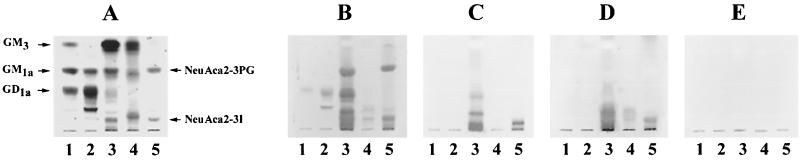
FIG. 1
FIG. 1
Binding of respiroviruses to mixtures of gangliosides in virus overlay assays. Total gangliosides (each 5 nmol as sialic acid) and specific kinds of gangliosides (1 nmol) were spotted on silica gel plastic plates and subjected to chromatography with solvent system 1. (A) Gangliosides were detected with resorcinol-hydrochloric acid reagent. (B to D) Ganglioside binding by SV (B), hPIV-1 (C), and hPIV-3 (D) was detected by using virus overlay assays and anti-HN MAbs specific for each virus. (E) A chromatogram was incubated without virus and later incubated with a mixture of anti-HN MAbs. Lanes 1, GM3, GM1a, and GD1a; lanes 2, total gangliosides from bovine brain; lanes 3, total gangliosides from human placenta; lanes 4, total gangliosides from human meconium; lanes 5, NeuAcα2–3PG and NeuAcα2–3I.
FIG. 2
FIG. 2
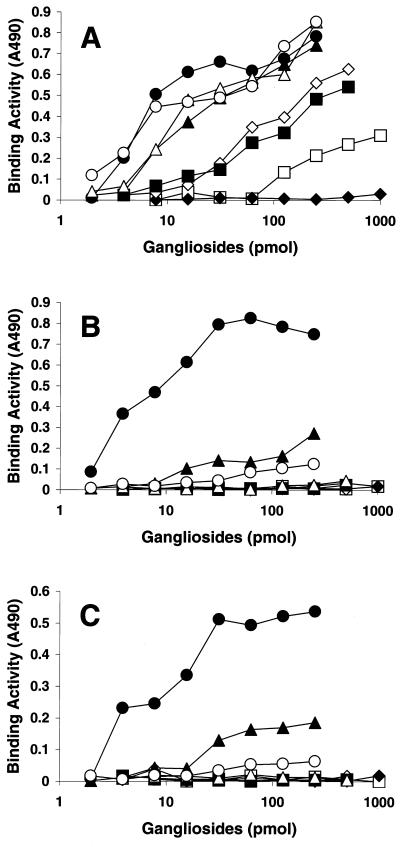
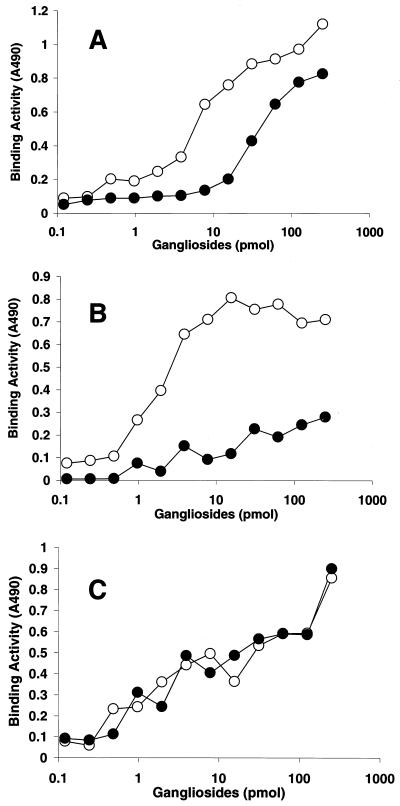
Binding of respiroviruses to gangliosides in solid-phase binding assays. The binding activities of SV (A), hPIV-1 (B), and hPIV-3 (C) were calculated as the mean values of triplicate measurements of the absorbance at 490 nm (A490) after the subtraction of background values. Symbols: ●, NeuAcα2–3I; ○, NeuAcα2–3PG; ♦, GM1a and GD1b; ⋄, GD1a; ▴, NeuAcα2–3i; ▵, GQ1b; ▪, GT1b; □, GM3.
FIG. 3
FIG. 3
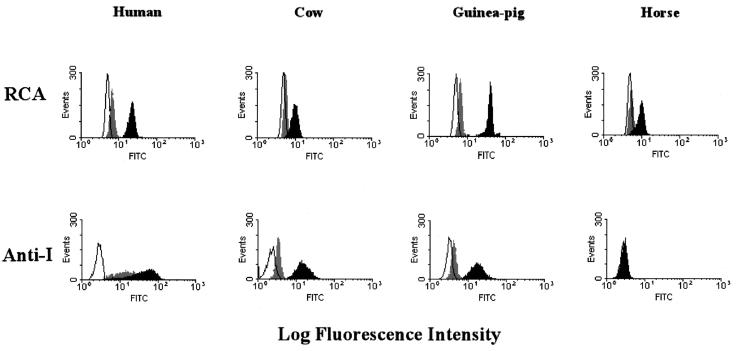
Comparison of blood group I antigen on the surface of native and sialidase-treated animal erythrocytes by FACS analysis. Human anti-I serum was used for the detection of blood group I antigen. Native and sialidase-treated erythrocytes from humans, cows, guinea pigs, and horses were fixed and incubated with human anti-I serum. As a control, biotin-labeled R. communis agglutinin (RCA) was used for the detection of ubiquitous glycans on the erythrocytes. As a negative control, fixed erythrocytes were incubated without anti-I serum and R. communis agglutinin. The erythrocytes were washed with PBS and incubated with the FITC-conjugated F(ab′)2 fragment of rabbit anti-human IgM antibody or FITC-conjugated streptavidin. The fluorescence intensities of the cells were analyzed. The white, gray, and solid portions of each histogram indicate results obtained with negative control cells, intact cells, and sialidase-treated cells, respectively.
FIG. 4
FIG. 4
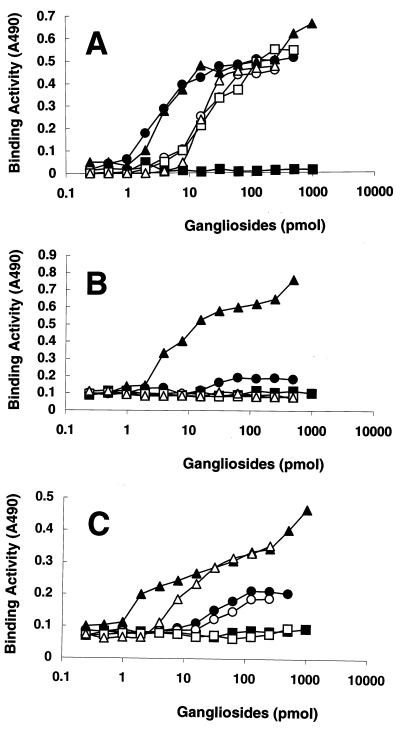
Binding of respiroviruses to neolacto-series gangliosides containing different terminal sialyl linkages in solid-phase binding assays. The binding activities of SV (A), hPIV-1 (B), and hPIV-3 (C) were calculated as described in the legend to Fig. 2. GM1a and GD1a were used as controls. Symbols: ●, NeuAcα2–3PG; ○, NeuAcα2–6PG; ▴, NeuAcα2–3I; ▵, NeuAcα2–6I; ▪, GM1a; □, GD1a.
FIG. 5
FIG. 5
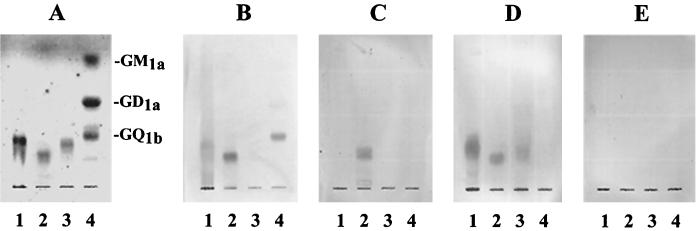
Binding of respiroviruses to blood group I-type gangliosides containing different terminal molecular species of sialic acid in virus overlay assays. Specific types of gangliosides (1 nmol) were spotted on silica gel plastic plates and subjected to chromatography with solvent system 2. (A) Gangliosides were detected with resorcinol-hydrochloric acid reagent. (B to D) Virus overlay assays with SV (B), hPIV-1 (C), and hPIV-3 (D) were done as described in the legend to Fig. 1 and in Materials and Methods. (E) A chromatogram that was incubated without virus and with a mixture of anti-HN MAbs served as a negative control. Lanes 1, NeuGcα2–3I; lanes 2, NeuAcα2–3I; lanes 3, NeuAcα2–6I; lanes 4, GM1a, GD1a, and GQ1b.
FIG. 6
FIG. 6
Binding of respiroviruses to serial dilutions of blood group I-type gangliosides containing different terminal molecular species of sialic acid in solid-phase binding assays. The binding activities of SV (A), hPIV-1 (B), and hPIV-3 (C) were calculated as described in the legend to Fig. 2. Symbols: ○, NeuAcα2–3I; ●, NeuGcα2–3I.
FIG. 7
FIG. 7
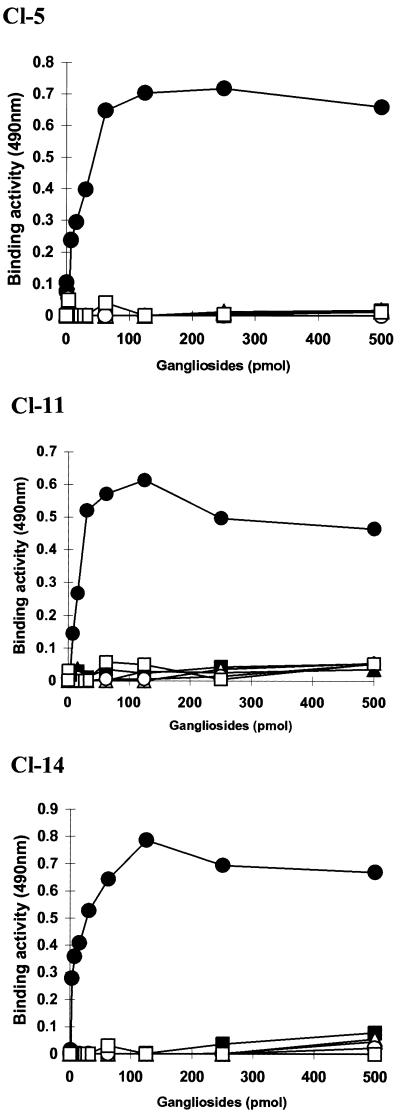
Binding of hPIV-1 clinical isolates to gangliosides in solid-phase binding assays. The binding activities of hPIV-1 clinical isolates Cl-5, Cl-11, and Cl-14 were calculated as described in the legend to Fig. 2. Symbols: ●, NeuAcα2–3I; ○, NeuAcα2–6I; ▴, NeuAcα2–6SPG; ▵, GD1a; ▪, GM1a; □, GM3.
FIG. 8
FIG. 8
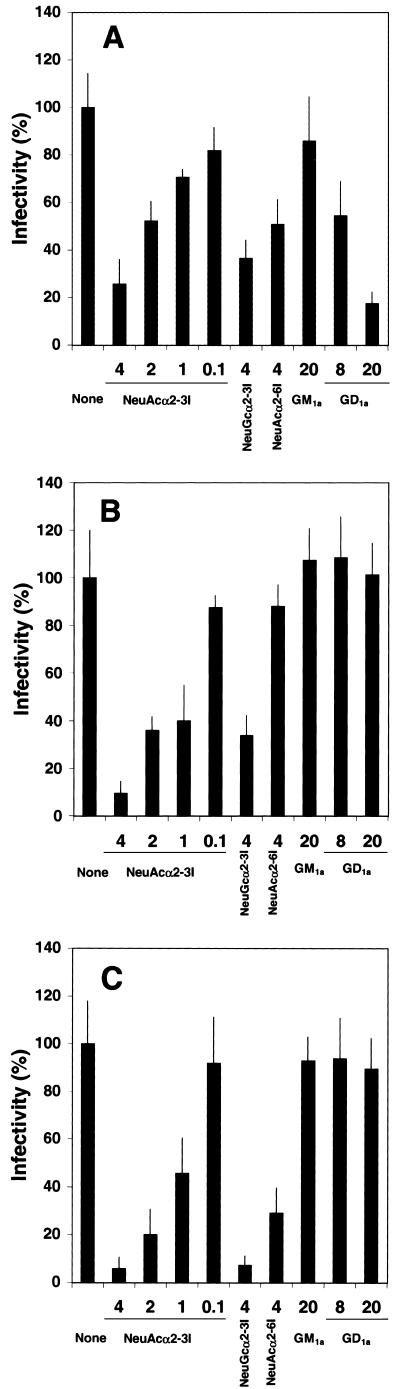
Ganglioside-mediated inhibition of respirovirus infection of LLC-MK2 cells. The percentage of infectivity is the ratio of the total number of cells infected with viruses (SV [A], hPIV-1 [B], or hPIV-3 [C]) that were pretreated with various gangliosides (y axis; in nanomoles) to the number of cells infected with viruses that were not pretreated with gangliosides. The values are the means and standard deviations for three measurements.

References

    1. Ah-Tye C, Schwartz S, Huberman K, Carlin E, Moscona A. Virus-receptor interactions of human parainfluenza viruses type 1, 2 and 3. Microb Pathog. 1999;27:329–336. - PubMed
    1. Baenziger J U, Fiete D. Structure determinants of Ricinus communis agglutinin and toxin specificity for oligosaccharides. J Biol Chem. 1979;254:9795–9799. - PubMed
    1. Collins P L, Chanock R M, McIntosh K. Parainfluenza viruses. In: Fields B N, Knipe D M, Howley P M, editors. Fields virology. Philadelphia, Pa: Lippincott-Raven; 1996. pp. 1205–1241.
    1. Connor R J, Kawaoka Y, Webster R G, Paulson J C. Receptor specificity in human, avian, and equine H2 and H3 influenza virus isolates. Virology. 1994;205:17–23. - PubMed
    1. Conyers S M, Kidwell D A. Chromogenic substrates for horseradish peroxidase. Anal Biochem. 1991;192:207–211. - PubMed

Publication types

LinkOut - more resources