. 2001 May 1;532(Pt 3):673-84.
doi: 10.1111/j.1469-7793.2001.0673e.x.

Pregnenolone sulfate block of GABA(A) receptors: mechanism and involvement of a residue in the M2 region of the alpha subunit

Affiliations

Pregnenolone sulfate block of GABA(A) receptors: mechanism and involvement of a residue in the M2 region of the alpha subunit

G Akk et al. J Physiol. .

Abstract

Neurosteroids are produced in the brain, and can have rapid actions on membrane channels of neurons. Pregnenolone sulfate (PS) is a sulfated neurosteroid which reduces the responses of the [gamma]-aminobutyric acid A (GABA(A)) receptor. We analysed the actions of PS on single-channel currents from recombinant GABA(A) receptors formed from [alpha]1, [beta]2 and [gamma]2L subunits. Currents were elicited by a concentration of GABA eliciting a half-maximal response (50 microM) and a saturating concentration (1 mM). PS reduced the duration of clusters of single-channel activity at either concentration of GABA. PS had no discernable effect on rapid processes: no effects were apparent on channel opening and closing, nor on GABA affinity, and a rapidly recovering desensitised state was not affected. Instead, PS produced a slowly developing block which occurred at a similar rate for receptors with open or closed channels and with one or two bound GABA molecules. The rate of block was independent of membrane potential, implying that the charged sulfate moiety does not move through the membrane field. Change in a specific residue near the intracellular end of the channel lining portion of the [alpha]1 subunit had a major effect on the rate of block. Mutation of the residue [alpha]1 V256S reduced the rate of block by 30-fold. A mutation at the homologous position of the [beta]2 subunit ([beta]2 A252S) had no effect, nor did a complementary mutation in the [gamma]2L subunit ([gamma]2L S266A). It seems likely that this residue is involved in a conformational change underlying block by PS, instead of forming part of the binding site for PS.


Figures

Figure 1
Figure 1. PS has similar effects on clusters at two GABA concentrations
Single clusters elicited by 50 μm or 1 mm GABA are shown in the top row (the current through an open channel is downwards). The middle row shows typical clusters in the presence of 10 μm PS, while the bottom row shows two clusters in the presence of 50 μm PS. Note that the clusters are of similar duration at the two GABA concentrations, and are reduced similarly by increasing concentrations of PS. The probability of being open is about twice as high in the presence of 1 mm GABA compared with 50 μm, as can be seen in the top and middle traces. Data recorded cell attached with a membrane potential of about -100 mV (see Methods).
Figure 2
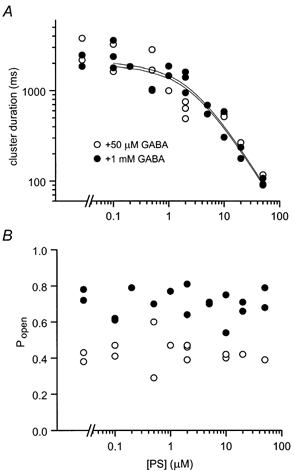
Figure 2. Dependence on [PS] of the reduction in cluster duration and the cluster P open
A, mean cluster duration (T([PS])) for data from individual patches plotted against [PS] (note logarithmic abscissal co-ordinates; the points on the left are for GABA with no PS). The data for activity elicited by 50 μm and 1 mm GABA overlap at all [PS]. The lines show the fits of eqn (2). When eqn (1) is fitted to the data, the best-fitting parameter estimates are: 50 μm GABA, Tmax 2652 ± 1158 ms, nH -0.8 ± 0.2, IC50 0.9 ± 1.1 μm; 1 mm GABA, Tmax 2149 ± 362 ms, nH -1.0 ± 0.1, IC50 2.1 ± 1.0 μm. For eqn (2), the values are k+D 0.52 ± 0.11 s−1, k+PS 0.21 ± 0.04 μm−1 s−1 (50 μm) and k+D 0.48 ± 0.06 s−1, k+PS 0.20 ± 0.03 μm−1 s−1 (1 mm). B shows there is no change in P open over the same range of [PS]. Each point shows data from a single patch.
Figure 3
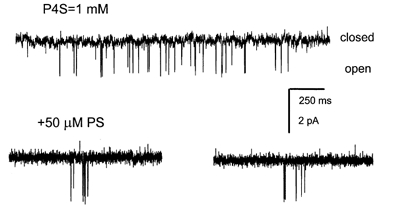
Figure 3. PS reduces the durations of clusters elicited by a low efficacy agonist
A single cluster elicited by 1 mm piperidine-4-sulfonic acid (P4S) is shown in the upper row, while the lower row shows typical clusters elicited by 1 mm P4S in the presence of 50 μm PS. The probability of being open in clusters elicited by P4S is very low (compare with Fig. 1), but PS reduces the cluster duration. Data recorded cell attached with a membrane potential of about -100 mV (see Methods).
Figure 4
Figure 4. PS does not change the histograms of open or closed times within clusters
Histograms of the open durations (first and second columns) and closed durations (third and fourth columns) are shown for clusters elicited by 50 μm (a) or 1 mm GABA (b) in the absence (first and third columns) or presence (second and fourth columns) of 50 μm PS. Each histogram shows data from a single patch. In each case the data have been fitted with the sum of 3 exponential components (time constants given in the panels), shown by the continuous lines. The collected data on the mean durations and fractional areas of the 3 components are shown in Fig. 5. Note that the histograms are displayed with the square root of the number of counts in each bin, and bins are logarithmically scaled.
Figure 5
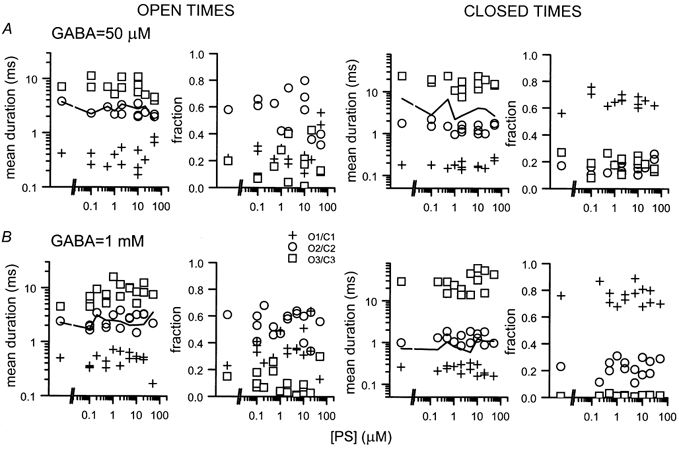
Figure 5. PS does not change the distributions of open or closed times within clusters
The mean durations and relative areas of the components fitted to the duration histograms are shown for clusters elicited by 50 μm GABA (A) and 1 mm GABA (b) at a range of PS concentrations. The data from a patch (1000-20 000 sojourns) were well fitted with the sum of 3 exponential components (identified as O1, O2, O3 and C1, C2, C3, respectively) with time constants separated 3- to 10-fold. The plots show results from individual patches plotted against [PS]; note that the points on the left in each panel are for patches with no PS. The lines in panels showing mean durations denote the weighted average durations of all 3 components of the respective histograms. The plots in the first column show the mean open times (in ms) for each component while the plots in the second column show the fraction of the total open times in each component. Note that PS has no effect on the durations or prevalence of open-time components nor the weighted average duration. There is also no apparent difference between open-time distributions in the presence of 50 μm and 1 mm GABA. The third and fourth columns show the data for closed times in the same format: the mean closed time for each component (third column), then the fraction of the total closed times in each component (fourth column). In contrast to the data on open times, there is a change in the distributions of closed times between the two GABA concentrations, most clearly seen in the fractional representation in each component (fourth column; compare A with B). However, again PS has no effect on the duration or prevalence of the closed-time components nor on the weighted average duration.
Figure 6
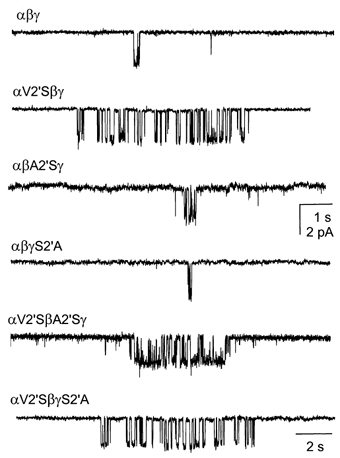
Figure 6. Mutation in the α subunit reduces the ability of PS to shorten cluster duration
Representative clusters elicited by 1 mm GABA in the presence of 50 μm PS are shown. Note that the clusters in the presence of PS are much longer when the receptor contains the mutated α1(V2′S) subunit, while the mutated β2(A2′S) or γ2(S2′A) subunits have no effect by themselves, nor do they alter the consequences of incorporating the α1(V2′S) subunit. The bottom trace has a different time scale from the others

References

    1. Akk G, Steinbach JH. Activation and block of recombinant GABAA receptors by pentobarbitone: a single-channel study. British Journal of Pharmacology. 2000;130:249–258. - PMC - PubMed
    1. Amin J, Weiss DS. GABAA receptor needs two homologous domains of the β-subunit for activation by GABA but not by pentobarbital. Nature. 1993;366:565–569. - PubMed
    1. Ausubel FM, Brent R, Kingston RE, Moore DD, Seidman JG, Smith JA, Struhl K. Short Protocols in Molecular Biology. 2. New York: John Wiley; 1992.
    1. Charnet P, Labarca C, Leonard RJ, Vogelaar NJ, Czyzyk L, Gouin A, Davidson N, Lester HA. An open-channel blocker interacts with adjacent turns of α-helices in the nicotinic acetylcholine receptor. Neuron. 1990;4:87–95. - PubMed
    1. Corpechot C, Collins BE, Carey MP, Tsouros A, Robel P, Fry JP. Brain neurosteroids during the mouse oestrous cycle. Brain Research. 1997;766:276–280. - PubMed

Publication types

MeSH terms

LinkOut - more resources