. 2001 May;21(10):3491-502.
doi: 10.1128/MCB.21.10.3491-3502.2001.

A bipartite yeast SSRP1 analog comprised of Pob3 and Nhp6 proteins modulates transcription

Affiliations

A bipartite yeast SSRP1 analog comprised of Pob3 and Nhp6 proteins modulates transcription

N K Brewster et al. Mol Cell Biol. 2001 May.

Abstract

The FACT complex of vertebrate cells, comprising the Cdc68 (Spt16) and SSRP1 proteins, facilitates transcription elongation on a nucleosomal template and modulates the elongation-inhibitory effects of the DSIF complex in vitro. Genetic findings show that the related yeast (Saccharomyces cerevisiae) complex, termed CP, also mediates transcription. The CP components Cdc68 and Pob3 closely resemble the FACT components, except that the C-terminal high-mobility group (HMG) box domain of SSRP1 is not found in the yeast homolog Pob3. We show here that Nhp6a and Nhp6b, small HMG box proteins with overlapping functions in yeast, associate with the CP complex and mediate CP-related genetic effects on transcription. Absence of the Nhp6 proteins causes severe impairment in combination with mutations impairing the Swi-Snf chromatin-remodeling complex and the DSIF (Spt4 plus Spt5) elongation regulator, and sensitizes cells to 6-azauracil, characteristic of elongation effects. An artificial SSRP1-like protein, created by fusing the Pob3 and Nhp6a proteins, provides both Pob3 and Nhp6a functions for transcription, and competition experiments indicate that these functions are exerted in association with Cdc68. This particular Pob3-Nhp6a fusion protein was limited for certain Nhp6 activities, indicating that its Nhp6a function is compromised. These findings suggest that in yeast cells the Cdc68 partners may be both Pob3 and Nhp6, functioning as a bipartite analog of the vertebrate SSRP1 protein.


Figures
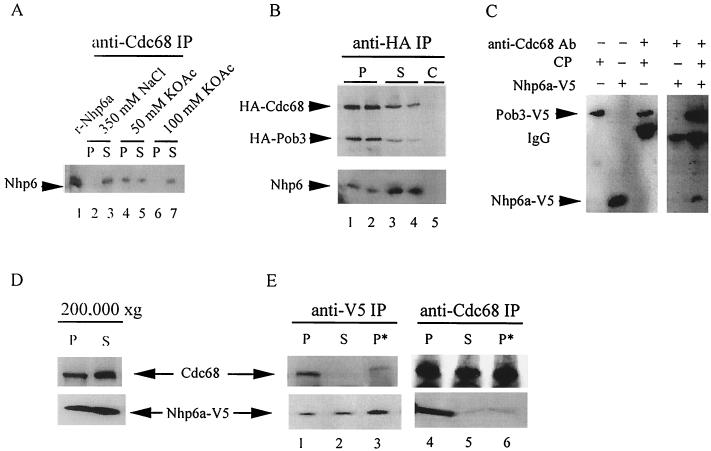
FIG. 1
FIG. 1
Nhp6 protein physically associates with the CP complex. (A) Material immunoprecipitated by anti-Cdc68 antibody (P) from a whole-cell extract (strain W303-1a) and that remaining in the supernatant (S) were resolved electrophoretically on a 15% polyacrylamide–sodium dodecyl sulfate gel and analyzed by Western blotting with anti-Nhp6a antibody. The buffer for extract preparation and immunoprecipitation contained 350 mM NaCl, 50 mM potassium acetate, or 100 mM potassium acetate as indicated. Recombinant Nhp6a protein (25 ng) served as the marker. (B) Material immunoprecipitated (P) or remaining in the supernatant (S) after treatment of whole-cell extracts of cells containing HA-tagged Cdc68 and Pob3 proteins (strain NQ6811) with anti-HA monoclonal antibody was resolved (8 and 15% gels) and analyzed by Western blotting with anti-HA and anti-Nhp6a antibodies. The negative control (designated C) comprised a whole-cell extract of untagged cells (strain W303-1a) treated as described above. Immunoprecipitations are shown for two independent experiments. (C) Nhp6a and the CP complex associate in vitro. Nhp6a-V5-His6 protein and CP containing Pob3-V5-His6 were separately purified (from strains RJY6249 harboring p314NV5 and NB6244) using metal affinity resin as described in the text, mixed, and immunoprecipitated with anti-Cdc68 antibody. Resulting Western blots of purified and immunoprecipitated material were probed with anti-V5 antibody. Data are from two independent experiments. (D) Nhp6-associated CP complex associates with high-molecular-weight material. A whole-cell extract from cells containing Nhp6a-V5-His6 protein (strain NB6241) made in 50 mM potassium acetate buffer was fractionated by centrifugation (1.5 h) at 200,000 × g to yield supernatant (S) and pellet (P) fractions. The pellet fraction was then resuspended in an original volume of 50 mM potassium acetate or 350 mM NaCl extraction buffer (P∗). Equal volumes were resolved (6-10-15% gel) and assayed by Western blotting with anti-Cdc68 or anti-V5 antibody. (E) Material immunoprecipitated from equal volumes of the indicated fractions with anti-Cdc68 or anti-V5 antibody was resolved (6-10-15% gels) and assayed by Western blotting using anti-Cdc68 and anti-V5 antibody.
FIG. 2
FIG. 2
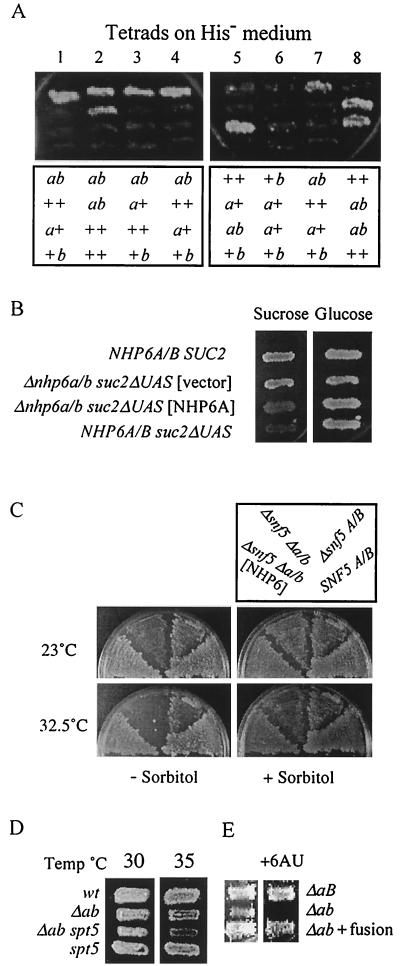
Nhp6 protein mediates transcription. (A) Haploid segregants from diploid strain NB40 (Δnhp6a::URA3/+ Δnhp6b::LEU2/+ his4-912δ/his4-912δ lys2-128δ/lys2-128δ) were grown on solid rich medium and replica plated to histidine-free medium to assess functional transcription from the his4-912δ reporter gene. The lower panels indicate NHP6A/B genotypes as indicated by Ura and Leu phenotypes. (B) Representative segregants from AW11-9a × NB6040 with genotypes suc2ΔUAS Δnhp6a/b harboring the NHP6A plasmid p314-NV5 or the pRS314 vector, SUC2 Δnhp6a/b, and suc2ΔUAS NHP6A NHP6B were grown on solid rich medium at 28°C, replica plated to rich medium containing glucose or sucrose (plus antimycin A at 1 μg/ml) as the carbon source, and incubated 3 days at 23°C. (C) Representative segregants from FY711 × NB39-18a with genotypes snf5-5::URA3 Δnhp6a/b with or without p314-NV5, SNF5 NHP6A NHP6B, and snf5-5 NHP6A NHP6B were grown on solid rich medium at 23°C, replica plated to rich medium, with or without 1 M sorbitol, containing glucose or sucrose (plus antimycin A) as the carbon source, and incubated for 6 days at 23 and 33°C. (D) Representative segregants from NB39-24b × (FY300 × NB39-11a segregant) were replica plated onto rich medium and incubated at the indicated temperatures. (E) Representative PPR2 segregants from NB2Δp-28b × NB40-1aF with genotypes Δnhp6a::URA3 Δnhp6b::LEU2, Δnhp6a::URA3 NHP6B, and Δnhp6a::URA3 Δnhp6b::LEU2 with POB3-NHP6A in place of POB3 were replica plated to uracil-free medium containing 6AU (100 μg/ml) and incubated at 28°C.
FIG. 3
FIG. 3
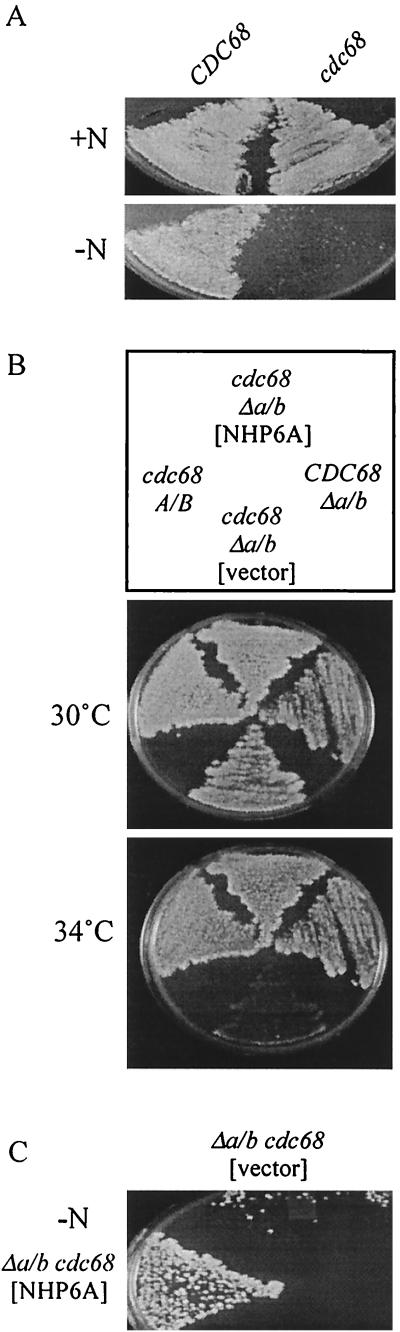
Nhp6 and Cdc68 proteins have related effects. (A) Cdc68 function helps to maintain viability upon nitrogen starvation. Cells of the cdc68-Δ922 strain DE4B-20a and the CDC68 strain DE4B-20b were grown on solid rich medium, replica plated to enriched synthetic medium lacking (NH4)2SO4, incubated 4 days, and then replica plated to rich medium and incubated 2 days to allow growth after starvation. All incubations were carried out at 23°C. (B) Nhp6 facilitates CP function. Cells of the cdc68-Δ922 Δnhp6a/b strain NB4B-3b harboring p314-NV5 or pRS314, the CDC68 Δnhp6a/b strain NB6040 harboring pRS314, and the cdc68-Δ922 NHP6A NHP6B strain DE4B-20a harboring pRS314 were grown on enriched selective medium at 23°C, replica plated to the same medium, and incubated at 30 and 34°C. (C) Cells of the cdc68-Δ922 Δnhp6a/b strain NB4B-1c harboring p314-NV5 or pRS314 were grown on solid enriched selective medium, replica plated to enriched selective medium lacking (NH4)2SO4, incubated 2 days, and then replica plated to rich medium and incubated 6 days to allow growth after starvation.
FIG. 4
FIG. 4
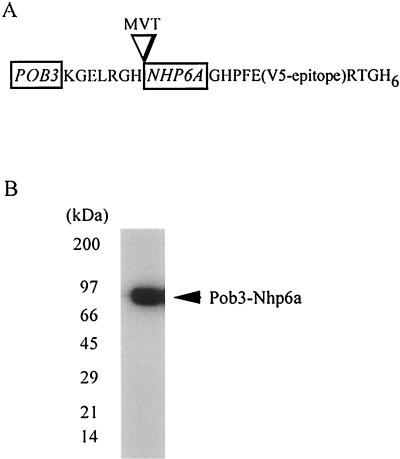
Pob3-Nhp6a fusion protein. (A) Schematic of the Pob3-Nhp6a protein tagged with V5 epitope and His6 tract; single-letter amino acid abbreviations are used. (B) The Pob3-Nhp6a-V5-His6 fusion protein is intact in vivo. A whole-cell extract (350 mM NaCl extraction buffer) from Δnhp6a/b POB3-NHP6A cells (strain NB6249) was resolved (6-10-15% gel) and analyzed by Western blotting with anti-V5 antibody.
FIG. 5
FIG. 5
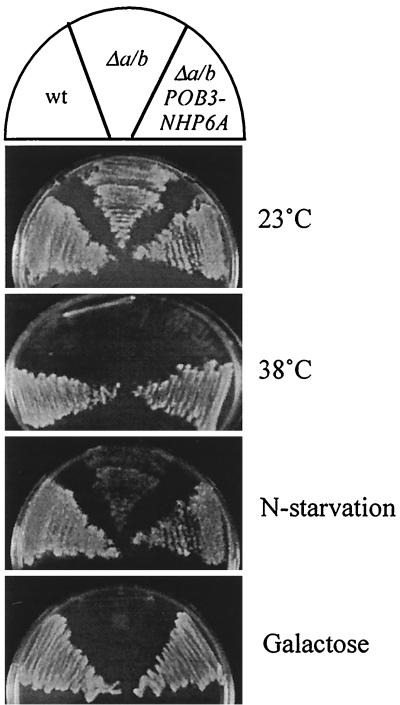
The Pob3-Nhp6a protein provides Pob3 and Nhp6a activity in vivo. Cells of the Δnhp6a/b POB3-NHP6A-V5-His6 strain NB6249 (designated Δa/b POB3-NHP6a), the Δnhp6a/b POB3 strain RJY6249 (designated Δa/b), and the NHP6A NHP6B POB3-V5-His6 strain NB6244 (designated wt) were grown on solid rich glucose medium at 23 and 38°C, on rich galactose medium at 23°C, and on rich glucose medium at 23°C following a 5-day incubation at 23°C on enriched medium lacking (NH4)2SO4 (designated N-starvation).
FIG. 6
FIG. 6
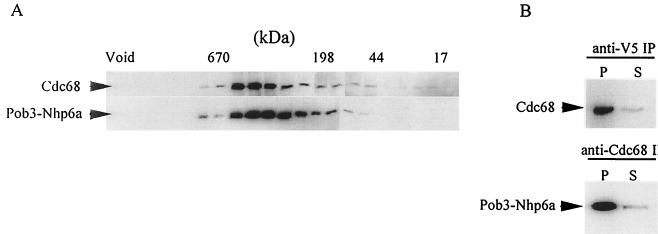
The Pob3-Nhp6a protein forms a stable complex with Cdc68. (A) Material in the 200,000 × g supernatant fraction from cells of strain NB6249 was size fractionated by gel filtration (4) and analyzed by Western blotting using anti-Cdc68 and anti-V5 antibodies. Size markers (Bio-Rad) were cofractionated with the extract. (B) Equal volumes of the same 200,000 × g supernatant were treated with anti-Cdc68 or anti-V5 antibody and the resultant immunoprecipitates and corresponding supernatants were resolved (8% gel) and analyzed by Western blotting with anti-Cdc68 and anti-V5 antibody.
FIG. 7
FIG. 7
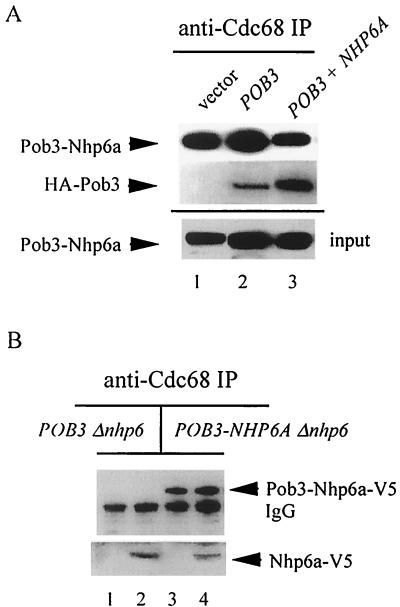
Interactions of the complex containing Pob3-Nhp6a and Cdc68. (A) An Nhp6a function of the Pob3-Nhp6a protein depends on Cdc68 association. Cells of the Δnhp6a/b POB3-NHP6A-V5-His6 strain NB6251 harboring the pRS424 vector (lane 1) or the POB3 plasmid p424-HAPOB (lane 2) or the POB3 + NHP6A plasmid pHAPNV5 (lane 3) were grown at 37°C in enriched selective medium to ∼107 cells/ml. Whole-cell extracts were treated with anti-Cdc68 antibody, and the immunoprecipitates were resolved (8% gel) and analyzed for coimmunoprecipitation of Pob3-Nhp6-V5 and HA-Pob3 using anti-V5 and anti-HA antibodies. On the same blot (but in different lanes), whole-cell extracts (input) were probed with anti-V5 antibody to indicate the relative amounts of extract used for immunoprecipitation. (B) The assemblage of Cdc68 and Pob3-Nhp6a protein binds Nhp6a. Anti-Cdc68 immunoprecipitates from whole-cell extracts of Δnhp6a/b POB3 cells (strain RJY6249) and Δnhp6a/b POB3-NHP6A-V5-His6 cells (strain NB6251), each housing p314-NV5 (lanes 2 and 4) or the pRS314 vector (lanes 1 and 3), were resolved (6-10-15% gel) and analyzed by Western blotting with anti-V5 antibody.

References

    1. Abrams E, Neigeborn L, Carlson M. Molecular analysis of SNF2 and SNF5, genes required for expression of glucose-repressible genes in Saccharomyces cerevisiae. Mol Cell Biol. 1986;6:3643–3651. - PMC - PubMed
    1. Allain F H-T, Yen Y-M, Masse J E, Schultze P, Dieckmann T, Johnson R C, Feigon J. Solution structure of the HMG protein NHP6A and its interaction with DNA reveals the structural determinants for non-sequence-specific binding. EMBO J. 1999;18:2563–2579. - PMC - PubMed
    1. Biggar S R, Crabtree G R. Continuous and widespread roles for the Swi-Snf complex in transcription. EMBO J. 1999;18:2254–2264. - PMC - PubMed
    1. Bortvin A, Winston F. Evidence that Spt6p controls chromatin structure by a direct interaction with histones. Science. 1996;272:1473–1476. - PubMed
    1. Brewster N K, Johnston G C, Singer R A. Characterization of the CP complex, an abundant dimer of Cdc68 and Pob3 proteins that regulates yeast transcriptional activation and chromatin repression. J Biol Chem. 1998;273:21972–21979. - PubMed

Publication types

MeSH terms