


Osteogenic protein-1 (bone morphogenetic protein-7) in the treatment of tibial nonunions
- PMID: 11314793
- PMCID: PMC1425155
Osteogenic protein-1 (bone morphogenetic protein-7) in the treatment of tibial nonunions
Abstract
Background: The role of bone morphogenetic proteins (BMPs) in osseous repair has been demonstrated in numerous animal models. Recombinant human osteogenic protein-1 (rhOP-1 or BMP-7) has now been produced and was evaluated in a clinical trial conducted under a Food and Drug Administration approved Investigational Device Exemption to establish both the safety and efficacy of this BMP in the treatment of tibial nonunions. The study also compared the clinical and radiographic results with this osteogenic molecule and those achieved with fresh autogenous bone.
Materials and methods: One hundred and twenty-two patients (with 124 tibial nonunions) were enrolled in a controlled, prospective, randomized, partially blinded, multi-center clinical trial between February, 1992, and August, 1996, and were followed at frequent intervals over 24 months. Each patient was treated by insertion of an intramedullary rod, accompanied by rhOP-1 in a type I collagen carrier or by fresh bone autograft. Assessment criteria included the severity of pain at the fracture site, the ability to walk with full weight-bearing, the need for surgical re-treatment of the nonunion during the course of this study, plain radiographic evaluation of healing, and physician satisfaction with the clinical course. In addition, adverse events were recorded, and sera were screened for antibodies to OP-1 and type-I collagen at each outpatient visit.
Results: At 9 months following the operative procedures (the primary end-point of this study), 81% of the OP-1-treated nonunions (n = 63) and 85% of those receiving autogenous bone (n = 61) were judged by clinical criteria to have been treated successfully (p = 0.524). By radiographic criteria, at this same time point, 75% of those in the OP-1-treated group and 84% of the autograft-treated patients had healed fractures (p = 0.218). These clinical results continued at similar levels of success throughout 2 years of observation, and there was no statistically significant difference in outcome between the two groups of patients at this point (p = 0.939). All patients experienced adverse events. Forty-four percent of patients in each treatment group had serious events, none of which were related to their bone grafts. More than 20% of patients treated with autografts had chronic donor site pain following the procedure.
Conclusions: rhOP-1 (BMP-7), implanted with a type I collagen carrier, was a safe and effective treatment for tibial nonunions. This molecule provided clinical and radiographic results comparable with those achieved with bone autograft, without donor site morbidity.
Figures
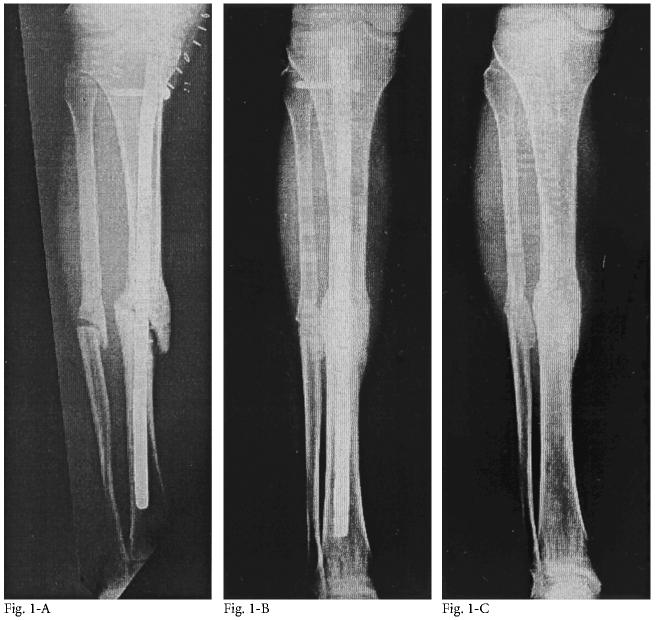
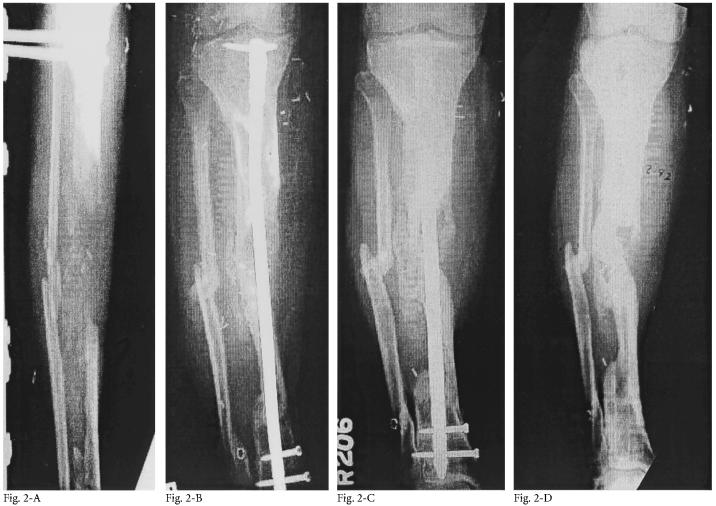
Comment in
-
Selection of a control group in BMP clinical studies.J Bone Joint Surg Am. 2001;83-A Suppl 1(Pt 2):S159-60. J Bone Joint Surg Am. 2001. PMID: 11314794 No abstract available.
-
OP-1 clinical studies.J Bone Joint Surg Am. 2001;83-A Suppl 1(Pt 2):S160-1. J Bone Joint Surg Am. 2001. PMID: 11314795 No abstract available.
References
-
- Bassett CA, Pilla AA, Pawluk RJ. A non-operative salvage of surgically-resistant pseudarthroses and non-unions by pulsing electromagnetic fields. A preliminary report. Clin Orthop. 1977;124:128–43. - PubMed
-
- Boden SD, Stevenson S. Orthop Clin N Am. Vol. 30. W. B. Saunders; Philadelphia: 1999. Bone Grafting and Bone Graft Substitutes.
-
- Bolander ME. Regulation of fracture repair and synthesis of matrix macromolecules. In: Brighton CT, Friedlaender GE, Lane JM, editors. Bone Formation and Repair. American Academy of Orthopaedic Surgeons; Rosemont, Illinois: 1994. pp. 185–196.
-
- Brighton CT, Friedenberg ZB, Zemsky LM, Pollis PR. Direct-current stimulation of non-union and congenital pseudarthrosis. Exploration of its clinical application. J Bone Joint Surg [Am] 1975;57:368–77. - PubMed
-
- Brighton CT, Friedlaender GE, Lane JM. Bone Formation and Repair. American Academy of Orthopaedic Surgeons; Rosemont, Illinois: 1994.
Publication types
MeSH terms
Substances
Grants and funding
LinkOut - more resources
Full Text Sources
Other Literature Sources
Medical
Research Materials
Miscellaneous
