. 2001 May;67(5):2183-90.
doi: 10.1128/AEM.67.5.2183-2190.2001.

Organization and transcriptional analysis of a six-gene cluster around the rplK-rplA operon of Corynebacterium glutamicum encoding the ribosomal proteins L11 and L1

Affiliations

Organization and transcriptional analysis of a six-gene cluster around the rplK-rplA operon of Corynebacterium glutamicum encoding the ribosomal proteins L11 and L1

C Barreiro et al. Appl Environ Microbiol. 2001 May.

Abstract

A cluster of six genes, tRNA(Trp)-secE-nusG-rplK-rplA-pkwR, was cloned and sequenced from a Corynebacterium glutamicum cosmid library and shown to be contiguous in the C. glutamicum genome. These genes encode a tryptophanyl tRNA, the protein translocase component SecE, the antiterminator protein NusG, and the ribosomal proteins L11 and L1 in addition to PkwR, a putative regulatory protein of the LacI-GalR family. S1 nuclease mapping analysis revealed that nusG and rplK are expressed as separate transcriptional units and rplK and rplA are cotranscribed as a single mRNA. A 19-nucleotide inverted repeat that appears to correspond to a transcriptional terminator was located in the 3' region downstream from nusG. Northern analysis with different probes confirmed the S1 mapping results and showed that the secE-rplA four-gene region gives rise to four transcripts. secE was transcribed as a 0.5-kb monocistronic mRNA, nusG formed two transcripts of 1.4 and 1.0 kb from different initiation sites, and the two ribosomal protein genes rplK and rplA were cotranscribed as a single mRNA of 1.6 kb. A consensus L1 protein binding sequence was identified in the leader region of the rplK-rplA transcript, suggesting that expression of the rplK-rplA cluster was regulated by autogenous regulation exerted by the L1 protein at the translation level. The promoters of the nusG and rplK-rplA genes were subcloned in a novel corynebacterial promoter-probe vector and shown to confer strong expression of the reporter gene.


Figures
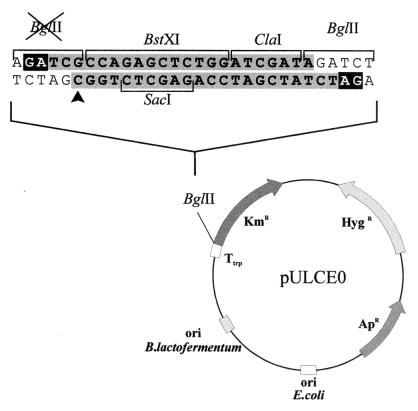
FIG. 1
FIG. 1
Construction of the promoter-probe vector pULCE0. This vector was constructed by inserting a polylinker (shaded nucleotide sequence) with unique restriction sites (absent from other places in the vector) in the BglII site upstream from the promoterless kanamycin resistance marker. One of the BglII sites was removed (X) by appropriate selection of oligonucleotides (arrowhead). Reverse-type letters indicate BglII ends partially filled to avoid vector religation. KmR, kanamycin-resistance gene; HygR, hygromycin resistance gene; ApR, ampicillin resistance gene. ori E. coli is the colE1 plasmid replication origin, and ori B. lactofermentum corresponds to the replication origin of plasmid pBL1 of B. lactofermentum (synonymous with C. lactofermentum). Ttrp, transcriptional terminator of the C. lactofermentum tryptophan operon (to avoid readthrough expression).
FIG. 2
FIG. 2
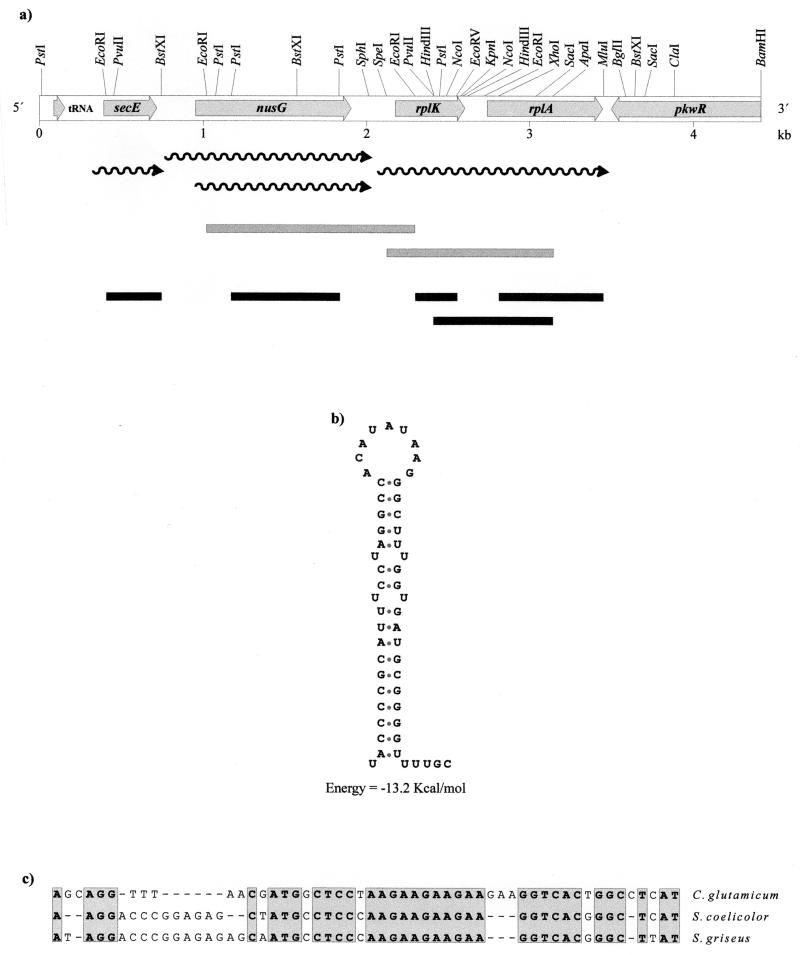
(a) Restriction map and locations of the six genes found in the sequenced 4.42-kb DNA fragment (see the text). The wavy arrows correspond to the transcripts of the genes. The shaded bars show the S1 protection probes, and the solid bars represent the probes used in Northern analysis (see Fig. 4 and 5). (B) Stem-and-loop structure formed in the intergenic region between nusG and rplK-rplA corresponding to an imperfect inverted repeat of 19 nt. (C) Alignment of the L1-binding sequence in the 5′ untranslated region of the rplK-rplA transcript with those of S. coelicolor (35) and S. griseus (20).
FIG. 3
FIG. 3
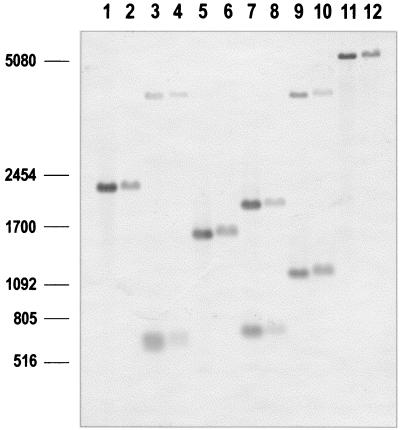
Southern hybridization showing that ORF5 (pkwR) is adjacent to rplA both in the cosmid pCG1 (lanes 1, 3, 5, 7, 9, and 11) and in the chromosome (lanes 2, 4, 6, 8, 10, and 12). Cosmid DNA and total DNA were digested with BamHI plus SpeI (lanes 1 and 2), BamHI plus SacI (lanes 3 and 4), BamHI plus EcoRI (lanes 5 and 6), BamHI plus BstXI (lanes 7 and 8), BamHI plus ApaI (lanes 9 and 10), and BamHI (lanes 11 and 12).
FIG. 4
FIG. 4
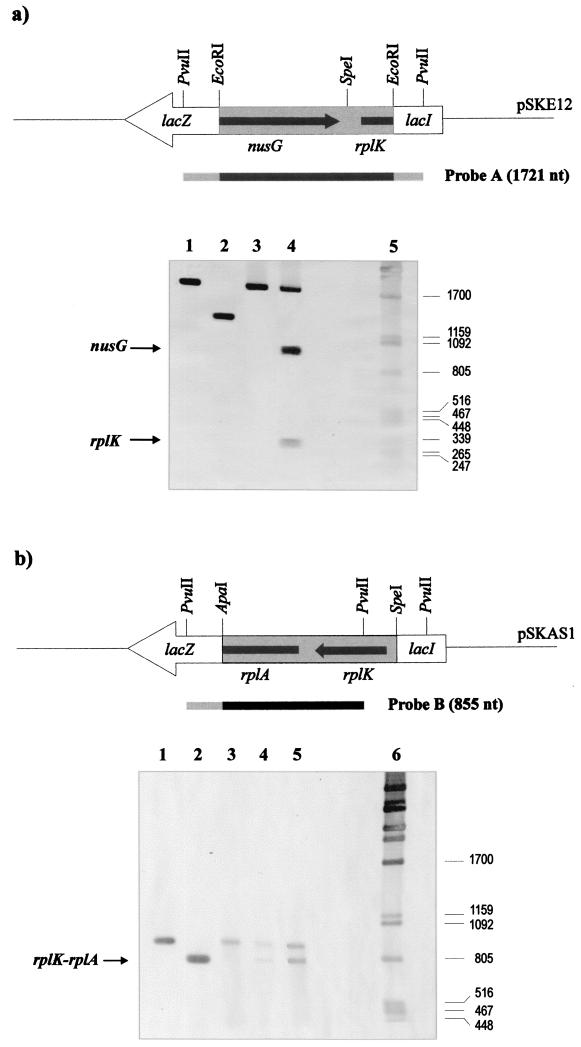
Low-resolution S1 mapping experiments. The probes used in each protection experiment are shown below the cloned DNA fragment. Note that each probe contains a homologous region (solid) and a heterologous region (shaded) belonging to lacZ and lacI. (A) Protected bands in the nusG-rplK region. Lanes: 1, probe A; 2, homologous part of probe A; 3, negative control with probe A and tRNA; 4, S1 protection assay (protected bands are indicated by arrows); 5, molecular size marker. (B) Lanes: 1, probe B; 2, homologous part of probe B; 3, negative control with probe and tRNA; 4, S1 protection assay (60-min digestion with nuclease S1); 5, S1 protection assay (30-min digestion with nuclease S1) (the protected band is indicated by the arrow); 6, size marker. Sizes in nucleotides are indicated at the right. Commercial tRNA from S. cerevisiae was used as a negative control instead of C. glutamicum RNA.
FIG. 5
FIG. 5
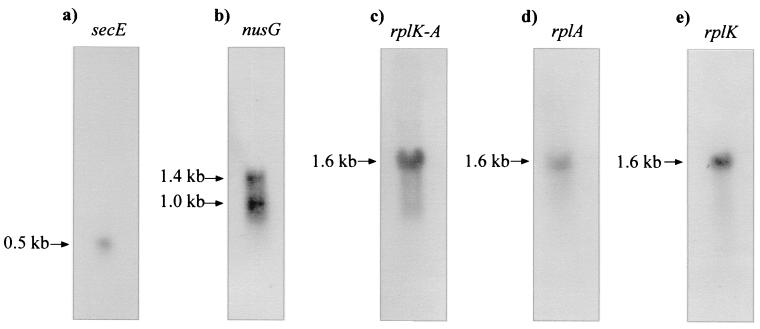
Northern analysis of transcripts of the cloned region with probes corresponding to secE, nusG, rplK-rplA, rplA, or rplK. The probes used are solid in Fig. 2A and were labeled by nick translation. Note that rplK and rplA are expressed as a single transcript of 1.6 kb.
FIG. 6
FIG. 6
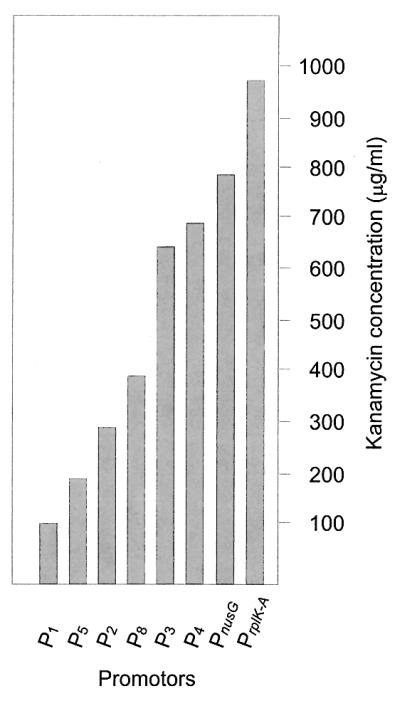
Levels of resistance to kanamycin (in solid TSB plates) conferred by expressing the kanamycin resistance gene of pULCE0 from the rplK-rplA promoter and from the nusG promoter in comparison with expression from the promoters obtained from pBL1 of C. lactofermentum (4).

References

    1. Alting-Mees M A, Short J M. pBluescript II: gene mapping vectors. Nucleic Acids Res. 1989;17:9494. - PMC - PubMed
    1. Amador E, Castro J M, Correia A, Martín J F. Structure and organization of the rrnD operon of Brevibacterium lactofermentum: analysis of the 16s rRNA gene. Microbiology. 1999;145:915–924. - PubMed
    1. Birnboim H C, Doly J. A rapid alkaline extraction procedure for screening recombinant plasmid DNA. Nucleic Acids Res. 1979;7:1513–1523. - PMC - PubMed
    1. Cadenas R F, Martín J F, Gil J A. Construction and characterization of promoter-probe vectors for corynebacteria using the kanamycin-resistance reporter gene. Gene. 1991;98:117–121. - PubMed
    1. Cole S T, Brosch R, Parkhill J, Garnier T, Churcher C, Harris D, Gordon S V, Eiglmeier K, Gas S, Barry III C E, Tekaia F, Badcock K, Basham D, Brown D, Chillingworth T, Connor R, Davies R, Devlin K, Feltwell T, Gentles S, Hamlin N, Holroyd S, Hornsby T, Jagels K, Barrel B G, et al. Deciphering the biology of Mycobacterium tuberculosis from the complete genome sequence. Nature. 1998;393:537–544. - PubMed

Publication types

Associated data

LinkOut - more resources