. 2001 May;67(5):2354-9.
doi: 10.1128/AEM.67.5.2354-2359.2001.

DNA extraction from soils: old bias for new microbial diversity analysis methods

Affiliations

DNA extraction from soils: old bias for new microbial diversity analysis methods

F Martin-Laurent et al. Appl Environ Microbiol. 2001 May.

Erratum in

  • Appl Environ Microbiol 2001 Sep;67(9):4397

Abstract

The impact of three different soil DNA extraction methods on bacterial diversity was evaluated using PCR-based 16S ribosomal DNA analysis. DNA extracted directly from three soils showing contrasting physicochemical properties was subjected to amplified ribosomal DNA restriction analysis and ribosomal intergenic spacer analysis (RISA). The obtained RISA patterns revealed clearly that both the phylotype abundance and the composition of the indigenous bacterial community are dependent on the DNA recovery method used. In addition, this effect was also shown in the context of an experimental study aiming to estimate the impact on soil biodiversity of the application of farmyard manure or sewage sludge onto a monoculture of maize for 15 years.


Figures
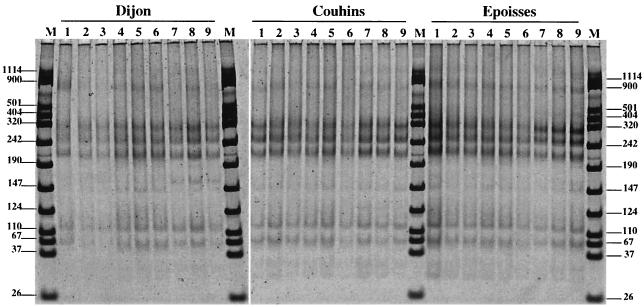
FIG. 1
FIG. 1
ARDRA. Shown is a SYBR green II-stained gel (6% acrylamide) of RsaI-digested PCR products amplified with 16S rDNA universal primers (27f and 1492r) from DNA extracted from Dijon, Couhins, and Epoisses soils following three different extraction methods: the MS laboratory method (lanes 1 to 3), the MoBio kit method (lanes 4 to 6), and the Bio 101 kit method (lanes 7 to 9). Lanes M, VIII Boehringer Mannheim molecular size markers (sizes indicated in base pairs at left and right).
FIG. 2
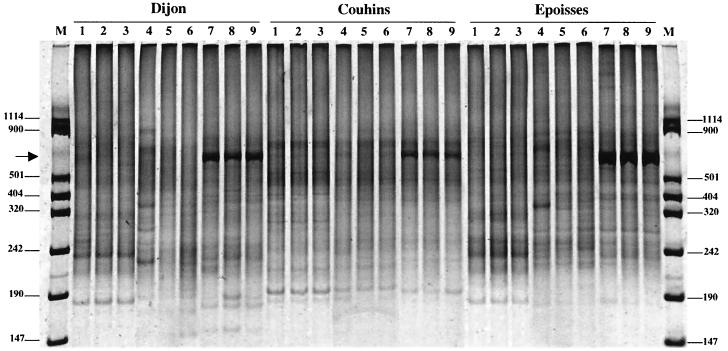
FIG. 2
RISA shown is a SYBR green II-stained gel (6% acryamide) of PCR products amplified with 16S rDNA intergenic spacer universal primers (38r and 72f) from DNA extracted from Dijon, Couhins, and Epoisses soils following three different extraction methods: the MS laboratory method (lanes 1 to 3), the MoBio kit method (lanes 4 to 6), and the Bio 101 kit method (lanes 7 to 9). Lanes M, VIII Boehringer Mannheim molecular size markers (sizes indicated in base pairs at left and right). Arrow, 800-bp band.
FIG. 3
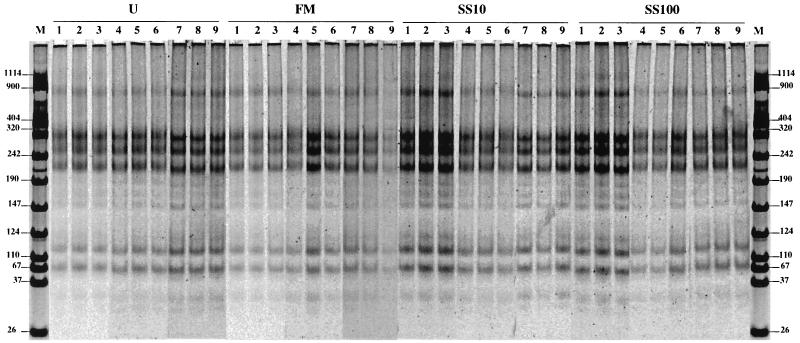
FIG. 3
ARDRA. Shown is a SYBR green II-stained gel (6% acrylamide) of RsaI-digested PCR products amplified with 16S rDNA universal primers (27f and 1492r) from DNA extracted from unamended soil (U) and farmyard manure (FM)- and sewage sludge (SS10 and SS100)-treated plots of Couhins following three different extraction methods: the MS laboratory method (lanes 1 to 3), the MoBio kit method (lanes 4 to 6), and the Bio 101 kit method (lanes 7 to 9). Lanes M, VIII Boehringer Mannheim molecular size markers (sizes indicated in base pairs at left and right). SS10, 10 tons of dry matter/ha/years. SS100, 100 tons of dry matter/ha/2 years.
FIG. 4
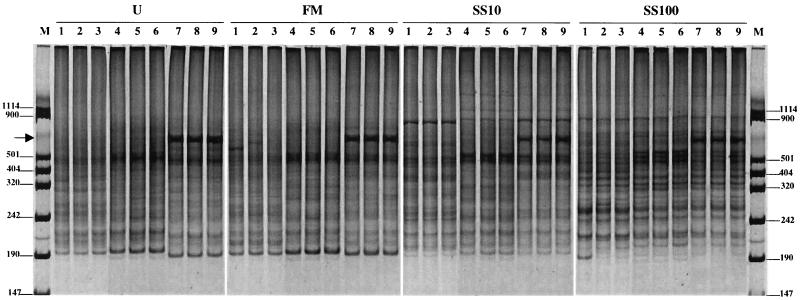
FIG. 4
RISA. Shown is SYBR green II-stained gel (6% acryamide) of PCR products amplified with 16S ribosomal universal primers (38r and 72f) from DNA extracted from unamended soil (U) and farmyard manure (FM)- or sewage sludge (SS10 and SS100)-treated plots of Couhins soil following three different extraction methods: the MS laboratory method (MS) (lanes 1 to 3), the MoBio kit method (lanes 4 to 6), and the Bio 101 kit method (lanes 7 to 9). Lanes M, VIII Boehringer Mannheim molecular size markers (sizes indicated in base pairs at left and right). Arrow, 800-bp band.

References

    1. Frostegard A, Courtois S, Ramisse V, Clerc S, Bernillon D, LeGall F, Jeanin P, Nesme X, Simonet P. Quantification of bias related to the extraction of DNA directly from soils. Appl Environ Microbiol. 1999;65:5409–5420. - PMC - PubMed
    1. Gurtler V, Stanisich V A. New approaches to typing and identification of bacteria using the 16S–23S rDNA spacer region. Microbiology. 1996;142:3–16. - PubMed
    1. Hill G T, Mitkowski N A, Aldrich-Wolfe L, Emele L R, Jurkonie D D, Ficke A, Maldona-Ramirez S, Lynch S T, Nelson E B. Methods for assessing the composition and diversity of soil microbial communities. Appl Soil Ecol. 2000;15:25–36.
    1. Hugenholtz P, Goebel B M, Pace N R. Impact of culture-independent studies on the emerging phylogenetic view of bacterial diversity. J Bacteriol. 1998;180:4765–4774. - PMC - PubMed
    1. Kresk M, Wellington E M H. Comparison of different methods for the isolation and purification of total community DNA from soil. J Microbiol Methods. 1999;39:1–16. - PubMed

Publication types

MeSH terms

LinkOut - more resources