


Host microarray analysis reveals a role for the Salmonella response regulator phoP in human macrophage cell death
- PMID: 11320214
- PMCID: PMC33302
- DOI: 10.1073/pnas.091110098
Host microarray analysis reveals a role for the Salmonella response regulator phoP in human macrophage cell death
Abstract
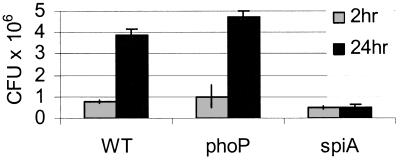
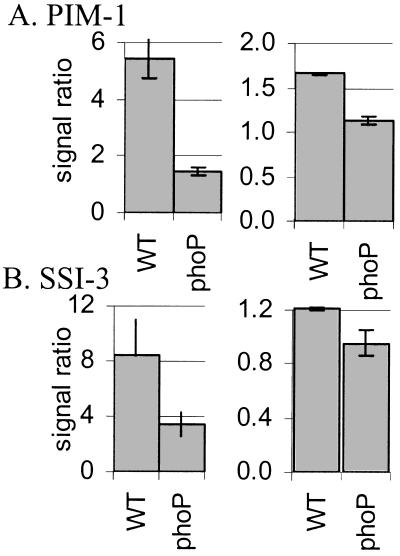
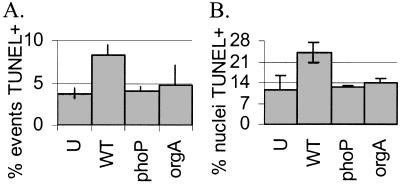
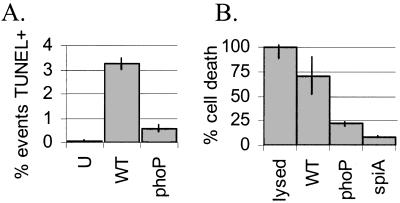
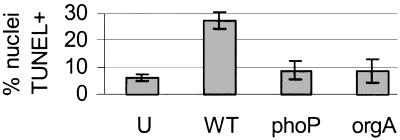
Bacterial pathogens manipulate host cells to promote pathogen survival and dissemination. We used a 22,571 human cDNA microarray to identify host pathways that are affected by the Salmonella enterica subspecies typhimurium phoP gene, a transcription factor required for virulence, by comparing the expression profiles of human monocytic tissue culture cells infected with either the wild-type bacteria or a phoPTn10 mutant strain. Both wild-type and phoPTn10 bacteria induced a common set of genes, many of which are proinflammatory. Differentially expressed genes included those that affect host cell death, suggesting that the phoP regulatory system controls bacterial genes that alter macrophage survival. Subsequent experiments showed that the phoPTn10 mutant strain is defective for killing both cultured and primary human macrophages but is able to replicate intracellularly. These experiments indicate that phoP plays a role in Salmonella-induced human macrophage cell death.
Figures
References
-
- Tsolis R M, Kingsley R A, Townsend S M, Ficht T A, Adams L G, Baumler A J. Adv Exp Med Biol. 1999;473:261–274. - PubMed
-
- Vazquez-Torres A, Jones-Carson J, Baumler A J, Falkow S, Valdivia R, Brown W, Le M, Berggren R, Parks W T, Fang F C. Nature (London) 1999;401:804–808. - PubMed
-
- Chen L M, Kaniga K, Galán J E. Mol Microbiol. 1996;21:1101–1115. - PubMed
-
- Libby S J, Lesnick M, Hasegawa P, Weidenhammer E, Guiney D G. Cell Micro. 2000;2:49–58. - PubMed
Publication types
MeSH terms
Substances
Grants and funding
LinkOut - more resources
Full Text Sources
Other Literature Sources
Molecular Biology Databases
