. 2001 Apr 24;98(9):5104-9.
doi: 10.1073/pnas.091577598.

Mutation in bone morphogenetic protein receptor-IB is associated with increased ovulation rate in Booroola Mérino ewes

Affiliations

Mutation in bone morphogenetic protein receptor-IB is associated with increased ovulation rate in Booroola Mérino ewes

P Mulsant et al. Proc Natl Acad Sci U S A. .

Abstract

Ewes from the Booroola strain of Australian Mérino sheep are characterized by high ovulation rate and litter size. This phenotype is due to the action of the FecB(B) allele of a major gene named FecB, as determined by statistical analysis of phenotypic data. By genetic analysis of 31 informative half-sib families from heterozygous sires, we showed that the FecB locus is situated in the region of ovine chromosome 6 corresponding to the human chromosome 4q22-23 that contains the bone morphogenetic protein receptor IB (BMPR-IB) gene encoding a member of the transforming growth factor-beta (TGF-beta) receptor family. A nonconservative substitution (Q249R) in the BMPR-IB coding sequence was found to be associated fully with the hyperprolificacy phenotype of Booroola ewes. In vitro, ovarian granulosa cells from FecB(B)/FecB(B) ewes were less responsive than granulosa cells from FecB(+)/FecB(+) ewes to the inhibitory effect on steroidogenesis of GDF-5 and BMP-4, natural ligands of BMPR-IB. It is suggested that in FecB(B)/FecB(B) ewes, BMPR-IB would be inactivated partially, leading to an advanced differentiation of granulosa cells and an advanced maturation of ovulatory follicles.


Figures
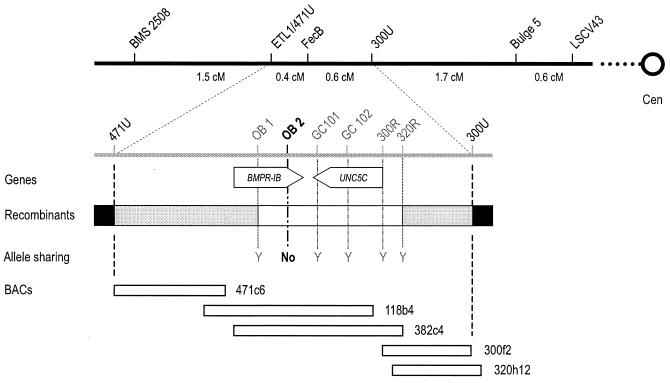
Figure 1
Figure 1
Physical and genetic map of the FecB region on ovine chromosome 6. The FecB locus is flanked by the two closest recombinant markers, 471U and 300U. No recombination was observed between FecB and markers OB1, OB2, GC101, GC102, 300R, and 320R. Arrows correspond to the orientation of BMPR-IB and UNC5C coding sequences. The 5′ part of the UNC5C coding sequence was not present in the BAC 382c4. Recombinants: white box, zero-recombinant zone; gray boxes, zone with zero or one recombinant; black boxes, at least one recombinant with FecB. Allele sharing between wild-type and carrier animals for the FecBB allele is indicated: Y, yes; N, no; open boxes, BACs; Cen, centromere; ETL1, enhancer trap locus 1.
Figure 2
Figure 2
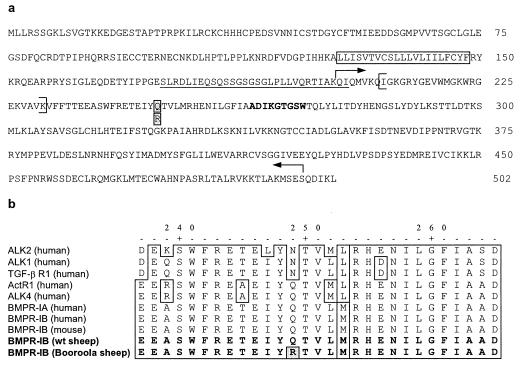
Predicted amino acid sequence of ovine BMPR-IB cDNA. (a) The mutation site between wild type and FecBB/FecBB is shown with a stippled box. Also indicated are the transmembrane domain (open box), GS domain (underlined), the limits of the kinase domain (bent arrows), the ATP binding region signature (under brackets), and the L45 loop (in bold). (b) Comparison of partial amino acid sequences of different members of type I TGF-β receptor family from different species. Numbers indicate amino acid positions in the ovine BMPR-IB protein.
Figure 3
Figure 3
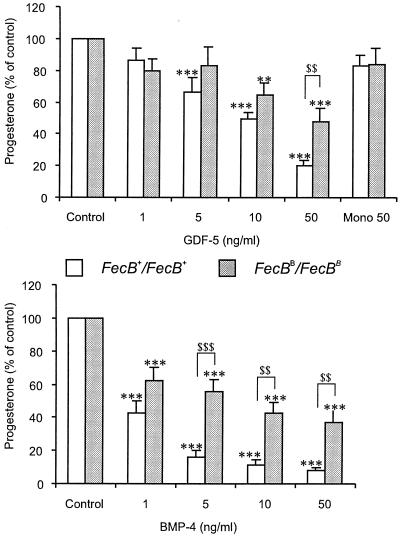
Effects of GDF-5 (Upper) and BMP-4 (Lower) on progesterone secretion by FecBB/FecBB and FecB+/FecB+ granulosa cells in vitro. Granulosa cells from FecBB/FecBB and FecB+/FecB+ antral follicles of 1–3 mm in diameter were cultured for 96 h in serum-free conditions with 10 ng/ml insulin-like growth factor-1. Cultures were performed in the presence or absence (Control) of different concentrations of BMP-4, dimeric GDF-5, or 50 ng/ml monomeric GDF-5 as negative control (Mono 50) and with or without FSH (5 ng/ml) in culture medium. Results represent progesterone secretion by granulosa cells between 48 and 96 h in three independent cultures. Data are expressed as percentages of the amount of progesterone secreted by cells cultured in the absence of GDF-5 or BMP-4. In vitro, FSH had no significant effect on the inhibition rate induced by both ligands, and data include FSH-treated and untreated cells. **, P < 0.01 and ***, P < 0.001, BMP-4 or GDF-5 vs. control; $$, P < 0.01 and $$$, P < 0.001, FecBB/FecBB vs. FecB+/FecB+.
Figure 4
Figure 4
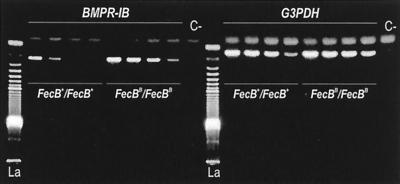
RT-PCR analysis of BMPR-IB from sheep granulosa cells. Successive dilutions of total granulosa cDNA (1 ng and 250, 50, and 10 pg, from left to right for each group) were used as template for PCR amplification of BMPR-IB (Left) and G3PDH (Right). L, 100-bp ladder; C, negative control (no cDNA).
Figure 5
Figure 5
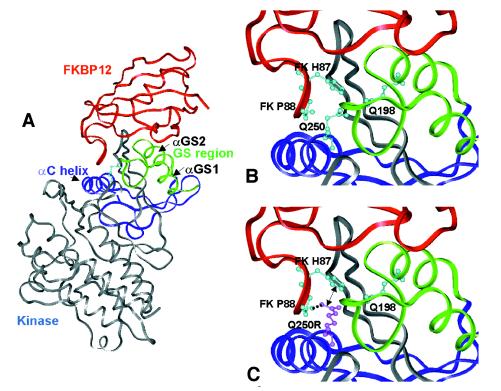
Modeling of the effects of Q250R substitution on the human TβR-I/FKBP12 complex structure. (A) Experimental structure of TβR-I in complex with FKBP12 (Protein Data Bank identifier 1B6C). Q250, located at the C terminus of αC helix, is shown in a ball-and-stick representation. The ovine BMPR-IB model is very similar to TβR-I (0.1 Å rms between the two structures: 326 superimposable Cα). (B) Q250 is sandwiched between the FKBP12 flap (one side of the FKBP12 active site in which helix αGS2 is embedded) and the αGS1/αGS2 loop (GS region), which undergoes phosphorylation after kinase activation. The movement of αC helix, allowed by the GS region phosphorylation and/or FKBP12 dissociation, is likely to be responsible partly for kinase activation (23). Q250 does not form any obvious bond with the GS region nor with FKBP12 (Q198 Oɛ1 atom, the nearest neighbor, is 3.5 Å distant from Q250 Nɛ2 atom). (C) Consequence of the Q250R mutation. In the most probable conformer, R250 is predicted to form a strong hydrogen bond through its Nη1 atom with the main chain oxygen of FKBP12 P88 (dashed line). This interaction between FKBP12 and the receptor should be reinforced by a nearly parallel stacking interaction between π electrons of R250 and FKBP12 H87 (e.g., 3.2 Å between R250 Nɛ and FKBP12 H87 Nɛ2; see arrow). The same prediction can be made for the ovine BMPR-IB model that has been fitted on the TβR-I/FKBP12 complex.

References

    1. Davis G H, Montgomery G W, Allision A J, Kelly R W, Bray A R. N Z J Agric Res. 1982;25:525–529.
    1. Piper L R, Bindon B M, Davis G H. In: Genetics of Reproduction in Sheep. Land R B, Robinson D W, editors. London: Butterworths; 1985. pp. 115–125.
    1. McNatty K P, Henderson K M. J Steroid Biochem. 1987;27:365–373. - PubMed
    1. Montgomery G W. Rev Reprod. 2000;5:25–37. - PubMed
    1. Montgomery G W, Crawford A M, Penty J M, Dodds K G, Ede A J, Henry H M, Pierson C A, Lord E A, Galloway S M, Schmack A E, et al. Nat Genet. 1993;4:410–414. - PubMed

Publication types

MeSH terms

Associated data

LinkOut - more resources