. 2001 May;133(1):61-72.
doi: 10.1038/sj.bjp.0704043.

The role of alpha(1)-adrenoceptors and 5-HT(1A) receptors in the control of the micturition reflex in male anaesthetized rats

Affiliations

The role of alpha(1)-adrenoceptors and 5-HT(1A) receptors in the control of the micturition reflex in male anaesthetized rats

R K Conley et al. Br J Pharmacol. 2001 May.

Abstract

1. The effects of the alpha(1)-adrenoceptor antagonists doxazosin (0.1 -- 2 mg kg(-1)), RS-100329 (alpha(1A); 0.01 -- 1 mg kg(-1)), RS-513815 (Ro 151-3815, alpha(1B); 0.3 -- 3 mg kg(-1)) and BMY 7378 (alpha(1D); 0.1 -- 1 mg kg(-1)), the 5-HT(1A) receptor agonist, 8-OH-DPAT (0.03 -- 0.3 mg kg(-1)) and antagonist WAY-100635 (0.03 -- 0.3 mg kg(-1)) were investigated (i.v.) on the 'micturition reflex' in the urethane anaesthetized male rat. 2. Reflex-evoked urethra contractions were most sensitive to the inhibitory action of RS-100329, followed by doxazosin, BMY 7378 and WAY-100635 and then RS-513815. The maximum inhibition was 66, 63, 54, 46 and 22% at doses of 0.3, 0.5, 0.3, 0.3 and 3 mg kg(-1) respectively. 3. BMY 7378 and 8-OH-DPAT decreased, while WAY-100635 increased, the pressure threshold to induce bladder contraction. WAY-100635 (0.01 mg kg(-1)) blocked the effects of BMY 7378 (1 mg kg(-1)) on bladder pressure and volume threshold. 4. Doxazosin, RS-100329 and BMY 7378 had a similar potency in inducing a fall in arterial blood pressure while WAY-100635 only caused a fall at the highest dose. 5. Therefore, reflex-evoked urethral contraction involves the activation of alpha(1A/1D)-adrenoceptors, as BMY 7378 and RS-100329 are similarly potent in attenuating this effect. The ability of WAY-100635 to attenuate this contraction may suggest that 5-HT(1A) receptors are also involved. However, as this inhibition occurred at the highest dose of WAY-100635, which also caused a fall in arterial blood pressure; this effect is considered to be due to blockade of alpha(1)-adrenoceptors not 5-HT(1A) receptors. Nevertheless the initiation of the 'micturition reflex' involves the activation of 5-HT(1A) receptors.


Figures

Figure 1
Figure 1
Schematic representation of the experimental method used for both evoking and measuring changes in bladder and urethral pressures. (A) Shows the overall preparation with the ureters tied and cut at the level of the bladder and cannulated at the level of the kidneys plus the position of the cannulae for evoking and recording of changes in bladder and urethral pressures. (B) Is an expanded diagram of the double lumen cannula embedded in an eppendorf tip which is wedged against the bladder neck plus the two additional cannulae inserted into the bladder which allow the measurement of intravesical bladder pressure as well as saline infusion to evoke the micturition reflex.
Figure 2
Figure 2
Urethane anaesthetized male rats: traces showing changes in bladder and urethral pressures during intravesical infusions of saline before (Control) and after i.v. injections of (A) lactic acid, (B) 0.3 mg kg−1 of RS-100329, (C) 0.3 mg kg−1 of BMY 7378, (D) 0.3 mg kg−1 of 8-OH-DPAT and (E) 0.1 mg kg−1 of WAY-100635. The length of line under each trace represents the duration of the intravesical infusions.
Figure 3
Figure 3
Urethane anaesthetized male rats: comparison of changes (Δ) caused by i.v. doxazosin (0.1 – 2 mg kg−1), RS-100329 (0.01 – 0.1 mg kg−1), RS-513815 (0.3 – 3.0 mg kg−1) and BMY 7378 (0.1 – 1 mg kg−1) on (A) intravesical infusion of saline (reflex) evoked urethral contractions, (B) baseline urethral pressure and (C) mean arterial blood pressure. Each point represents the mean value and the vertical bars show s.e.mean. Changes caused by drugs were compared with vehicle controls (0.04 M lactic acid i.v.) using Student's unpaired t-test. * P<0.05 and ** P<0.01.
Figure 4
Figure 4
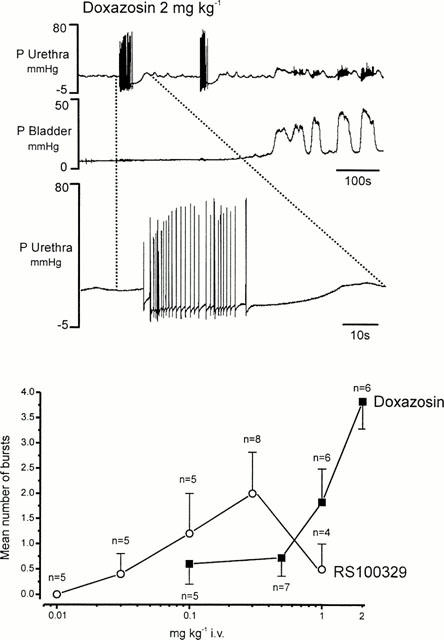
Urethane anaesthetized male rat. (A) traces showing the effect of i.v. doxazosin (2 mg kg−1) on baseline urethral and bladder pressure (P, mmHg). The lower trace shows an expanded section, as indicated by the dotted lines, the top urethral pressure trace illustrates the very fast oscillations observed in urethral pressure after pretreatment with doxazosin. (B) A graph comparing the effects of doxazosin (0.1 – 2 mg kg−1) with those of RS-100329 (0.01 – 0.1 mg kg−1) on urethral fast oscillations (bursts).
Figure 5
Figure 5
Urethane anaesthetized male rats. Comparison of changes (Δ) caused by i.v. 8-OH-DPAT (0.03 – 0.3 mg kg−1), WAY-100635 (0.03 – 0.3 mg kg−1) and BMY 7378 (0.1 – 1 mg kg−1) on (A) intravesical infusion of saline (reflex) evoked urethral contractions, (B) baseline urethral pressure and (C) mean arterial blood pressure. Each point represents the mean value and the vertical bars show s.e.mean. Changes caused by these drugs were compared with vehicle controls (0.04 M lactic acid i.v.) using Student's unpaired t-test. *P<0.05 and ** P<0.01.
Figure 6
Figure 6
Urethane anaesthetized male rats. (A) Comparison of changes (Δ), in bladder pressure threshold for intravesical infusion of saline to evoke bladder contractions, caused by i.v. 8-OH-DPAT (0.03 – 0.3 mg kg−1), WAY-100635 (0.03 – 0.3 mg kg−1) and BMY 7378 (0.1 – 1 mg kg−1). Each point represents the mean value and the vertical bars show s.e.mean. Changes caused by these drugs were compared with vehicle controls (0.04 M lactic acid i.v.) using Student's unpaired t-test. ** P<0.01. (B) A comparison of the effect of 1 mg kg−1 of BMY 7378 in the absence and presence of WAY-100635 (0.01 mg kg−1) on changes (Δ) in bladder pressure threshold.

References

    1. ANDERSON K.E. Pharmacology of lower urinary tract smooth muscles and penile erectile tissues. Pharmacol. Rev. 1993;45:253–308. - PubMed
    1. ANDERSON I.K., MARTIN G.R., RAMAGE A.G. Evidence that i.c.v. administration of 5-HT causes sympathoexcitation through activation of 5-HT1A receptors and vasopressin release through activation of 5-HT2/1C receptors in anaesthetized rats. Br. J. Pharmacol. 1995;107:1020–1028. - PMC - PubMed
    1. ANDERSON I.K., RAMAGE A.G., GARDINER S.M. Cardiovascular effects of i.c.v. administration of serotonin and DP-5-CT in conscious Long-Evans and Brattleboro rats. Am. J. Physiol. 1996;271:R455–R463. - PubMed
    1. BRUNE M.E., KATWALA S.P., MILICIC I., BUCKNER S.A., IRELAND L.M., KERWIN J.F., JR, HANCOCK A.A. Effects of selective and nonselective alpha-1-adrenoceptor antagonists on intraurethral and arterial pressures in intact conscious dogs. Pharmacology. 1996;53:356–368. - PubMed
    1. CHAPPLE C.R. Selective α1-adrenoceptor antagonists in benign prostatic hyperplasia: rationale and clinical experience. Eur. Urol. 1996;29:129–144. - PubMed

Publication types

MeSH terms