. 2001 May;133(1):89-96.
doi: 10.1038/sj.bjp.0704047.

Protection against beta-amyloid peptide toxicity in vivo with long-term administration of ferulic acid

Affiliations

Protection against beta-amyloid peptide toxicity in vivo with long-term administration of ferulic acid

J J Yan et al. Br J Pharmacol. 2001 May.

Abstract

1. beta-Amyloid peptide (A beta), a 39 -- 43 amino acid peptide, is believed to induce oxidative stress and inflammation in the brain, which are postulated to play important roles in the pathogenesis of Alzheimer's disease. Ferulic acid is an antioxidant and anti-inflammatory agent derived from plants; therefore, the potential protective activity of ferulic acid against A beta toxicity in vivo was examined. 2. Mice were allowed free access to drinking water (control) or water containing ferulic acid (0.006%). After 4 weeks, A beta 1-42 (410 pmol) was administered via intracerebroventricular injection. 3. Injection of control mice with A beta 1-42 impaired performance on the passive avoidance test (35% decrease in step-through latency), the Y-maze test (19% decrease in alternation behaviour), and the water maze test (32% decrease in percentage time in platform-quadrant). In contrast, mice treated with ferulic acid prior to A beta 1-42 administration were protected from these changes (9% decrease in step-through latency; no decrease in alternation behaviour; 14% decrease in percentage time in platform-quadrant). A beta 1-42 induced 31% decrease in acetylcholine level in the cortex, which was tended to be ameliorated by ferulic acid. 4. In addition, A beta 1-42 increased immunoreactivities of the astrocyte marker glial fibrillary acidic protein (GFAP) and interleukin-1 beta (IL-1 beta) in the hippocampus, effects also suppressed by pretreatment with ferulic acid. 5. Administration of ferulic acid per se unexpectedly induced a transient and slight increase in GFAP and IL-1 beta immunoreactivity in the hippocampus on day 14, which returned to basal levels on day 28. A slight (8%) decrease in alternation behaviour was observed on day 14. 6. These results demonstrate that long-term administration of ferulic acid induces resistance to A beta 1-42 toxicity in the brain, and suggest that ferulic acid may be a useful chemopreventive agent against Alzheimer's disease.


Figures
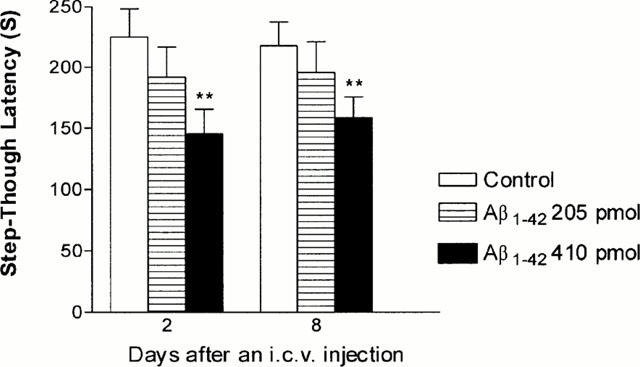
Figure 1
Figure 1
Effects of Aβ1-42 given by intracerebroventricular injection on passive avoidance performance in mice. Various doses of Aβ1-42 were injected and on day 1 post-injection, mice were subjected to the training trial; testing trials were conducted on day 2 and day 8 post-injection. Control animals were injected with Aβ42-1 (410 pmol per mouse). The data are expressed as mean±s.e.mean, with n=10 – 20 mice per group. ** P<0.01 compared to Aβ42-1-treated control.
Figure 2
Figure 2
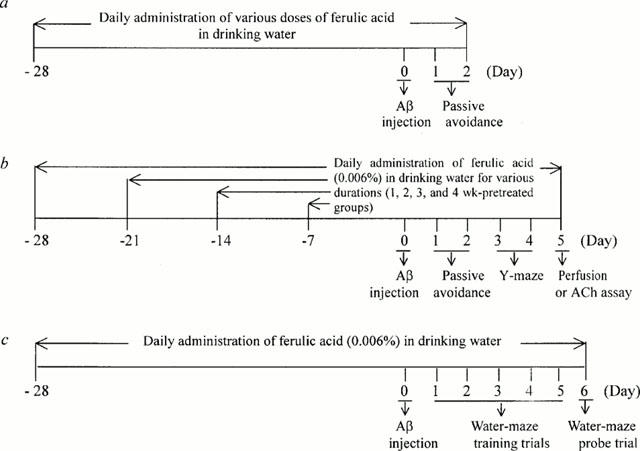
Experimental schedules.
Figure 3
Figure 3
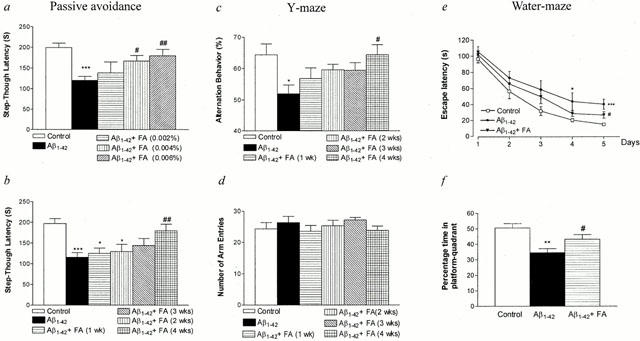
Protective effect of ferulic acid on the Aβ1-42-induced impairment in learning and memory in mice. After injection of Aβ (410 pmol per mouse), each behavioural test was performed as shown in Figure 2. Passive avoidance task (a,b): On day 1 post-injection, mice were trained on a one-trial step-through passive avoidance task. The testing trial was given 1 day after the training trial. (a) Dose-dependent effect of ferulic acid. (b) Time-dependent effect of ferulic acid. Y-maze task: Spontaneous alternation behaviour (c) and the number of arm entries (d) were measured during an 8-min session. Water-maze task: The training trials (e) and probe trial (f) were carried out on days 1 – 5 and on day 6 after Aβ injection, respectively. The latency showed the mean of a block of three trials per day (e). The data are presented as means±s.e.mean (n=10 – 20). Control mice were injected with Aβ42-1 (410 pmol per mouse). * P<0.05, ** P<0.01, *** P<0.001 vs Aβ42-1-treated control, # P<0.05, ## P<0.01 vs Aβ1-42 alone.
Figure 4
Figure 4
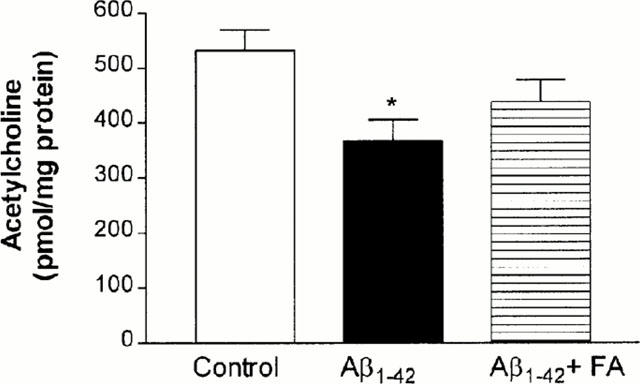
Effect of ferulic acid on the Aβ1-42-induced decrease in acetylcholine levels. Mice were allowed free access to the drinking water containing ferulic acid (0.006%) for up to 4 weeks prior to 410 pmol Aβ1-42 or Aβ42-1 injection. Acetylcholine level in the cortex was measured on day 5 after Aβ injection. Control animals were injected with 410 pmol Aβ42-1. The data are means±s.e.mean (n=10). * P<0.05 vs Aβ42-1-treated control.
Figure 5
Figure 5
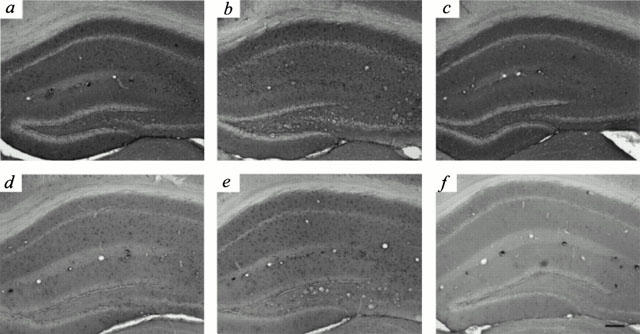
Blockade of the Aβ1-42-induced increase in GFAP and IL-1β immunoreactivity by ferulic acid. Mice were allowed free access to normal drinking water (a,b,d,e), or water containing ferulic acid (0.006%) (c,f) for up to 4 weeks prior to Aβ injection. GFAP (a – c) and IL-1β (d – f) immunoreactivities in the hippocampus were examined on day 5 after injection of 410 pmol Aβ42-1 (a,d) or Aβ1-42 (b,c,e,f). Mice injected with 410 pmol Aβ42-1 (a,d) served as controls. Scale bar, 100 μm.
Figure 6
Figure 6
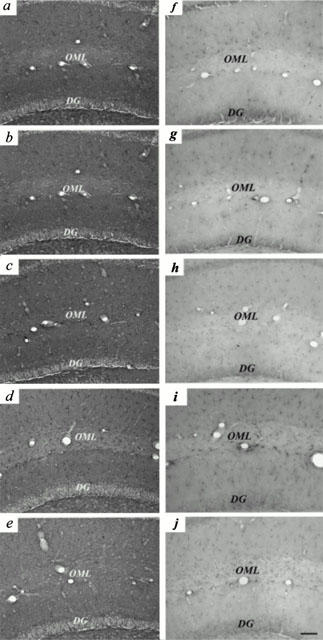
Ferulic acid induces transient increase in GFAP and IL-1β immunoreactivities in hippocampus. Mice were allowed free access to water containing ferulic acid (0.006%) for 1 (b,g), 5 (c,h), 14 (d,i) and 28 (e,j) days before being examined for GFAP (a – e) and IL-1β (f – j) immunoreactivities in hippocampus. Mice not exposed to ferulic acid (a,f) served as controls. OML, outer molecular layer, DG, dentate gyrus. Scale bar, 50 μm.
Figure 7
Figure 7
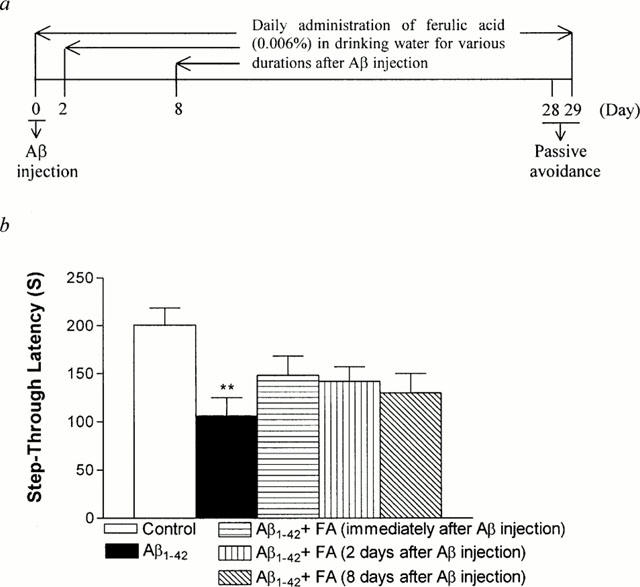
Therapeutic effect of ferulic acid on the Aβ1-42-induced impairment in passive avoidance performance in mice. After injection of Aβ (410 pmol per mouse), ferulic acid was administered to mice after either immediately, 2 days, or 8 days after an i.c.v. injection of Aβ1-42. On day 28 post-injection, mice were trained on a one-trial step-through passive avoidance task. The testing trial was given 1 day after the training trial (a, Experimental schedule). The data are presented as means±s.e.mean (n=10 – 11). Control mice were injected with Aβ42-1 (410 pmol per mouse).

References

    1. ARAUJO D.M., COTMAN C.W. Beta-amyloid stimulates glial cells in vitro to produce growth factors that accumulate in senile plaques in Alzheimer's disease. Brain Res. 1992;569:141–145. - PubMed
    1. BAKER H., FARBMAN A.I. Olfactory afferent regulation of the dopamine phenotype in the fetal rat olfactory system. Neuroscience. 1993;52:115–134. - PubMed
    1. BEHL C. Alzheimer's disease and oxidative stress: implications for novel therapeutic approaches. Prog. Neurobiol. 1999;57:301–323. - PubMed
    1. BEHL C., DAVIS J., COLE G.M., SCHUBERT D. Vitamin E protects nerve cells from amyloid beta protein toxicity. Biochem. Biophys. Res. Commun. 1992;186:944–950. - PubMed
    1. BEHL C., DAVIS J.B., LESLEY R., SCHUBERT D. Hydrogen peroxide mediates amyloid beta protein toxicity. Cell. 1994;77:817–827. - PubMed

Publication types

MeSH terms