Molecular epidemiology of Mycobacterium tuberculosis in Norway
- PMID: 11325994
- PMCID: PMC88029
- DOI: 10.1128/JCM.39.5.1802-1807.2001
Molecular epidemiology of Mycobacterium tuberculosis in Norway
Abstract
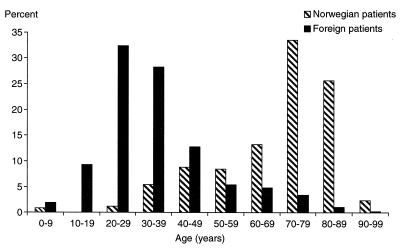
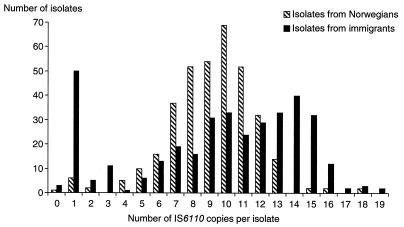
The incidence of tuberculosis in Norway is one of the lowest in the world, and approximately half of the cases occur in first- and second-generation immigrants. In the present study, the genetic diversity of 92% of all strains of Mycobacterium tuberculosis isolated in Norway in 1994 to 1998 was assessed using restriction fragment length polymorphism (RFLP) analysis, with the insertion sequence IS6110 and the repetitive element DR as probes, to determine the degree of active transmission between patients. The DR probe was used as a secondary molecular marker to support or rule out clustering of strains with fewer than five copies of IS6110. After exclusion of 20 cultures representing laboratory contamination, 573 different IS6110 patterns were found among the 698 strains analyzed. Of these 573 patterns, 542 were observed only once and 31 were shared by 2 to 14 isolates. Among 81 strains (11.5%) carrying fewer than five copies of IS6110, 56 RFLP patterns were found when the results of both the IS6110 and DR methods were combined. Among the 698 strains, 570 were considered to be independent cases. A total of 14.5% of the native Norwegians and 19.7% of the foreign patients were part of a cluster. Thus, the degree of recent transmission of tuberculosis in Norway is low and the great majority of the cases are due to reactivation of previous disease. Transmission between immigrants and native Norwegians is uncommon. Two outbreaks, one among native Norwegians and one mainly among immigrants, have been ongoing for several years, indicating that, even in a low-incidence country such as Norway, with a good national program for tuberculosis surveillance, certain transmission chains are difficult to break.
Figures
References
-
- Alland D, Kalkut G E, Moss A R, McAdam R A, Hahn J A, Bosworth W, Drucker E, Bloom B R. Transmission of tuberculosis in New York City. An analysis by DNA fingerprinting and conventional epidemiologic methods. N Engl J Med. 1994;330:1710–1716. - PubMed
-
- Borgdorff W M, Nagelkerke N, Van Soolingen D, De Haas P E, Veen J, van Embden J D A. Analysis of tuberculosis transmission between nationalities in The Netherlands in the period 1993 to 1995 using DNA fingerprinting. Am J Epidemiol. 1998;147:187–195. - PubMed
-
- Burman W J, Reves R R. Review of false-positive cultures of Mycobacterium tuberculosis and recommendations for avoiding unnecessary treatment. Clin Infect Dis. 2000;31:1390–1395. - PubMed
Publication types
MeSH terms
Substances
LinkOut - more resources
Full Text Sources