


doi: 10.1128/JCM.39.5.1956-1959.2001.
Does blood of healthy subjects contain bacterial ribosomal DNA?
Affiliations
- PMID: 11326021
- PMCID: PMC88056
- DOI: 10.1128/JCM.39.5.1956-1959.2001
Item in Clipboard
Does blood of healthy subjects contain bacterial ribosomal DNA?
J Clin Microbiol.
2001 May.
Abstract
Real-time PCR methods with primers and a probe targeting conserved regions of the bacterial 16S ribosomal DNA (rDNA) revealed a larger amount of rDNA in blood specimens from healthy individuals than in matched reagent controls. However, the origins and identities of these blood-associated bacterial rDNA sequences remain obscure.
Figures
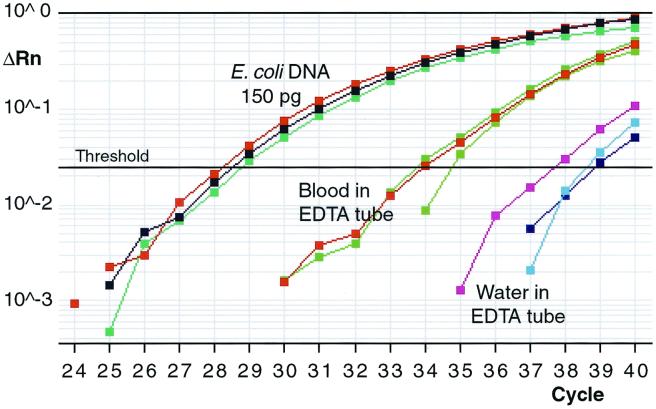
A representative logarithmic broad-range bacterial 16S rDNA amplification plot obtained with 150 pg of E. coli DNA, as well as DNA isolated from the blood of a healthy individual (subject 1) and similarly processed sterile water, both of which were drawn into EDTA-containing tubes, as templates. All samples were analyzed in triplicate and for 40 cycles. Each plot line represents independent measurements for each of the triplicates. The average Ct values in this experiment were 34.1 (range, 33.7 to 34.7) for the blood sample and 38.3 (range, 37.6 to 38.8) for the reagent control. PCR products from reactions with EDTA-anticoagulated blood and reagent control (water in an EDTA-containing tube) as templates were further characterized by cloning and sequencing. ΔRn, relative fluorescence.

Phylogenetic relationships inferred from bacterial 16S rDNA sequences detected in a blood specimen of a healthy individual and from control clone library sequences. This unrooted tree was constructed by using 425 homologous sequence positions and a maximum-likelihood algorithm (17). The sequences associated with the blood specimen (study groups) are shown in red, and those generated in a control PCR with water as template are shown in green. Representative percentages for each group from the rDNA sequences from the total clone library are shown in parentheses. The blood-associated clone libraries and the control clone library included 115 and 77 rDNA sequences, respectively. Well-characterized reference sequences most similar to the study sequences are given in blue; and those of Staphylococcus epidermidis, Pseudomonas aeruginosa, and E. coli are shown as additional references. BCF, Bacteroides-Cytophaga-Flexibacter group; Low GC, low G+C content.
References
-
- Berger S A, Weitzman S, Edberg S C, Casey J I. Bacteremia after the use of an oral irrigation device. A controlled study in subjects with normal-appearing gingiva: comparison with use of toothbrush. Ann Intern Med. 1974;80:510–511. - PubMed
-
- Bergmans A M, Groothedde J W, Schellekens J F, van Embden J D, Ossewaarde J M, Schouls L M. Etiology of cat scratch disease: comparison of polymerase chain reaction detection of Bartonella (formerly Rochalimaea) and Afipia felis DNA with serology and skin tests. J Infect Dis. 1995;171:916–923. - PubMed
Publication types
MeSH terms
Substances
LinkOut - more resources
Full Text Sources
Other Literature Sources
