doi: 10.1101/gad.875901.
RAD51-independent break-induced replication to repair a broken chromosome depends on a distant enhancer site
Affiliations
- PMID: 11331601
- PMCID: PMC312680
- DOI: 10.1101/gad.875901
Item in Clipboard
RAD51-independent break-induced replication to repair a broken chromosome depends on a distant enhancer site
Genes Dev.
.
Abstract
Without the RAD51 strand exchange protein, Saccharomyces cerevisiae cannot repair a double-strand break (DSB) by gene conversion. However, cells can repair DSBs by recombination-dependent, break-induced replication (BIR). RAD51-independent BIR is initiated more than 13 kb from the DSB. Repair depends on a 200-bp sequence adjacent to ARS310, located approximately 34 kb centromere-proximal to the DSB, but does not depend on the origin activity of ARS310. We conclude that the ability of a recombination-induced replication fork to copy > 130 kb to the end of the chromosome depends on a special site that enhances assembly of a processive repair replication fork.
Figures
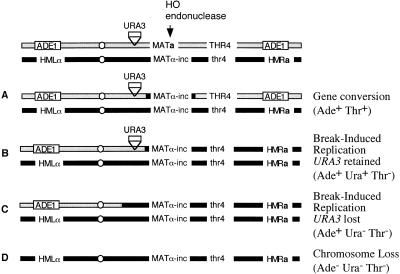
Repair of a DSB in a MATa/MATα-inc diploid. In the absence of Rad51p, gene conversion (A) is virtually eliminated. Repair occurs by break-induced replication, producing Ade+Thr− cells that may either retain a URA3 marker (B) or else occur such that URA3 is lost (C). If no repair occurs, the entire broken chromosome is lost, and cells become Ade− Thr− (D). Many colonies repair the DSB after one or more cell divisions, so that the colonies often are sectored Ade+ Thr−/Ade− Thr−.
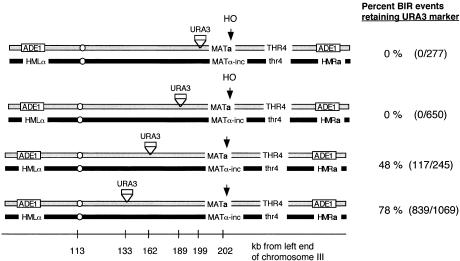
Position of BIR as determined by the retention of a URA3 marker placed centromere-proximal to the DSB at MAT. The retention of URA3 markers inserted 3, 10, 40, and 69 kb proximal to the DSB was determined among colonies in which BIR had occurred. (BIR) break-induced replication; (DSB) double-strand break.
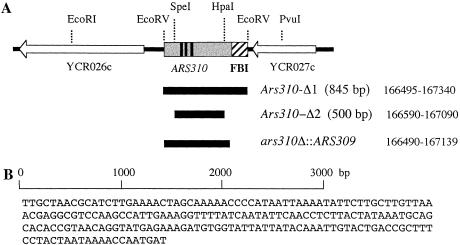
Deletion analysis of the ARS310 region. (A) Map of the region containing ARS310 and the locations of three deletion/modifications created in this region. (B) Two hundred base pair sequence of FBI, the facilitator of rad51-independent BIR. (FBI) facilitator of BIR; (BIR) break-induced replication.
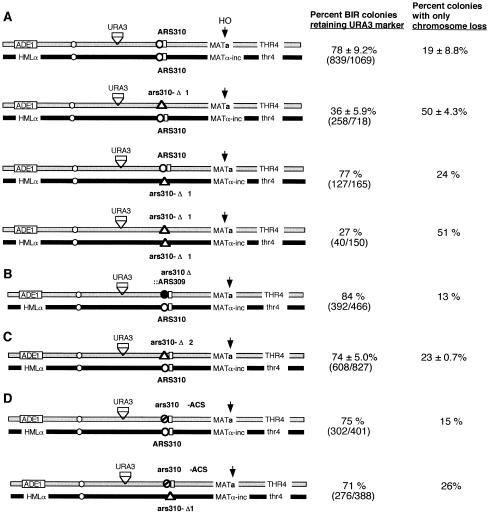
Role of the ARS310 region in facilitating rad51Δ-independent BIR. (A) Effect of homozygous and heterozygous ars310–Δ1 deletions. (B) Effect of the ars310Δ :: ARS309 replacement of part of the ARS310 region. (C) Effect of the ars310–Δ2 deletion, which leaves the FBI region (indicated by rectangle) intact. (D) Effect of 3-bp substitutions in each of the three ACS sequences within ARS310. (BIR) break-induced replication.
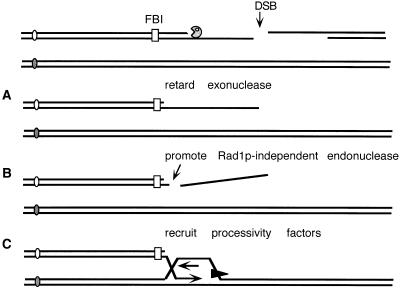
Possible roles of the FBI sequence in promoting Rad51p-independent BIR. (A) DNA is resected by 5′ to 3′ exonucleases, leaving long 3′ single-stranded DNA (ssDNA) tails. FBI may stall the exonuclease, allowing other processing of the ssDNA. (B) The 3′-ended tails must be cleaved off to provide a 3′ end that can act as a primer to initiate new DNA synthesis. FBI may participate in this Rad1p-Rad10p independent process. (C) FBI may help recruit processivity or other factors (shown as a black triangle) needed for BIR to the end of the chromosome, >130 kb away. (DSB) double-strand break; (FBI) facilitator of BIR.
References
-
- Aparicio OM, Weinstein DM, Bell SP. Components and dynamics of DNA replication complexes in S. cerevisiae: Redistribution of MCM proteins and Cdc45p during S phase. Cell. 1997;91:59–69. - PubMed
-
- Boeke JD, Lacroute F, Fink GR. A positive selection for mutants lacking orotidine-5′-phosphate decarboxylase activity in yeast: 5-Fluoro-orotic acid resistance. Mol Gen Genet. 1984;197:345–346. - PubMed
-
- Boeke JD, Trueheart J, Natsoulis G, Fink GR. 5-Fluoroorotic acid as a selective agent in yeast molecular genetics. Methods Enzymol. 1987;154:164–175. - PubMed
Publication types
MeSH terms
Substances
Grants and funding
LinkOut - more resources
Full Text Sources
Other Literature Sources
Molecular Biology Databases
Research Materials