


Structure of Hjc, a Holliday junction resolvase, from Sulfolobus solfataricus
- PMID: 11331763
- PMCID: PMC33243
- DOI: 10.1073/pnas.091613398
Structure of Hjc, a Holliday junction resolvase, from Sulfolobus solfataricus
Abstract
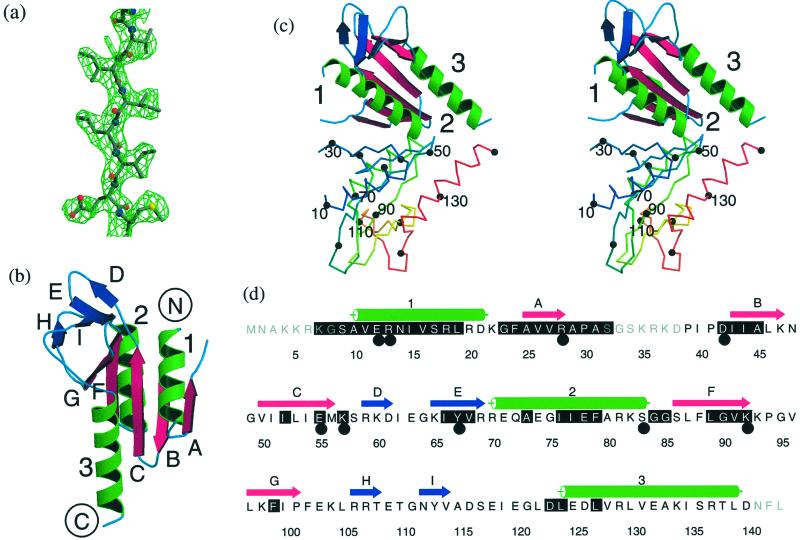
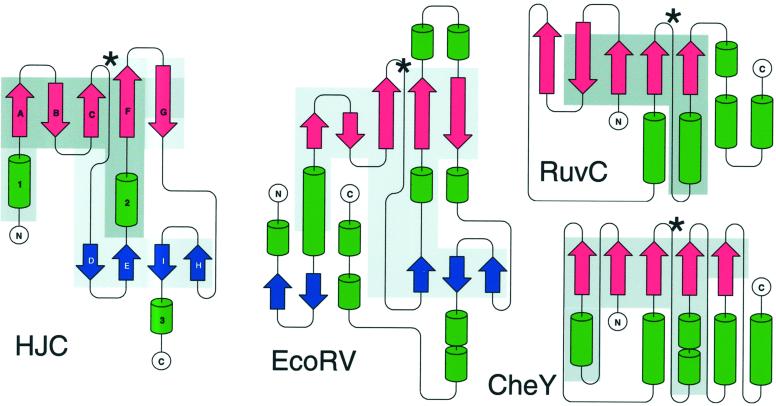
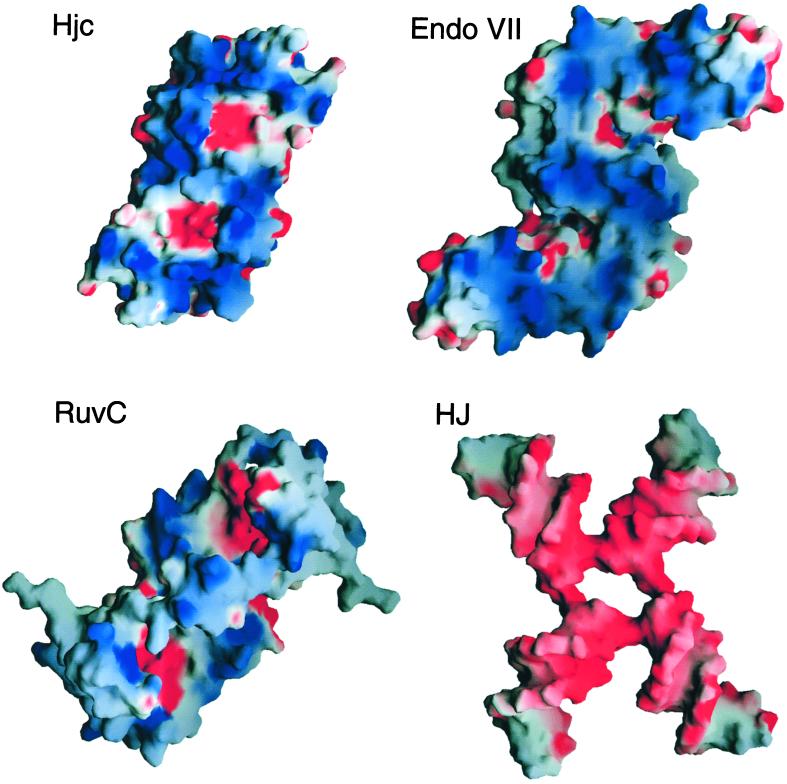
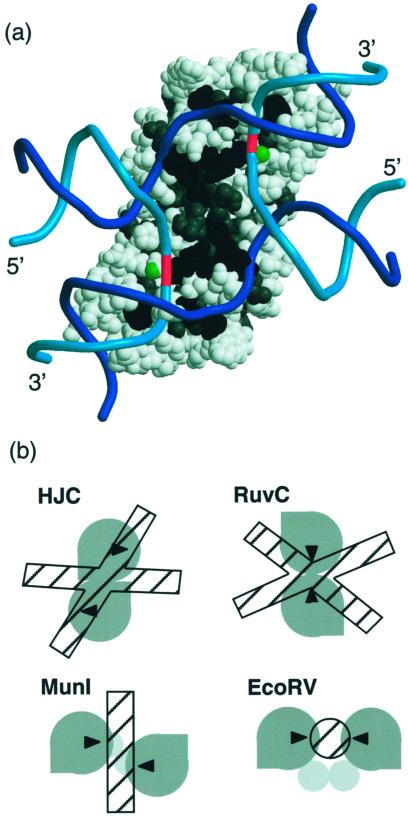
The 2.15-A structure of Hjc, a Holliday junction-resolving enzyme from the archaeon Sulfolobus solfataricus, reveals extensive structural homology with a superfamily of nucleases that includes type II restriction enzymes. Hjc is a dimer with a large DNA-binding surface consisting of numerous basic residues surrounding the metal-binding residues of the active sites. Residues critical for catalysis, identified on the basis of sequence comparisons and site-directed mutagenesis studies, are clustered to produce two active sites in the dimer, about 29 A apart, consistent with the requirement for the introduction of paired nicks in opposing strands of the four-way DNA junction substrate. Hjc displays similarity to the restriction endonucleases in the way its specific DNA-cutting pattern is determined but uses a different arrangement of nuclease subunits. Further structural similarity to a broad group of metal/phosphate-binding proteins, including conservation of active-site location, is observed. A high degree of conservation of surface electrostatic character is observed between Hjc and T4-phage endonuclease VII despite a complete lack of structural homology. A model of the Hjc-Holliday junction complex is proposed, based on the available functional and structural data.
Figures
References
-
- West S C. Annu Rev Genet. 1997;31:213–244. - PubMed
-
- Shinagawa H, Iwasaki H. Trends Biochem Sci. 1996;21:107–111. - PubMed
-
- White M F, Giraud-Panis M J, Pohler J R, Lilley D M J. J Mol Biol. 1997;269:647–664. - PubMed
-
- Ariyoshi M, Vassylyev D G, Iwasaki H, Nakamura H, Shinagawa H, Morikawa K. Cell. 1994;78:1063–1072. - PubMed
Publication types
MeSH terms
Substances
Associated data
- Actions
Grants and funding
LinkOut - more resources
Full Text Sources
Other Literature Sources
