


Regulation of mRNA translation and cellular signaling by hepatitis C virus nonstructural protein NS5A
- PMID: 11333890
- PMCID: PMC114914
- DOI: 10.1128/JVI.75.11.5090-5098.2001
Regulation of mRNA translation and cellular signaling by hepatitis C virus nonstructural protein NS5A
Abstract
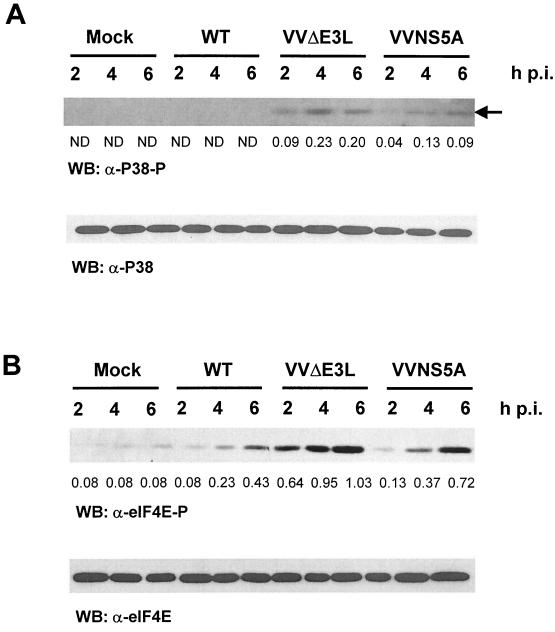
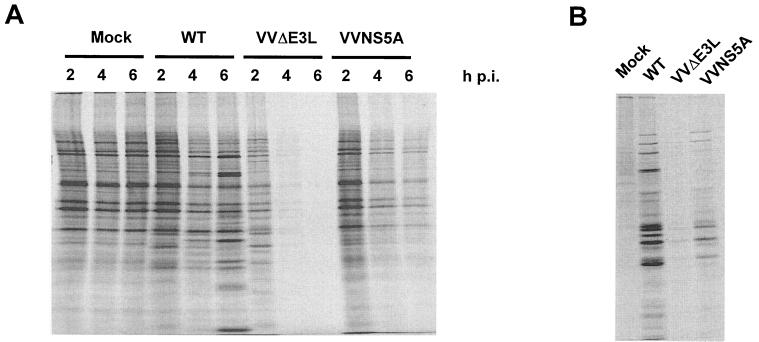
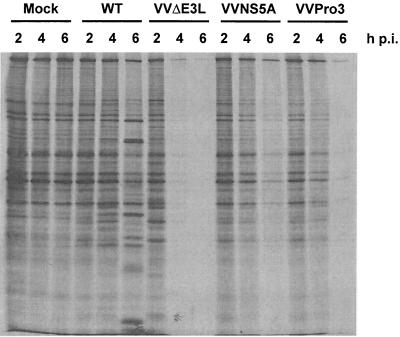
The NS5A nonstructural protein of hepatitis C virus (HCV) has been shown to inhibit the cellular interferon (IFN)-induced protein kinase R (PKR). PKR mediates the host IFN-induced antiviral response at least in part by inhibiting mRNA translation initiation through phosphorylation of the alpha subunit of eukaryotic initiation factor 2 (eIF2alpha). We thus examined the effect of NS5A inhibition of PKR on mRNA translation within the context of virus infection by using a recombinant vaccinia virus (VV)-based assay. The VV E3L protein is a potent inhibitor of PKR. Accordingly, infection of IFN-pretreated HeLa S3 cells with an E3L-deficient VV (VVDeltaE3L) resulted in increased phosphorylation levels of both PKR and eIF2alpha. IFN-pretreated cells infected with VV in which the E3L locus was replaced with the NS5A gene (VVNS5A) displayed diminished phosphorylation of PKR and eIF2alpha in a transient manner. We also observed an increase in activation of p38 mitogen-activated protein kinase in IFN-pretreated cells infected with VVDeltaE3L, consistent with reports that p38 lies downstream of the PKR pathway. Furthermore, these cells exhibited increased phosphorylation of the cap-binding initiation factor 4E (eIF4E), which is downstream of the p38 pathway. Importantly, these effects were reduced in cells infected with VVNS5A. NS5A was also found to inhibit activation of the p38-eIF4E pathway in epidermal growth factor-treated cells stably expressing NS5A. NS5A-induced inhibition of eIF2alpha and eIF4E phosphorylation may exert counteracting effects on mRNA translation. Indeed, IFN-pretreated cells infected with VVNS5A exhibited a partial and transient restoration of cellular and viral mRNA translation compared with IFN-pretreated cells infected with VVDeltaE3L. Taken together, these results support the role of NS5A as a PKR inhibitor and suggest a potential mechanism by which HCV might maintain global mRNA translation rate during early virus infection while favoring cap-independent translation of HCV mRNA during late infection.
Figures


References
-
- Alter M J H. Epidemiology of hepatitis C. Hepatology. 1997;26:62–65. - PubMed
-
- Barber G N, Tomita J, Garfinkel M S, Meurs E, Hovanessian A, Katze M G. Detection of protein kinase homologues and viral RNA-binding domains utilizing polyclonal antiserum prepared against a baculovirus-expressed dsRNA-activated 68,000-Da protein kinase. Virology. 1992;191:670–679. - PubMed
-
- Beattie E, Paoletti E, Tartaglia J. Distinct patterns of IFN sensitivity observed in cells infected with vaccinia K3L− and E3L− mutant viruses. Virology. 1995;210:254–263. - PubMed
-
- Beattie E, Tartaglia J, Paoletti E. Vaccinia virus-encoded eIF-2α homolog abrogates the antiviral effect of interferon. Virology. 1991;183:419–422. - PubMed
Publication types
MeSH terms
Substances
Grants and funding
LinkOut - more resources
Full Text Sources
Other Literature Sources
Miscellaneous
