


Functional analysis of 14 genes that constitute the purine catabolic pathway in Bacillus subtilis and evidence for a novel regulon controlled by the PucR transcription activator
- PMID: 11344136
- PMCID: PMC99626
- DOI: 10.1128/JB.183.11.3293-3302.2001
Functional analysis of 14 genes that constitute the purine catabolic pathway in Bacillus subtilis and evidence for a novel regulon controlled by the PucR transcription activator
Abstract
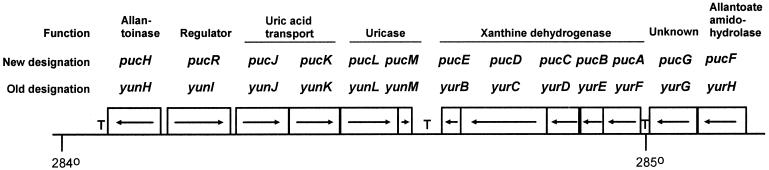
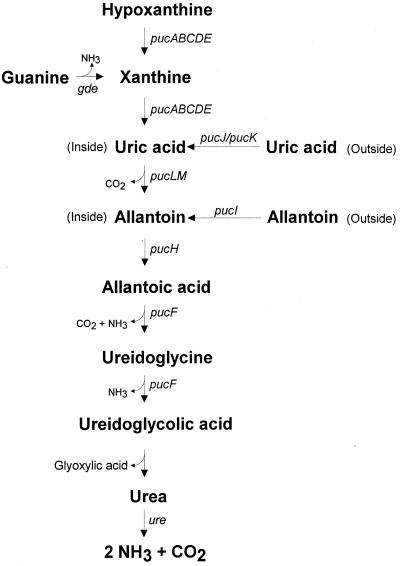
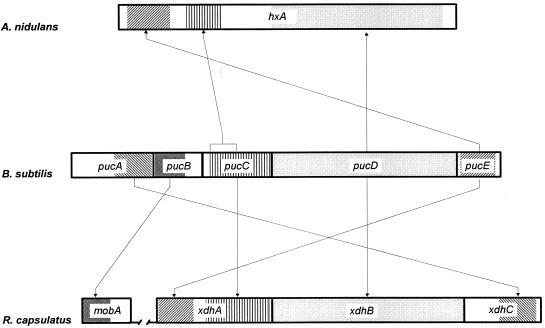
The soil bacterium Bacillus subtilis has developed a highly controlled system for the utilization of a diverse array of low-molecular-weight compounds as a nitrogen source when the preferred nitrogen sources, e.g., glutamate plus ammonia, are exhausted. We have identified such a system for the utilization of purines as nitrogen source in B. subtilis. Based on growth studies of strains with knockout mutations in genes, complemented with enzyme analysis, we could ascribe functions to 14 genes encoding enzymes or proteins of the purine degradation pathway. A functional xanthine dehydrogenase requires expression of five genes (pucA, pucB, pucC, pucD, and pucE). Uricase activity is encoded by the pucL and pucM genes, and a uric acid transport system is encoded by pucJ and pucK. Allantoinase is encoded by the pucH gene, and allantoin permease is encoded by the pucI gene. Allantoate amidohydrolase is encoded by pucF. In a pucR mutant, the level of expression was low for all genes tested, indicating that PucR is a positive regulator of puc gene expression. All 14 genes except pucI are located in a gene cluster at 284 to 285 degrees on the chromosome and are contained in six transcription units, which are expressed when cells are grown with glutamate as the nitrogen source (limiting conditions), but not when grown on glutamate plus ammonia (excess conditions). Our data suggest that the 14 genes and the gde gene, encoding guanine deaminase, constitute a regulon controlled by the pucR gene product. Allantoic acid, allantoin, and uric acid were all found to function as effector molecules for PucR-dependent regulation of puc gene expression. When cells were grown in the presence of glutamate plus allantoin, a 3- to 10-fold increase in expression was seen for most of the genes. However, expression of the pucABCDE unit was decreased 16-fold, while expression of pucR was decreased 4-fold in the presence of allantoin. We have identified genes of the purine degradation pathway in B. subtilis and showed that their expression is subject to both general nitrogen catabolite control and pathway-specific control.
Figures
References
-
- Ashihara H, Crozier A. Biosynthesis and metabolism of caffeine and related purine alkaloids in plants. Adv Bot Res. 2000;30:117–205.
-
- Blase M, Bruntner C, Tshisuaka B, Fetzner S, Lingens F. Cloning, expression, and sequence analysis of the three genes encoding quinoline 2-oxidoreductase, a molybdenum-containing hydroxylase from Pseudomonas putida86. J Biol Chem. 1996;271:23068–23079. - PubMed
-
- Bongaerts G P, Uitzetter J, Brouns R, Vogels G D. Uricase of Bacillus fastidiosus: properties and regulation of synthesis. Biochim Biophys Acta. 1978;527:348–358. - PubMed
-
- Cooper T G. Regulation of allantoin catabolism in Saccharomyces cerevisiae. In: Brambl R, Marzluf G A, editors. The mycota III: biochemistry and molecular biology. Berlin, Germany: Springer-Verlag; 1996. pp. 139–169.
Publication types
MeSH terms
Substances
LinkOut - more resources
Full Text Sources
Other Literature Sources
Molecular Biology Databases
