. 2001 Jun;183(11):3447-57.
doi: 10.1128/JB.183.11.3447-3457.2001.

The CDC42 homolog of the dimorphic fungus Penicillium marneffei is required for correct cell polarization during growth but not development

Affiliations

The CDC42 homolog of the dimorphic fungus Penicillium marneffei is required for correct cell polarization during growth but not development

K J Boyce et al. J Bacteriol. 2001 Jun.

Abstract

The opportunistic human pathogenic fungus Penicillium marneffei is dimorphic and is thereby capable of growth either as filamentous multinucleate hyphae or as uninucleate yeast cells which divide by fission. The dimorphic switch is temperature dependent and requires regulated changes in morphology and cell shape. Cdc42p is a Rho family GTPase which in Saccharomyces cerevisiae is required for changes in polarized growth during mating and pseudohyphal development. Cdc42p homologs in higher organisms are also associated with changes in cell shape and polarity. We have cloned a highly conserved CDC42 homolog from P. marneffei named cflA. By the generation of dominant-negative and dominant-activated cflA transformants, we have shown that CflA initiates polarized growth and extension of the germ tube and subsequently maintains polarized growth in the vegetative mycelium. CflA is also required for polarization and determination of correct cell shape during yeast-like growth, and active CflA is required for the separation of yeast cells. However, correct cflA function is not required for dimorphic switching and does not appear to play a role during the generation of specialized structures during asexual development. In contrast, heterologous expression of cflA alleles in Aspergillus nidulans prevented conidiation.


Figures
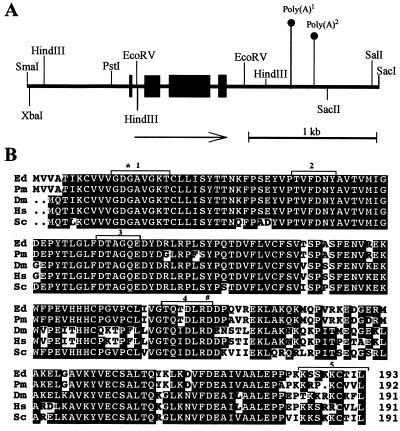
FIG. 1
FIG. 1
(A) Gene structure of cflA. The gene is composed of four exons (filled boxes) and three introns. Arrow, direction of transcription. The two alternative polyadenylation sites and restriction enzyme recognition sites are also indicated. (B) Protein sequence alignment of the Cdc42p homologs from E. dermatitidis (Ed; AF162788.1), P. marneffei (Pm), D. melanogaster (Dm; P40793), Homo sapiens (Hs; P21181), and S. cerevisiae (Sc; Q01112). Identical amino acids are shaded black, similar amino acids are shaded grey, and nonconserved amino acids are unshaded. Amino acids mutated in these studies are indicated (asterisk, G14V; hash sign, D120A). The domains important for function are indicated as follows: GTP binding, 1; interaction with effectors, 2; GTP hydrolysis, 3; GDP-to-GTP exchange, 4; targeting to the plasma membrane, 5.
FIG. 2
FIG. 2
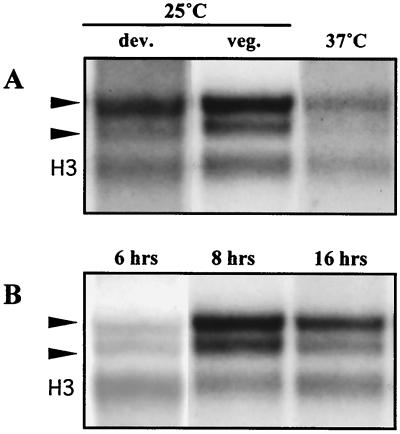
(A) Northern blot analysis of cflA expression. Total RNA was isolated from asexually developing cultures at 25°C (dev.), vegetatively growing mycelia at 25°C (veg.), and yeast cells (37°C). Northern blots were probed with cflA and a histone H3 probe (H3) as an RNA loading control. Arrowheads, the two cflA transcripts of 1.3 and 1.5 kb. (B) Northern blot analysis using total RNA isolated during the dimorphic switching from 37 to 25°C. Yeast cells were transferred from 37 to 25°C, and total RNA was isolated at 6, 18, and 24 h posttransfer. Northern blots were probed with cflA and a histone H3 probe as an RNA loading control. Arrowheads, the two cflA transcripts of 1.3 and 1.5 kb.
FIG. 3
FIG. 3
Colonial morphology of the P. marneffei and A. nidulans dominant-activated cflAG14V and dominant-negative cflAD120A transformants. (A) Colonial morphology of the P. marneffei cflAG14V and cflAD120A transformants compared to that of the parental SPM4 control strain (cflA+). Strains were grown on ANM-GABA-uridine-uracil (5 mM) medium at 25°C for 8 (25°C vegetative) or 12 days (25°C developmental) or on SD-uridine-uracil (5 mM) medium for 6 days at 37°C (37°C vegetative). (B) Colonial morphology of the P. marneffei and A. nidulans alcA(p)::cflA, alcA(p)::cflAD120A, and alcA(p)::cflAG14V transformants. Strains were grown at 25°C for 12 days on noninducing medium (carbon-free medium [CF]-GABA-fructose medium [noninduced]) or on inducing medium (CF-GABA-fructose-cyclopentanone [induced]).
FIG. 4
FIG. 4
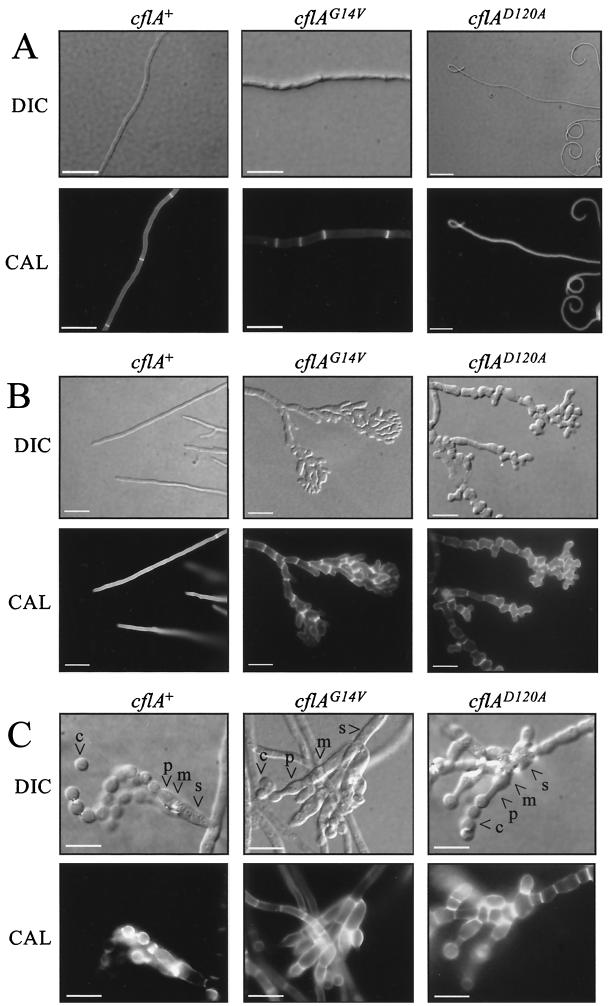
cflA mutant transformants at 25°C show numerous morphological defects. (A) Early vegetative hyphae. Strains were grown for 2 days at 25°C on SD solid medium. The cflAG14V transformants showed increased septation compared to the wild-type strain. The cflAD120A transformants possessed curled hyphal tip cells. Scale bars, 50 μm. (B) Vegetative hyphae at a later stage. Strains were grown for 5 days at 25°C on SD solid medium. The cflAG14V and cflAD120A transformants displayed a variety of morphological abnormalities including branched and swollen hyphae, which also exhibited increased septation. Apical cells show significant loss of polarization leading to fused, lysed, and aberrant cells. Scale bars, 50 μm. (C) Conidiation. Strains were grown at 25°C for 5 days on ANM-GABA solid medium. Conidiation proceeds normally in the cflA mutant transformants. Scale bars, 20 μm. Arrowheads, conidiophore structures (s, stalk; m, metulae; p, phialides; c, conidia). Images were captured using differential interference contrast (DIC) or under epifluorescence to observe Calcofluor-stained cell walls (CAL).
FIG. 5
FIG. 5
cflAG14V and cflAD120A transformants produce yeast cells with aberrant morphology. Cultures were incubated at 37°C for 4 days in BHI medium. The yeast cells produced by the cflAG14V transformants were swollen and septate. Some septa appeared thicker than those of dividing SPM4 control yeast cells (arrowhead), and some cells did not contain a nucleus. The cflAD120A transformants produced yeast cells which were branched, swollen, and septate. Scale bars, 20 μm. Images were captured using differential interference contrast (DIC) or under epifluorescence to observe Calcofluor cell wall stain (CAL).
FIG. 6
FIG. 6
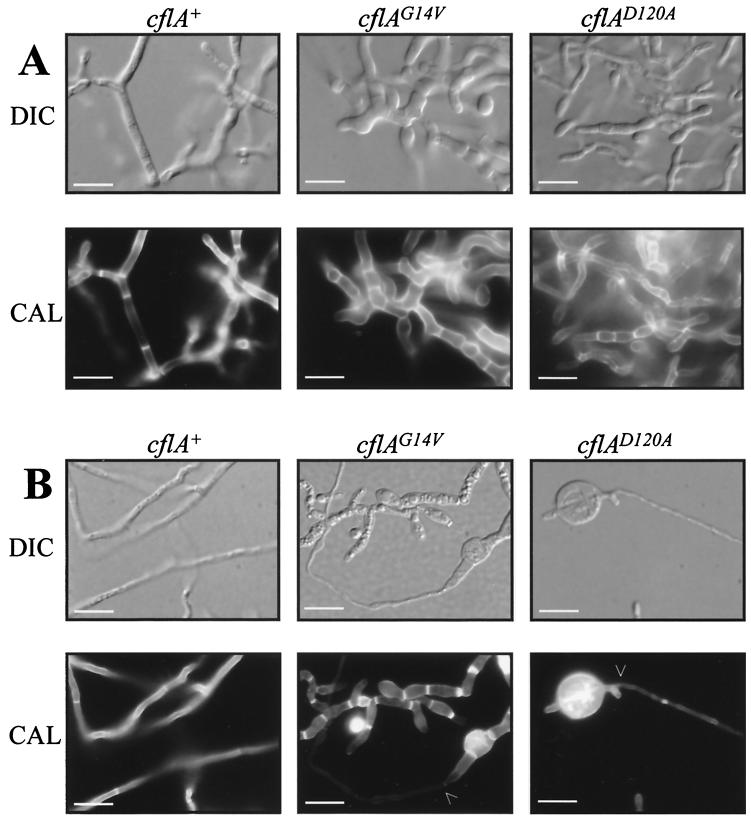
cflAG14V and cflAD120A dominant-negative and dominant-activated transformants are able to undergo the dimorphic temperature-dependent switch, but resulting cell types display aberrant morphology. (A) cflA mutant transformants grown at 25°C for 2 days and transferred to 37°C are able to produce chains of yeast-like cells after 3 days; however, these cells are swollen, highly septate, and unseparated. Scale bars, 20 μm. (B) cflAG14V and cflAD120A transformants extend narrow hyphae from swollen yeast cells when grown at 37°C for 10 days and transferred to 25°C for 3 days (arrowheads). Scale bars, 20 μm. Images were captured using differential interference contrast (DIC) or under epifluorescence to observe Calcofluor cell wall stain (CAL).

References

    1. Adams A E, Johnson D I, Longnecker R M, Sloat B F, Pringle J R. CDC42 and CDC43, two additional genes involved in budding and the establishment of cell polarity in the yeast Saccharomyces cerevisiae. J Cell Biol. 1990;111:131–142. - PMC - PubMed
    1. Ausubel F M, Brent R, Kingston R E, Moore D D, Seidman J G, Smith J A, Struhl K, editors. Current protocols in molecular biology. New York, N.Y: John Wiley & Sons, Inc.; 1994.
    1. Ayscough K R, Stryker J, Pokala N, Sanders M, Crews P, Drubin D G. High rates of actin filament turnover in budding yeast and roles for actin in establishment and maintenance of cell polarity revealed using the actin inhibitor latrunculin-A. J Cell Biol. 1997;137:399–416. - PMC - PubMed
    1. Banuett F. Signalling in the yeasts: an informational cascade with links to the filamentous fungi. Microbiol Mol Biol Rev. 1998;62:249–274. - PMC - PubMed
    1. Benton B K, Tinkelenberg A, Gonzalez I, Cross F R. Cla4p, a Saccharomyces cerevisiae Cdc42p-activated kinase involved in cytokinesis, is activated at mitosis. Mol Cell Biol. 1997;17:5067–5076. - PMC - PubMed

Publication types

MeSH terms

Substances

Associated data

LinkOut - more resources