. 2001 May 22;98(11):6110-5.
doi: 10.1073/pnas.101130298. Epub 2001 May 8.

Diffractive optics-based heterodyne-detected four-wave mixing signals of protein motion: from "protein quakes" to ligand escape for myoglobin

Affiliations

Diffractive optics-based heterodyne-detected four-wave mixing signals of protein motion: from "protein quakes" to ligand escape for myoglobin

G Dadusc et al. Proc Natl Acad Sci U S A. .

Abstract

Ligand transport through myoglobin (Mb) has been observed by using optically heterodyne-detected transient grating spectroscopy. Experimental implementation using diffractive optics has provided unprecedented sensitivity for the study of protein motions by enabling the passive phase locking of the four beams that constitute the experiment, and an unambiguous separation of the Real and Imaginary parts of the signal. Ligand photodissociation of carboxymyoglobin (MbCO) induces a sequence of events involving the relaxation of the protein structure to accommodate ligand escape. These motions show up in the Real part of the signal. The ligand (CO) transport process involves an initial, small amplitude, change in volume, reflecting the transit time of the ligand through the protein, followed by a significantly larger volume change with ligand escape to the surrounding water. The latter process is well described by a single exponential process of 725 +/- 15 ns. at room temperature. The overall dynamics provide a distinctive signature that can be understood in the context of segmental protein fluctuations that aid ligand escape via a few specific cavities, and they suggest the existence of discrete escape pathways.


Figures
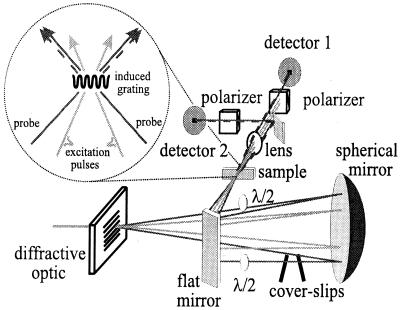
Figure 1
Figure 1
Optically heterodyned experimental setup. The Inset shows the beam geometry. The dashed black lines are the diffracted signals that are mixed at their respective detectors with the undiffracted probe (solid black) that serves as a reference.
Figure 2
Figure 2
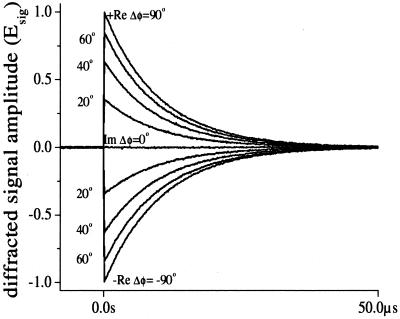
DeoxyMb phase dependence for Λ = 7.5 μm. By varying the relative phase Δφ between signal and reference beams, heterodyne detection allows separation of the Re and Im parts of the signal.
Figure 3
Figure 3
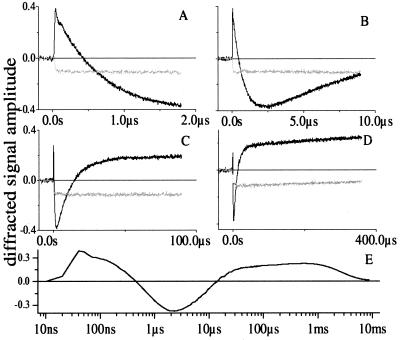
Re (black) and Im (gray) data at 20°C for all timescales. E shows the full time evolution of the Re part of the signal on a log(time) axis. A 3-point smoothing was performed because the data sets A–D were recorded at different sampling rates.
Figure 4
Figure 4
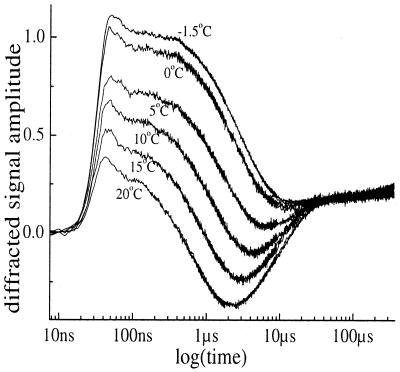
The 7.5-μm temperature dependent data with the following temperatures from bottom to top: 20°C, 15°C, 10°C, 5°C, 0°C, and −1.5°C. The suppression of the thermal feature in going from room temperature to −1.5°C is most apparent in the 1− to 10-μs window. In addition, the relatively flat feature of the data, clearly visible at T = −1.5°C from t = 0 to t ≈ 400 ns becomes shorter in going to higher temperatures.
Figure 5
Figure 5
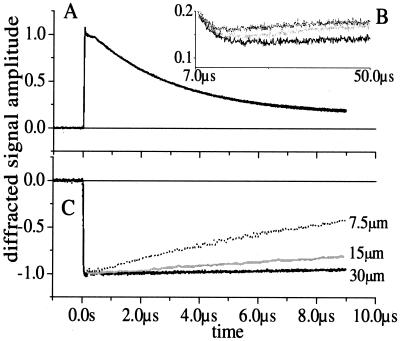
(A) MbCO data at −1.5°C for all Λ. Note that the dynamics are independent of Λ until 7 μs. The Inset (B) shows a magnified view of the dynamics after 7 μs (grayscale for Λ as in C), where the CO diffusion effects begin to become apparent. (C) DeoxyMb data at room temperature for all Λ, indicating the strong dependence of the thermal phase grating signal on fringe spacing on this same time scale.
Figure 6
Figure 6
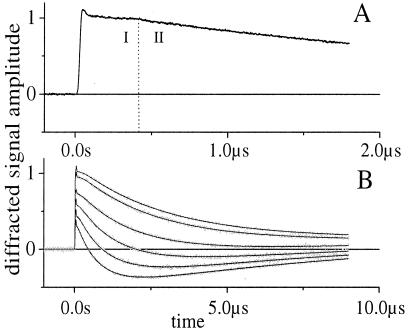
(A) Re signal showing the plateau region for t < 400 ns at −1.5°C and 7.5-μm fringe spacing. (B) Fits and data for t < 10 μs and 7.5 μm at the following temperatures (from bottom to top): 20°C, 15°C, 10°C, 5°C, 0°C, −1.5°C.
Figure 7
Figure 7
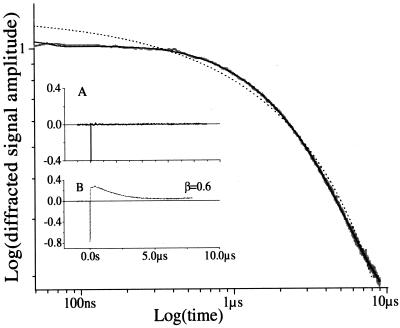
Comparison of fits to the data with a stretched exponential or exponential relaxation processes. (A) Residuals of the fit to the model of ref. (solid line). (B) Residuals of the fit to the data by using a stretched exponential of β = 0.6, optimized to give the best fit (τ = 5.9 μs).
Figure 8
Figure 8
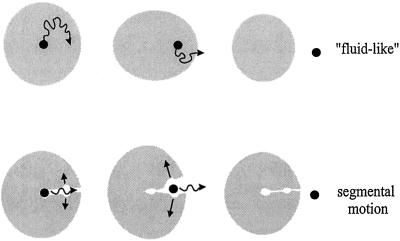
Segmental vs. localized protein motions. The “fluid-like” case schematically depicts the random diffusive motion of the ligand if the protein behaved as a highly associated fluid in which localized fluctuations permitted ligand access to the entire protein. There would be a distribution of volume changes and escape times characteristic of a diffusive process. The lower, segmental motions depict fluctuations involving correlations over the length scales required to create a contiguous path to void spaces in the protein and the solvent for ligand escape. The dynamics in this case would reflect a thermally activated hopping process with discrete intermediates that would depend on the number of accessible void spaces in the protein.

References

    1. Jackson T A, Lim M, Anfinrud P A. Seventh International Conference on Time-Resolved Vibrational Spectroscopy. 1995. comps. Dyer, R. B., Martinez, M. A. D., Shreve, A. & Woodruff, W. H. (Los Alamos Natl. Lab., Los Alamos, NM), Report LA-13290-C, pp. 9–13.
    1. Chu K, Vojtchovsky J, McMahon B H, Sweet R M, Berendzen J, Schlichting I. Nature (London) 2000;403:921–923. - PubMed
    1. Brunori M, Vallone B, Cutruzzola F, Travaglini-Allocatelli C, Berendzen J, Chu K, Sweet R, Schlichting I. Proc Natl Acad Sci USA. 2000;97:2058–2063. . (First Published February 11, 2000; 10.1073/pnas.040459697) - PMC - PubMed
    1. Brunori M. Biophys J. 1999;76:1259–1269. - PMC - PubMed
    1. Brunori M. Biophys Chem. 1999;86:221–230. - PubMed

Publication types

LinkOut - more resources