


Comment
doi: 10.1073/pnas.101137698.
Don't stop for repairs in a war zone: Darwinian evolution unites genes and environment in cancer development
Affiliations
- PMID: 11344279
- PMCID: PMC33219
- DOI: 10.1073/pnas.101137698
Item in Clipboard
Comment
Don't stop for repairs in a war zone: Darwinian evolution unites genes and environment in cancer development
Proc Natl Acad Sci U S A.
.
No abstract available
Figures
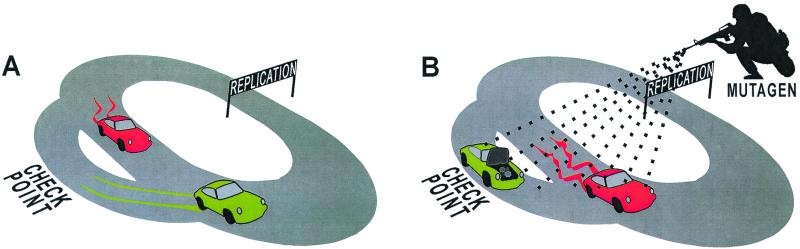
The cell cycle Grand Prix and effects of opposing repair strategies in
different environments. Team I (green) always stops for repairs when a
problem is indicated, whereas team II (red) ignores all warning lights.
Team I wins under ordinary conditions (A) because it
always has a faultless vehicle, whereas team II accumulates errors. In
the harsher environment (B) the vehicles accumulate
damages more quickly than can be repaired, and team I gets trapped in
the checkpoint. Team II, on the other hand, jerks along in its faulty
vehicle with a fair chance of making the finish line. This simple
assessment of repair strategies thereby provides an explanation for the
paradox that mutagenic environments favor repair deficiency.
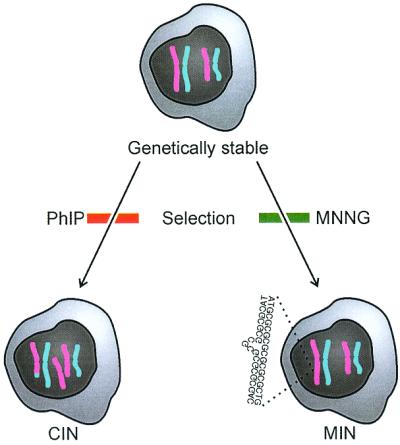
Mutagenic selection of genetic instability. Bardelli et
al. (3) started out with the genetically stable cell line H3
(HCT 116 artificially complemented with chromosome 3). This cell line
was first exposed to selection pressure involving cytotoxic levels of
PhIP. The selected cells expressed CIN, illustrated as a trisomy and a
translocation. The same cell line (H3) then was exposed to selection
pressure involving cytotoxic levels of MNNG
(N-methyl-N′-nitro-N-nitrosoguanine).
This time the selected cells expressed MIN, illustrated as slippage in
a repetitive sequence. The experiment thus supports the hypothesis that
the CIN and MIN phenotypes reflect Darwinian adaptations to different
mutagenic environments, methylating and BAF agents, respectively.
Comment on
-
Carcinogen-specific induction of genetic instability.Proc Natl Acad Sci U S A. 2001 May 8;98(10):5770-5. doi: 10.1073/pnas.081082898. Epub 2001 Apr 10. Proc Natl Acad Sci U S A. 2001. PMID: 11296254 Free PMC article.
References
-
- Klein G. Adv Cancer Res. 1998;72:1–23. - PubMed
-
- Breivik J, Gaudernack G. Semin Cancer Biol. 1999;9:245–254. - PubMed
-
- Lengauer C, Kinzler K W, Vogelstein B. Nature (London) 1998;396:643–649. - PubMed
-
- Rampino N, Yamamoto H, Ionov Y, Li Y, Sawai H, Reed J C, Perucho M. Science. 1997;275:967–969. - PubMed
Publication types
MeSH terms
Substances
LinkOut - more resources
Full Text Sources
