. 2001 Jun;69(6):3550-5.
doi: 10.1128/IAI.69.6.3550-3555.2001.

Tumor necrosis factor-dependent adhesions as a major protective mechanism early in septic peritonitis in mice

Affiliations

Tumor necrosis factor-dependent adhesions as a major protective mechanism early in septic peritonitis in mice

B Echtenacher et al. Infect Immun. 2001 Jun.

Abstract

The occurrence of peritoneal adhesions in surgical patients is positively correlated with tumor necrosis factor (TNF) levels. In a model of septic peritonitis-cecal ligation and puncture-TNF neutralization prevented formation of peritoneal adhesions and increased mortality, most likely because localization of the septic focus was prevented. To discriminate between the coagulation-independent protective TNF effect and a potential protective procoagulant TNF effect, formation of peritoneal adhesions after CLP was inhibited with heparin, hirudin, or urokinase. Each treatment increased mortality and increased the number of bacteria in the peritoneal lavage fluid, kidney, and liver to various degrees. Under these experimental conditions, antibiotics prevented death. In coagulation-compromised mice, lethality was further enhanced by additional TNF neutralization. These findings demonstrate that peritoneal adhesions early in septic peritonitis are an important mechanism of innate immunity that prevents increased spread of bacteria and reduces mortality.


Figures
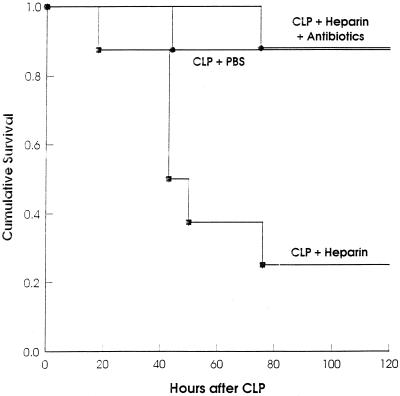
FIG. 1
FIG. 1
Heparin treatment after CLP increases mortality. After sublethal CLP, groups of mice (n = 8) were injected i.p. with PBS, heparin, or heparin plus antibiotics. (P < 0.015 for heparin versus PBS; P < 0.01 for heparin versus heparin plus antibiotics [log rank statistic].)
FIG. 2
FIG. 2
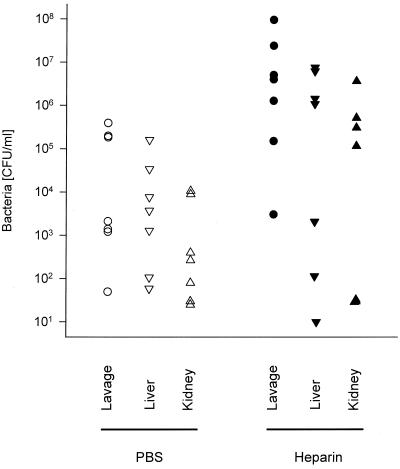
Heparin treatment after CLP increases bacterial spread. After CLP, groups of mice (n = 15) were injected i.p. with PBS or heparin; 16 h later, numbers of bacteria were determined in peritoneal lavage fluids, livers, and kidneys of the surviving heparin-treated mice (n = 7) and randomly chosen PBS-treated mice (n = 7). (Bacterial numbers after heparin versus after PBS: for lavage fluid, P < 0.018; for liver, P < 0.34; for kidney, P < 0.25 [two-tailed Mann-Whitney U test].)
FIG. 3
FIG. 3
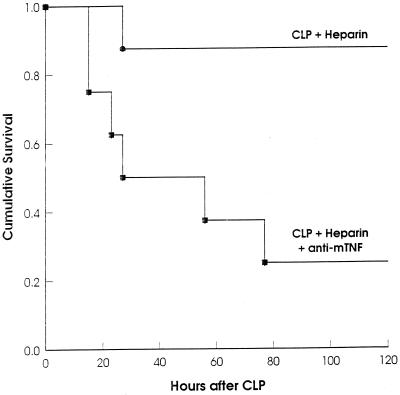
Nonlethal heparin treatment after sublethal CLP becomes lethal if followed by TNF neutralization. After sublethal CLP, groups of mice (n = 8) were injected i.p. with heparin plus normal rat IgG (control) or with heparin plus monoclonal anti-mouse TNF antibody. (P < 0.02 for control versus anti-TNF [log rank statistic].)
FIG. 4
FIG. 4
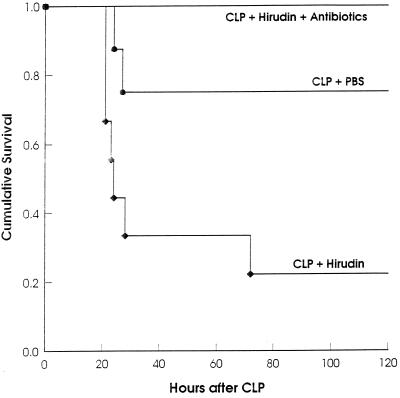
Treatment with the thrombin inhibitor hirudin after CLP increases mortality. After sublethal CLP, groups of mice were injected i.p. with PBS (n = 8), hirudin (n = 8), or hirudin plus antibiotics (n = 10). (P < 0.03 for hirudin versus PBS; P < 0.001 for hirudin versus hirudin plus antibiotics [log rank statistic].)
FIG. 5
FIG. 5
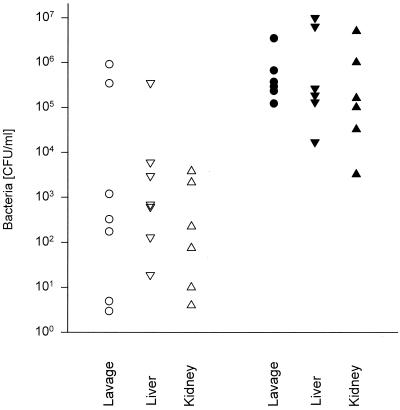
Treatment with hirudin after CLP increases bacterial spread. After CLP, groups of mice (n = 15) were injected i.p. with PBS or hirudin; 16 h later, numbers of bacteria were determined in peritoneal lavage fluids, livers, and kidneys of the surviving hirudin-treated mice (n = 6) and randomly chosen PBS-treated mice (n = 7). (Bacterial numbers after hirudin versus after PBS: for lavage fluid, P < 0.011; for liver, P < 0.016; for kidney, P < 0.0045 [two-tailed Mann-Whitney U test].)
FIG. 6
FIG. 6
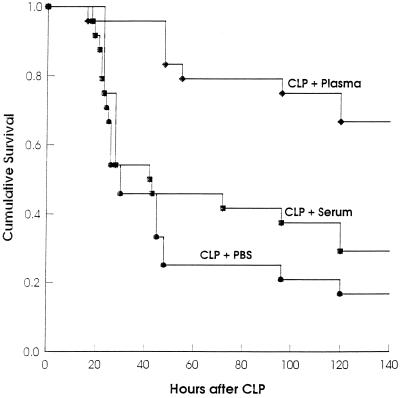
Intraperitoneal injection of plasma after CLP increases survival. After lethal CLP, mice were injected i.p. with plasma (n = 8), serum (n = 8), or PBS (n = 8). The data are pooled from three independent experiments (n = 72). (P < 0.0001 for PBS versus plasma; P < 0.0033 for serum versus plasma; P > 0.3 for PBS versus serum [log rank statistic].)
FIG. 7
FIG. 7
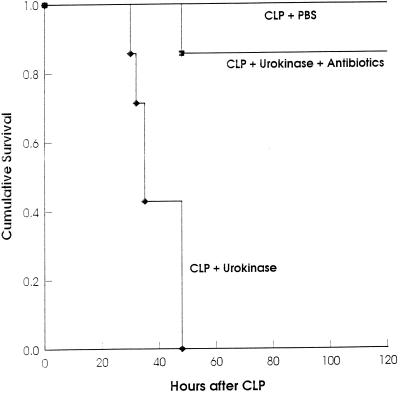
Treatment with the plasminogen activator urokinase after CLP increases mortality. Eight hours after sublethal CLP, groups of mice (n = 7) were injected i.p. with PBS, urokinase, or urokinase plus antibiotics. (P < 0.0005 for urokinase versus PBS; P < 0.002 for urokinase versus urokinase plus antibiotics [log rank statistic].)
FIG. 8
FIG. 8
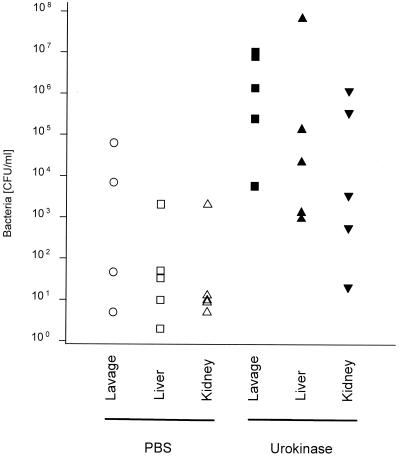
Treatment with urokinase after CLP increases bacterial spread. Eight hours after CLP, groups of mice (n = 5) were injected i.p. with PBS or hirudin; 11 h later, numbers of bacteria in peritoneal lavage fluids, livers, and kidneys were determined. (Bacterial numbers after hirudin versus after PBS: for lavage fluid, P < 0.028; for liver, P < 0.029, for kidney, P < 0.029 [two-tailed Mann-Whitney U test].)

References

    1. Bagby G J, Plessala K J, Wilson L A, Thompson J J, Nelson S. Divergent efficacy of antibody to tumor necrosis factor-alpha in intravascular and peritonitis models of sepsis. J Infect Dis. 1991;163:83–88. - PubMed
    1. Billing A G, Fröhlich D, Konecny G, Schildberg F W, Machleidt W, Fritz H, Jochum M. Local serum application: restoration of sufficient host defense in human peritonitis. Eur J Clin Investig. 1994;24:28–35. - PubMed
    1. Bone R C. Modulators of coagulation. A critical appraisal of their role in sepsis. Arch Intern Med. 1992;152:1381–1389. - PubMed
    1. Dickneite G, Czech J. Combination of antibiotic treatment with the thrombin inhibitor recombinant hirudin for the therapy of experimental Klebsiella pneumoniae sepsis. Thromb Haemost. 1994;71:768–772. - PubMed
    1. Dickneite G, Czech J, Keuper H. Formation of fibrin monomers in experimental disseminated intravascular coagulation and its inhibition by recombinant hirudin. Circ Shock. 1994;42:183–189. - PubMed

Publication types

MeSH terms