. 2001 Jun;69(6):4079-85.
doi: 10.1128/IAI.69.6.4079-4085.2001.

Anaerobic conditions induce expression of polysaccharide intercellular adhesin in Staphylococcus aureus and Staphylococcus epidermidis

Affiliations

Anaerobic conditions induce expression of polysaccharide intercellular adhesin in Staphylococcus aureus and Staphylococcus epidermidis

S E Cramton et al. Infect Immun. 2001 Jun.

Abstract

Products of the intercellular adhesion (ica) operon in Staphylococcus aureus and Staphylococcus epidermidis synthesize a linear beta-1,6-linked glucosaminylglycan. This extracellular polysaccharide mediates bacterial cell-cell adhesion and is required for biofilm formation, which is thought to increase the virulence of both pathogens in association with prosthetic biomedical implants. The environmental signal(s) that triggers ica gene product and polysaccharide expression is unknown. Here we demonstrate that anaerobic in vitro growth conditions lead to increased polysaccharide expression in both S. aureus and S. epidermidis, although the regulation is less stringent in S. epidermidis. Anaerobiosis also dramatically stimulates ica-specific mRNA expression in ica- and polysaccharide-positive strains of both S. aureus and S. epidermidis. These data suggest a mechanism whereby ica gene expression and polysaccharide production may act as a virulence factor in an anaerobic environment in vivo.


Figures
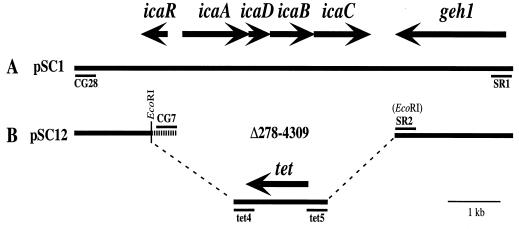
FIG. 1
FIG. 1
Schematic representation of cloning strategy used to construct the ica deletion-replacement mutant of S. epidermidis. A similar strategy was used to construct the ica deletion-replacement mutant of S. aureus, described in reference . (A) Plasmid pSC1. Sequences including and surrounding the ica locus are included in database entry U43366. Sequences including and surrounding the geh1 gene are included in database entry AF053006. PCR primers used to amplify cloned DNA are indicated (CG-28 and SR-1). (B) Plasmid pSC12, the deletion-replacement construct used for homologous recombination. Inverse PCR primers used to delete the ica locus (CG-7 and SR-2) and amplify the tetracycline resistance cassette (tet4 and tet5) are indicated. EcoRI restriction recognition sites contained within the sequences of primers SR-2, tet-4, and tet-5 and the EcoRI restriction site in the middle of icaR were used to insert the tetracycline resistance cassette. Deleted sequence numbers refer to database sequence U43366.
FIG. 2
FIG. 2
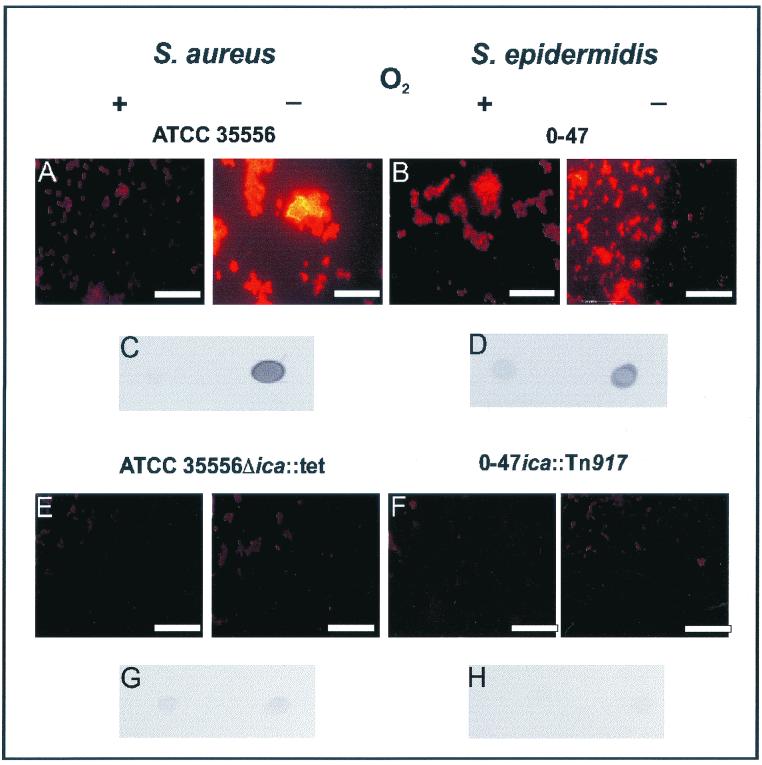
Increased expression of PIA/PNSG under anaerobic conditions in S. aureus and S. epidermidis in vitro. The ica-positive S. aureus strain ATCC 35556 (A), an isogenic ica-deletion mutant (ATCC 35556Δica::tet) (E), the ica-positive S. epidermidis strain O-47 (B), and an isogenic ica transposon mutant (O-47ica::Tn917) (F) were grown under aerobic (+) and anaerobic (−) conditions for 96 h in CYPG plus Glc. PIA/PNSG expression was detected by indirect immunofluorescence using rabbit antibodies raised against S. epidermidis PIA and a Cy3-conjugated goat anti-rabbit IgG antibody. Magnifications for panels A, B, E, and F, ×1,000; bar = 10 μm. Cell surface extracts from S. aureus (C and G) and S. epidermidis (D and H) wild type and isogenic deletion mutants, grown overnight (14 to 18 h) under aerobic or anaerobic conditions in TSB plus Glc, were spotted on nitrocellulose filters, and PIA/PNSG was detected using the same anti-S. epidermidis PIA antibody used for panels A, B, E, and F.
FIG. 3
FIG. 3
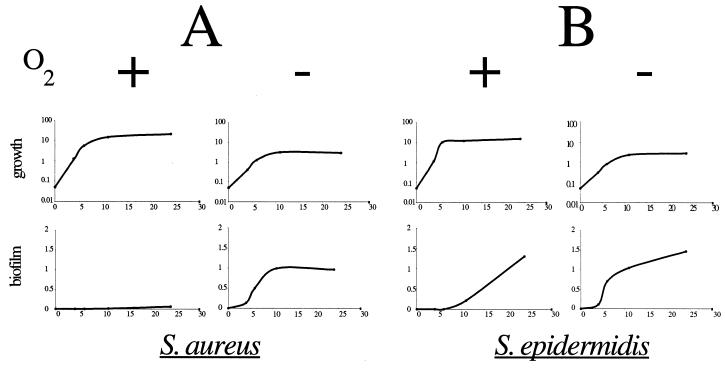
Biofilm formation under aerobic and anaerobic conditions. The same S. aureus (A) and S. epidermidis (B) wild-type strains shown in Fig. 2 were grown under aerobic and anaerobic conditions in CYPG plus Glc for up to 24 h in microtiter plates, and biofilm formation was quantified using the S. epidermidis anti-PIA antibody. The growth rate of the strains was determined independently by measuring the OD600 in liquid culture.
FIG. 4
FIG. 4
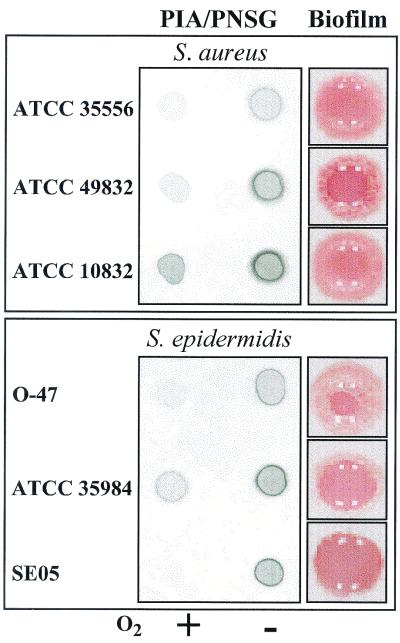
PIA/PNSG expression is stimulated under anaerobic conditions in six S. aureus and S. epidermidis biofilm-forming strains. Three S. aureus and three S. epidermidis biofilm-forming strains were grown under both aerobic (+) and anaerobic (−) conditions to early stationary phase (14 to 18 h) in TSB plus Glc. PIA/PNSG expression (PIA/PNSG) was detected in cell surface extracts isolated from an equal number of cells from each strain using an antibody raised against S. epidermidis PIA. Biofilm formation in a microtiter plate well is shown for each strain (Biofilm). Adhering cells are stained with safranin (red color) to facilitate visualization of the biofilm.
FIG. 5
FIG. 5
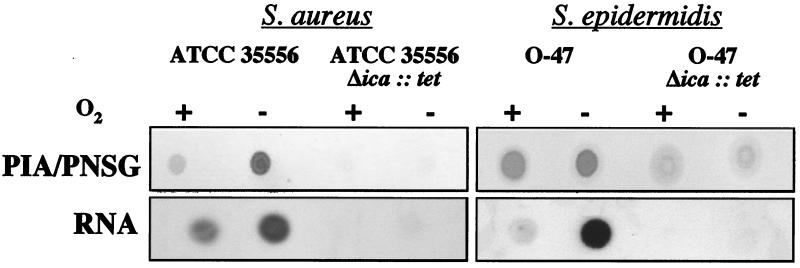
Increased PIA/PNSG expression under anaerobic conditions correlates with ica operon transcript levels in S. aureus and S. epidermidis. Cell surface extracts from S. aureus ATCC 35556, S. epidermidis O-47, and their respective isogenic ica deletion mutants were grown to an OD578 of 2.0 under aerobic (+) or anaerobic (−) conditions in TSB plus Glc. Cell surface extracts from an equal number of cells from each strain were spotted onto a nitrocellulose filter, and PIA/PNSG was detected using a polyclonal anti-S. epidermidis PIA antibody (PIA/PNSG). RNA was extracted from cells from the same cultures, spotted onto a nylon filter, and hybridized with an ica-specific DNA probe (RNA).

Similar articles

Cited by

References

    1. Albus A, Fournier J M, Wolz C, Boutonnier A, Ranke M, Hoiby N, Hochkeppel H, Döring G. Staphylococcus aureus capsular types and antibody response to lung infection in patients with cystic fibrosis. J Clin Microbiol. 1988;26:2505–2509. - PMC - PubMed
    1. Arvidson S. Extracellular enzymes from Staphylococcus aureus. In: Easmon C S F, Adlam C, editors. Staphylococci and staphylococcal infections. London, United Kingdom: Academic Press; 1983. pp. 745–808.
    1. Barker L P, Simpson W A, Christensen G D. Differential production of slime under aerobic and anaerobic conditions. J Clin Microbiol. 1990;28:2578–2579. - PMC - PubMed
    1. Brückner R. Gene replacement in Staphylococcus carnosus and Staphylococcus xylosus. FEMS Microbiol Lett. 1997;151:1–8. - PubMed
    1. Christensen G D, Bisno A L, Parisi J T, McLaughlin B, Ester M G H, Luther R W. Nosocomial septicemia due to multiply-resistant Staphylococcus epidermidis. Ann Intern Med. 1982;96:1–10. - PubMed

Publication types

MeSH terms

Substances

LinkOut - more resources